
Nobody warns you that the hardest part of your first clinical rotation might be a piece of paper. Turns out, it’s common practice. You can take the patient’s vitals and talk to them, comfort them, but the second the instructor asks you for a full nursing care plan, suddenly you have nothing to say (or hand in). That document is the first real wall for a lot of students, for some reason. It’s the written link between what you notice about the patient and the specific actions you take because of it, all followed up by how those specific actions improved or worsened the patient’s condition.
This guide brings together 10 nursing care plan examples, plus a simple reusable nursing care plan template so you know, step by step, how the ADPIE process works.
What Is a Nursing Care Plan?
A nursing care plan is a structured record of what a patient needs and the nursing actions you will take to meet those needs. The more formal ones go in the chart so the whole team can follow your reasoning. Then there are the semi-informal ones who are more of a running mental map you adjust as the shift goes. A standardized plan pulls from an evidence-based template built for a common condition. An individualized one gets written for a single patient. But even a standardized nursing care plan has to be tailored, because no patient presents exactly like the textbook, so you adjust the specifics every time.
Parts of a Nursing Care Plan
Most programs lay the nursing care plan format out as a five-column grid, and each column lines up with one letter of ADPIE. Here is what actually goes in each.
- Assessment is your data-gathering stage. Two halves - subjective and objective make this stage, out of which, the former is whatever the patient reports in their own words, and the latter is the measurable data, such as blood pressure or shallow breath.
- Diagnosis is your clinical judgment, phrased in standardized NANDA-I terms. "Ineffective airway clearance related to retained secretions as evidenced by a weak, congested cough," instead of “pneumonia.”
- Planning, also known as your goal-setting stage. Here, SMART goals will help you - Specific, Measurable, Achievable, Relevant, Time-bound. “Patient will maintain oxygen saturation at or above 94 percent on room air within 24 hours." You also rank the problems here, because your patient almost never has just one.
- Implementation is the doing. Interventions split three ways. An independent one runs on your own nursing authority, say repositioning a patient every two hours to protect the skin. A dependent one needs a provider order, like giving a prescribed antibiotic. A collaborative one brings in the wider team, for instance working with respiratory therapy on a breathing treatment.
- Evaluation is where you loop back and ask the blunt question of whether the goal was met. Every outcome lands in one of three buckets, met, partially met, or not met. When something comes back not met, you rewrite the plan and go again, which is what keeps a care plan a living document.

Nursing Care Plan Format and Template
With ADPIE straight in your head, the nursing care plan template is not complicated. Nearly every version is a table, one column per step. So, column by column, drop the patient’s details in. Here is what a nursing care plan template should include:
- Assessment data, both subjective and objective
- The nursing diagnosis in NANDA-I format
- Goals and expected outcomes, written SMART
- Nursing interventions
- Rationale for each intervention
- Evaluation, recorded once you review the outcomes
Nursing Care Plan Examples
A good nursing care plan reads clean and specific. Every diagnosis ties back to actual assessment data, every goal is measurable and time-bound, and every intervention has a rationale attached to it. The 10 nursing care plan examples below all follow that standard. Treat them as models you learn the reasoning from, not fill-in-the-blank answers to copy.
Nursing Care Example #1: Acute Pain
Post-operative patient after abdominal surgery.
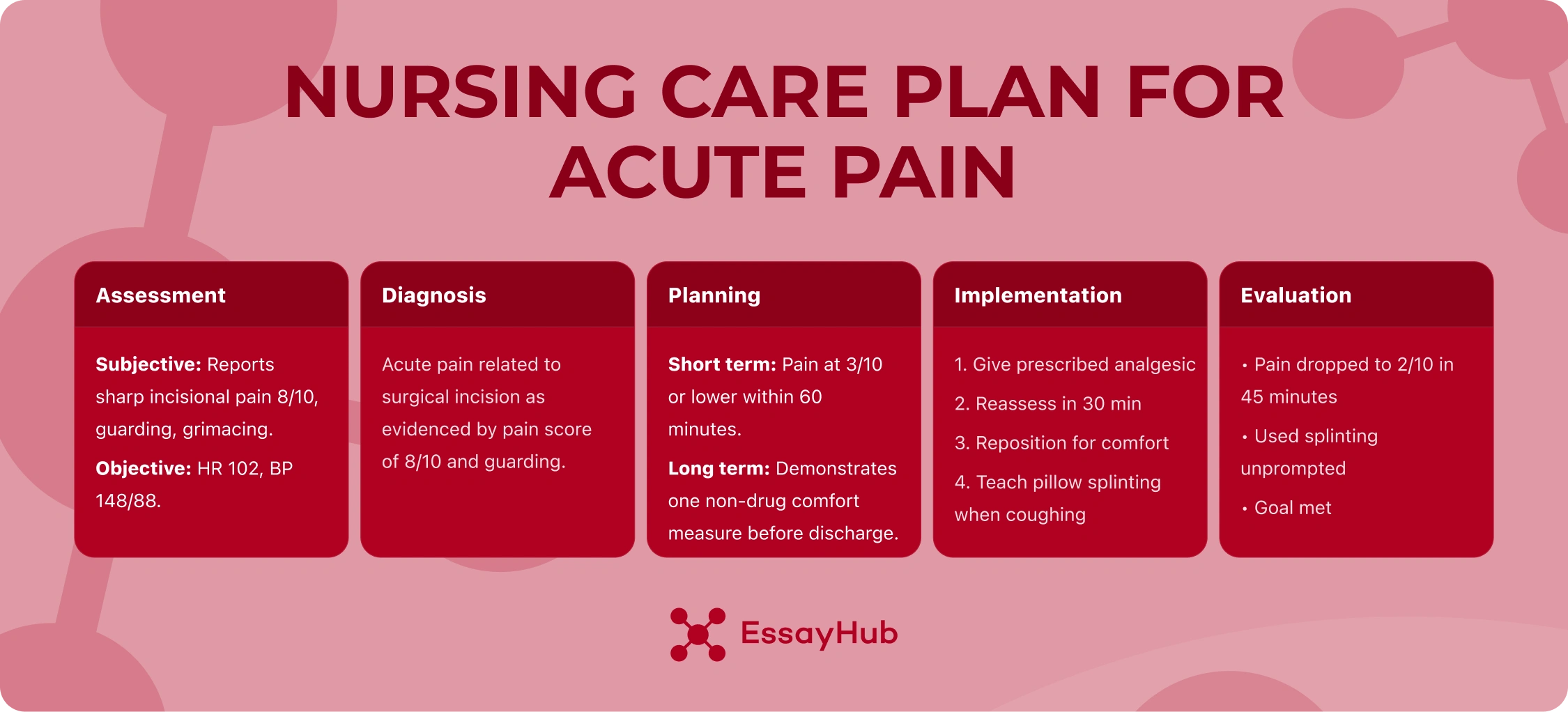
- Assessment: Patient reports sharp incisional pain rated 8 out of 10, guards the abdomen, and grimaces with movement. Heart rate 102, blood pressure 148 over 88.
- Diagnosis: Acute pain related to surgical incision as evidenced by a self-reported pain score of 8 out of 10 and guarding behavior.
- Planning: Patient will report pain at 3 out of 10 or lower within 60 minutes of intervention and demonstrate one non-pharmacologic comfort measure before discharge.
- Implementation: Administer prescribed analgesic and reassess in 30 minutes. Reposition for comfort. Teach splinting the incision with a pillow during coughing.
- Evaluation: Goal met. Pain dropped to 2 out of 10 within 45 minutes, and the patient used pillow splinting without prompting.
Nursing Care Example #2: Hypertension
Adult admitted with a blood pressure reading of 178 over 104.
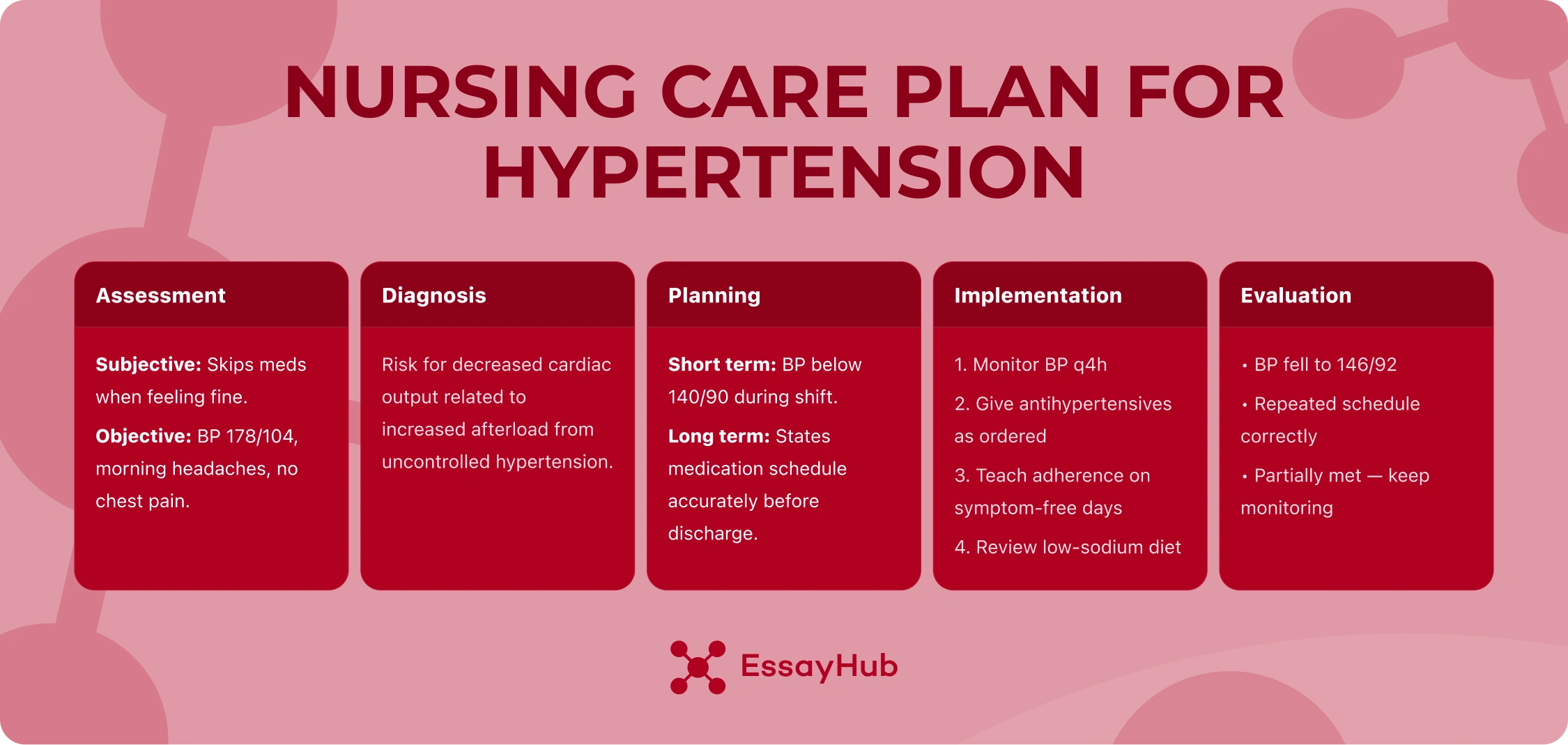
- Assessment: Patient states he skips his medication when he feels fine. Blood pressure 178 over 104, reports occasional morning headaches, no current chest pain.
- Diagnosis: Risk for decreased cardiac output related to increased afterload from uncontrolled hypertension.
- Planning: Patient will maintain blood pressure below 140 over 90 during the shift and describe his medication schedule accurately before discharge.
- Implementation: Monitor blood pressure every four hours. Administer antihypertensives as ordered. Teach why the medication continues even on symptom-free days, and review a low-sodium diet.
- Evaluation: Partially met. Blood pressure fell to 146 over 92, and the patient repeated his schedule back correctly. Continue monitoring.
Nursing Care Example #3: Type 2 Diabetes
Patient with poorly controlled type 2 diabetes.
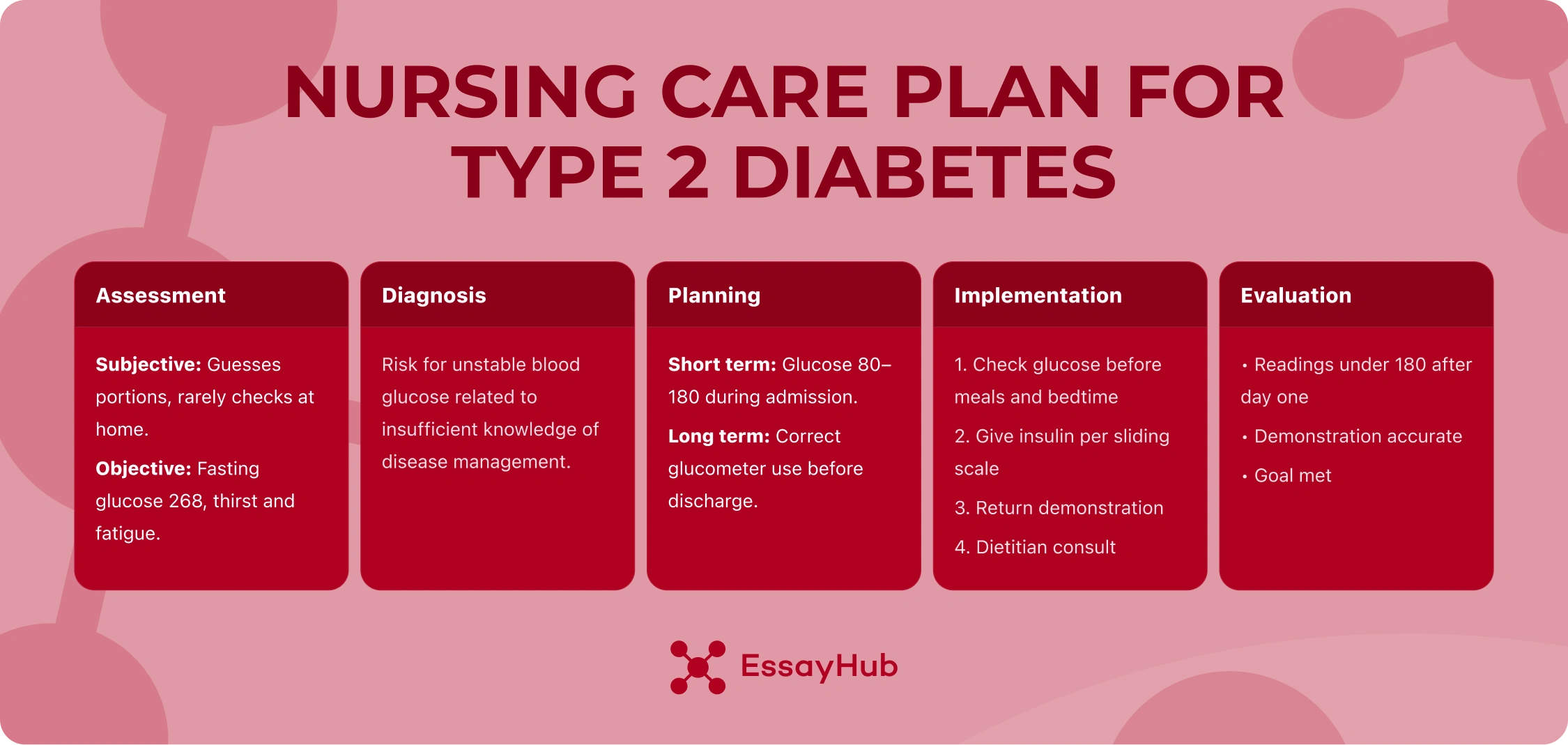
- Assessment: Fasting blood glucose 268. Patient admits she guesses at portion sizes and rarely checks her sugar at home. Reports increased thirst and fatigue.
- Diagnosis: Risk for unstable blood glucose level related to insufficient knowledge of disease management.
- Planning: Patient will keep blood glucose between 80 and 180 during admission and demonstrate correct glucometer use before discharge.
- Implementation: Check blood glucose before meals and at bedtime. Administer insulin per sliding scale. Have the patient perform a return demonstration of her glucometer. Arrange a dietitian consult.
- Evaluation: Goal met. Readings stayed under 180 after day one, and the return demonstration was accurate.
Nursing Care Example #4: Pneumonia
Older adult admitted with community-acquired pneumonia.
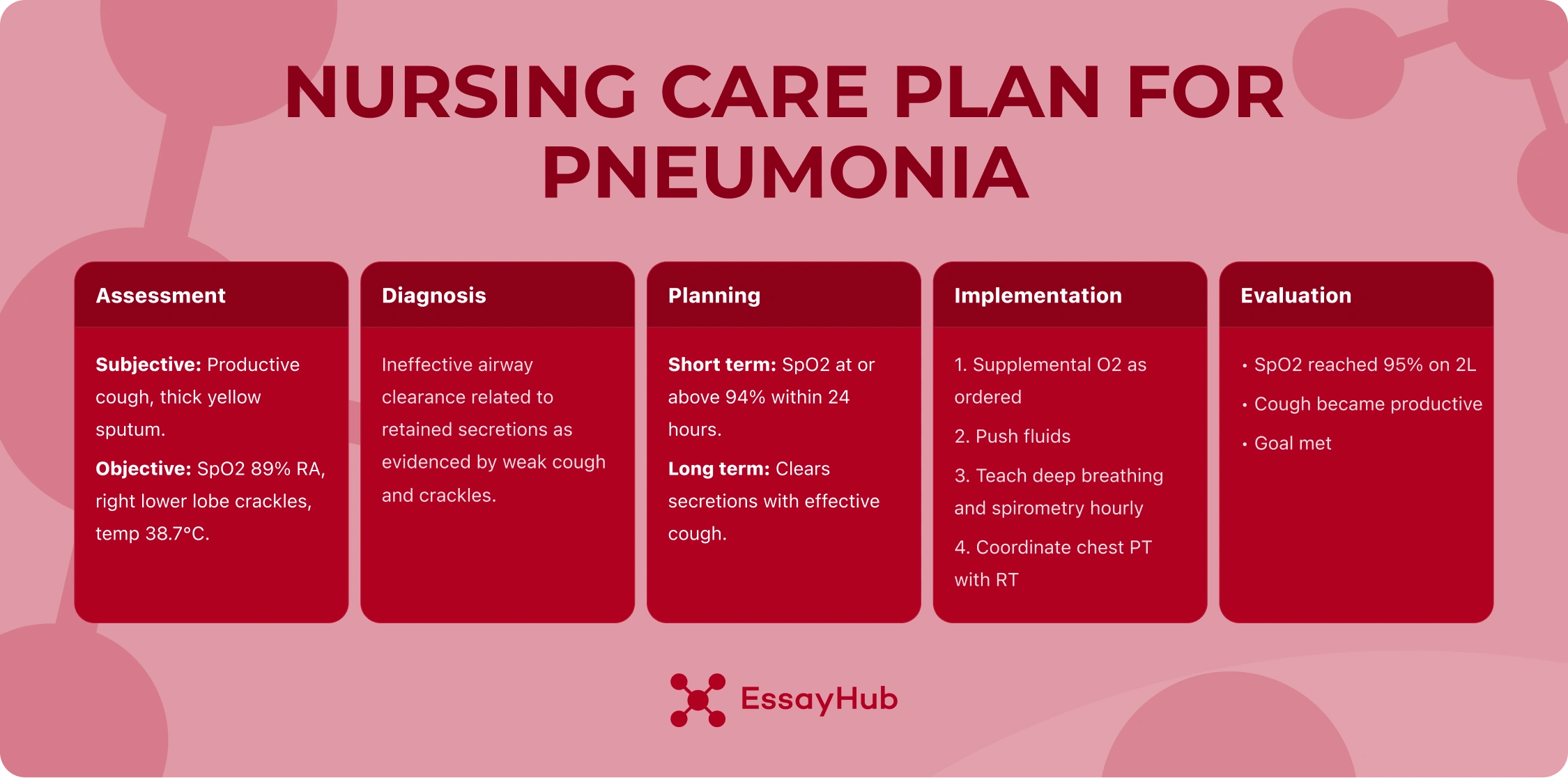
- Assessment: Productive cough with thick yellow sputum, crackles in the right lower lobe, oxygen saturation 89 percent on room air, temperature 38.7 Celsius.
- Diagnosis: Ineffective airway clearance related to retained secretions as evidenced by a weak cough and adventitious lung sounds.
- Planning: Patient will maintain oxygen saturation at or above 94 percent within 24 hours and clear secretions with an effective cough.
- Implementation: Apply supplemental oxygen as ordered. Encourage fluids to loosen secretions. Teach deep breathing and use of the incentive spirometer every hour while awake. Coordinate a chest physiotherapy schedule with respiratory therapy.
- Evaluation: Goal met. Saturation reached 95 percent on 2 liters, and the cough became productive and effective.
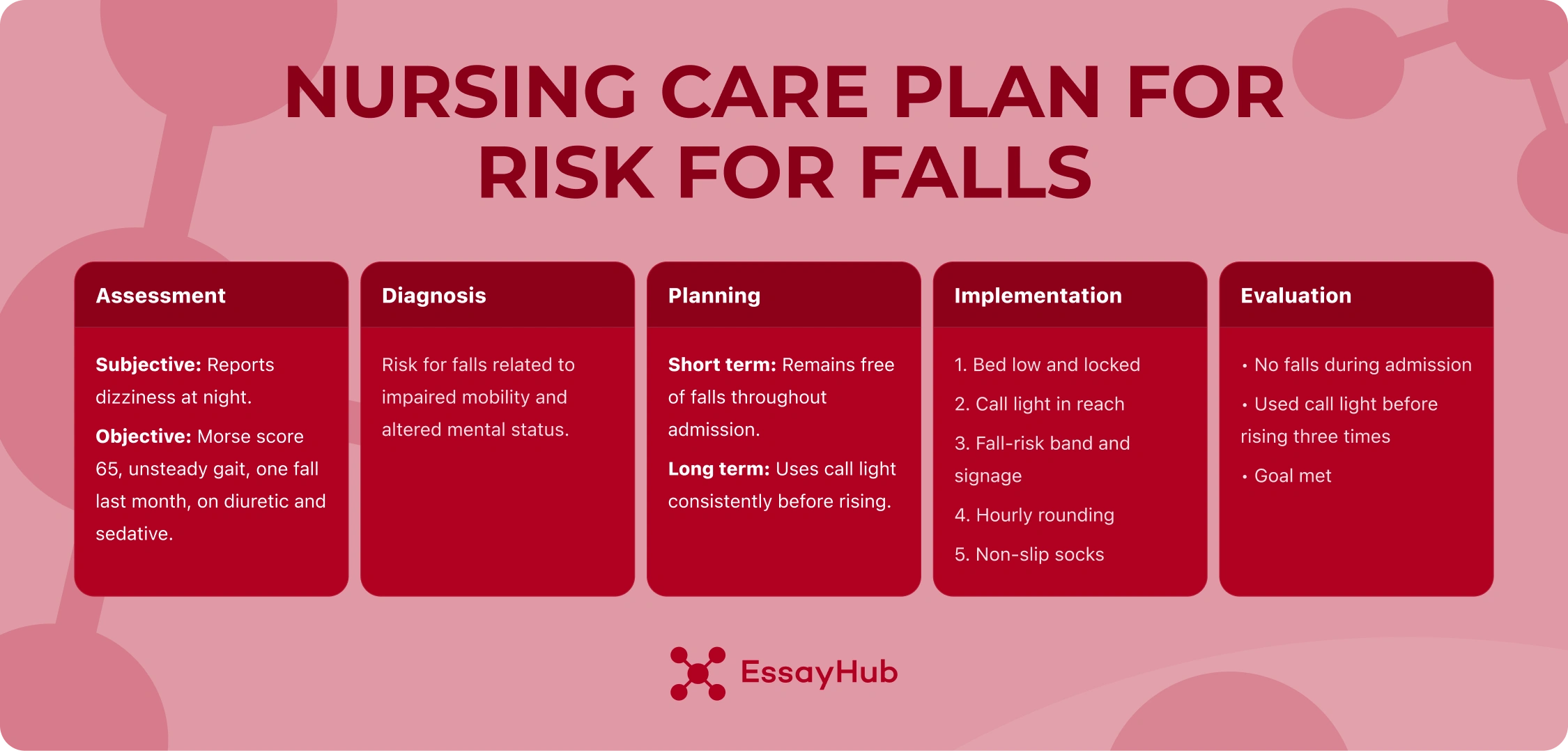
Nursing Care Example #5: Risk for Falls
Confused older adult on the medical-surgical unit.
- Assessment: Morse Fall Scale score of 65, unsteady gait, history of one fall last month, takes a diuretic and a sedative. Intermittent confusion at night.
- Diagnosis: Risk for falls related to impaired mobility and altered mental status.
- Planning: Patient will remain free of falls throughout admission.
- Implementation: Keep the bed low with brakes locked and the call light within reach. Place a fall-risk band and door signage. Round hourly. Assist to the bathroom on a scheduled basis and offer non-slip socks.
- Evaluation: Goal met. No falls occurred, and the patient used the call light before getting up on three separate occasions.
Nursing Care Example #6: Impaired Skin Integrity
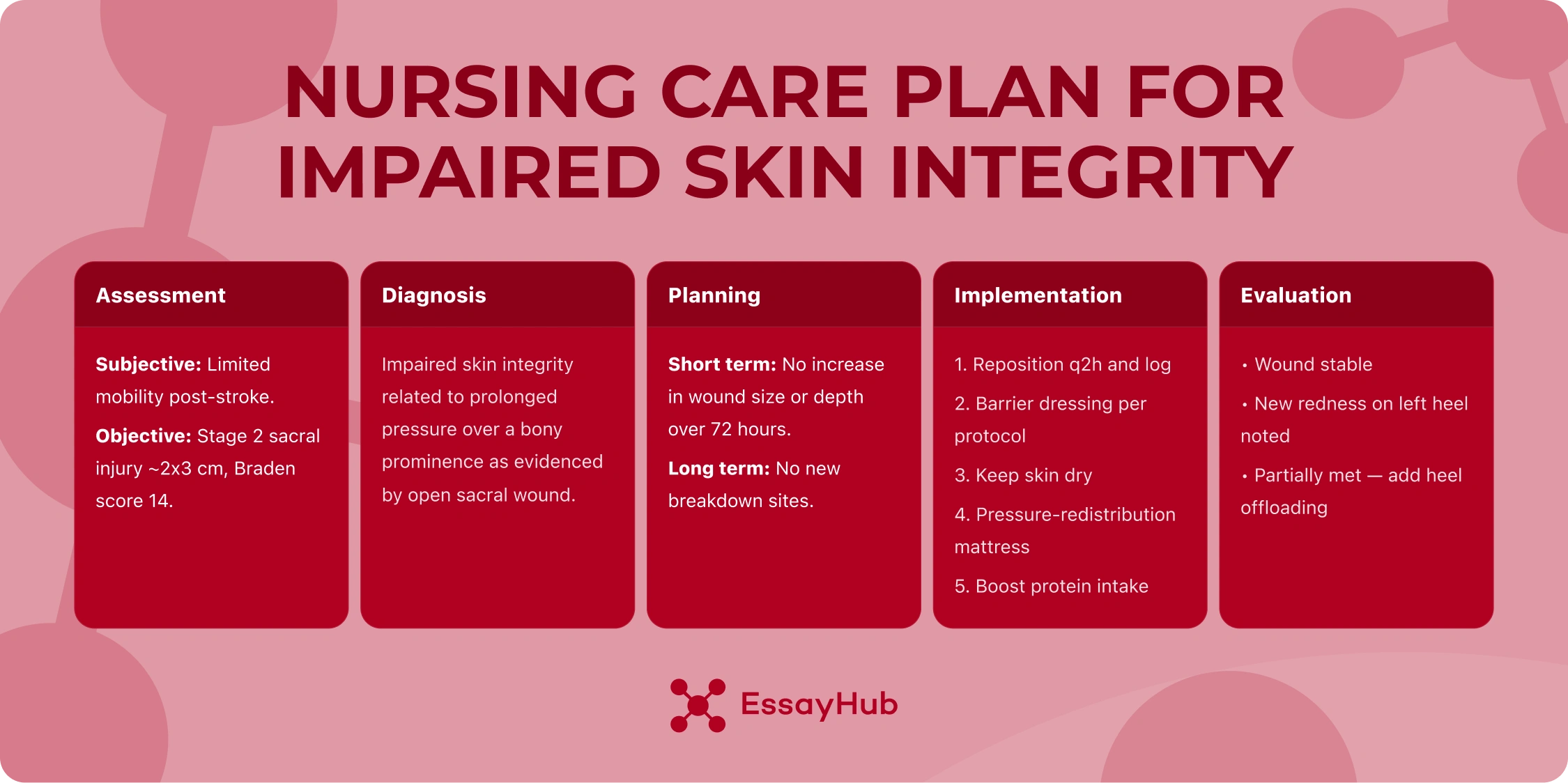
Bedbound patient with an early-stage sacral pressure injury.
- Assessment: Stage 2 pressure injury over the sacrum, roughly 2 by 3 centimeters, with intact surrounding skin. Braden score of 14. Patient has limited mobility after a stroke.
- Diagnosis: Impaired skin integrity related to prolonged pressure over a bony prominence as evidenced by an open sacral wound.
- Planning: The wound will show no increase in size or depth over the next 72 hours, and no new areas of breakdown will develop.
- Implementation: Reposition every two hours and log the schedule. Apply a barrier dressing per protocol. Keep skin clean and dry. Order a pressure-redistribution mattress and increase protein intake with a dietitian.
- Evaluation: Partially met. The existing wound held stable, though a reddened area appeared on the left heel. Add heel offloading.
Nursing Care Example #7: Anxiety
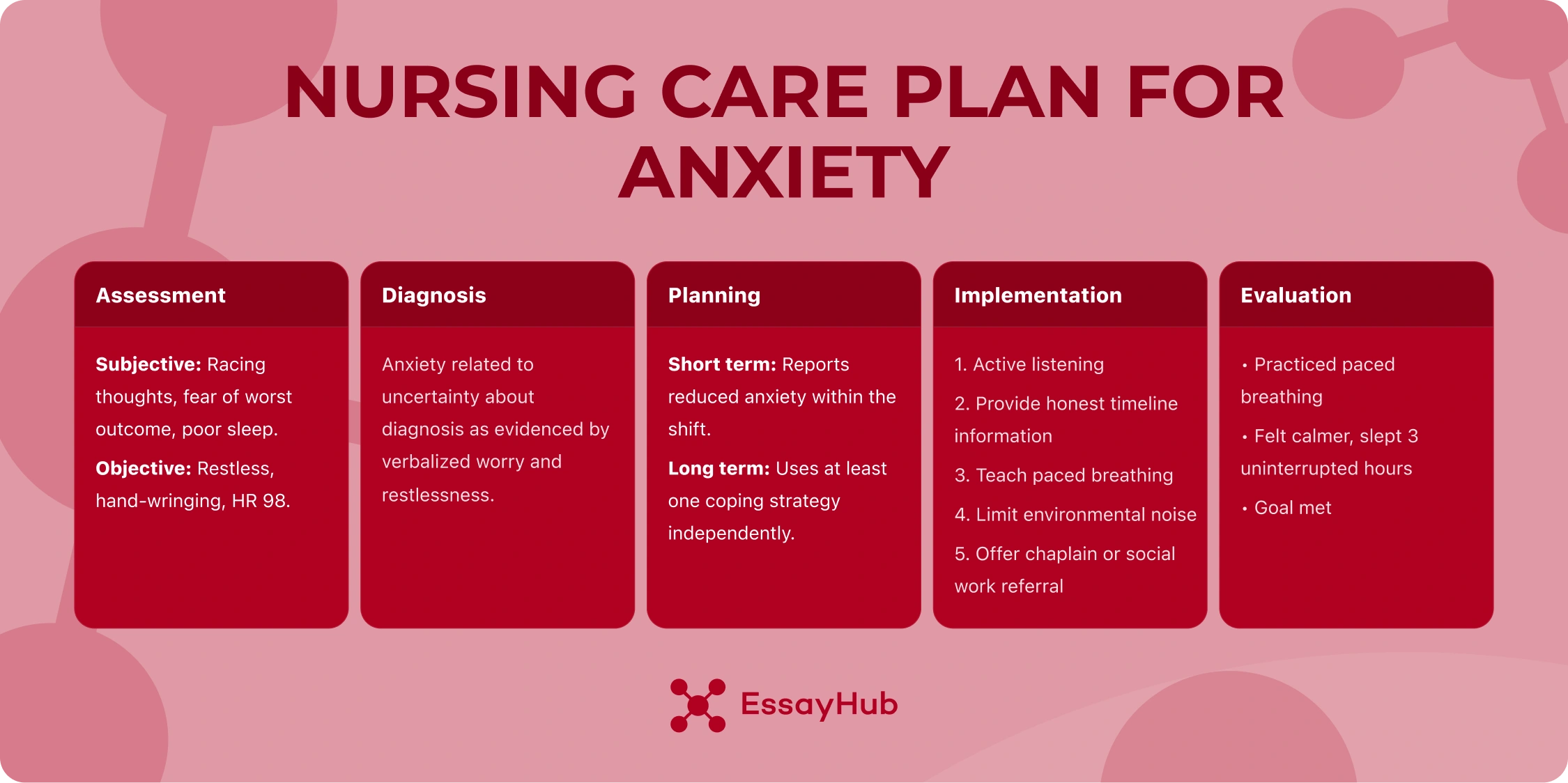
Patient awaiting biopsy results.
- Assessment: Patient reports racing thoughts and trouble sleeping, appears restless, wrings her hands, and states "I can't stop thinking about the worst outcome." Heart rate 98.
- Diagnosis: Anxiety related to uncertainty about diagnosis as evidenced by verbalized worry and restlessness.
- Planning: Patient will report reduced anxiety and use at least one coping strategy within the shift.
- Implementation: Sit with the patient and use active listening. Provide honest, clear information about the timeline. Teach a paced breathing technique. Limit unnecessary noise and offer a referral to the hospital chaplain or social worker.
- Evaluation: Goal met. The patient practiced paced breathing, said she felt calmer, and slept for three uninterrupted hours.
Nursing Care Example #8: Fluid Volume Deficit
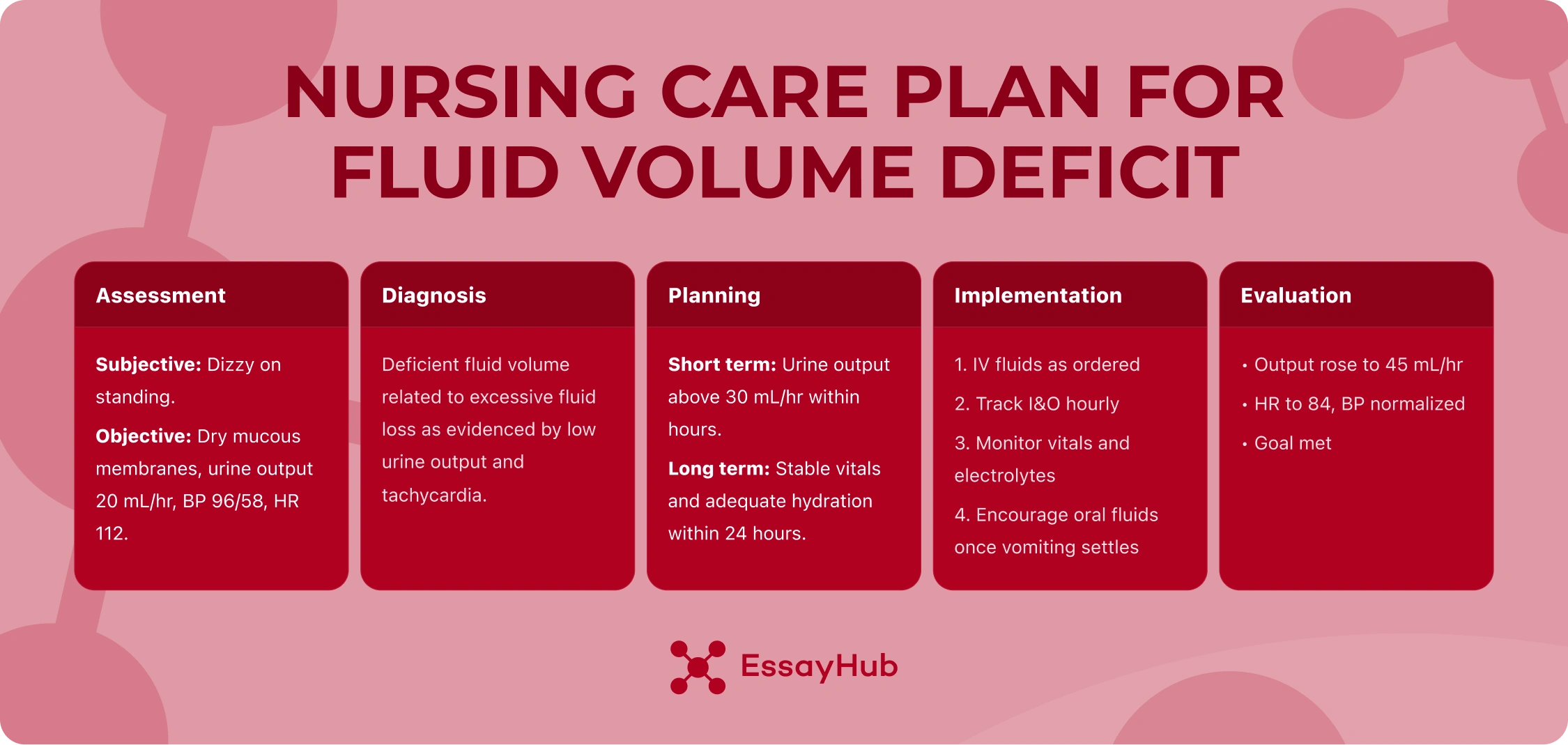
Patient admitted with dehydration after two days of vomiting.
- Assessment: Dry mucous membranes, poor skin turgor, urine output 20 milliliters per hour, blood pressure 96 over 58, heart rate 112. Reports dizziness when standing.
- Diagnosis: Deficient fluid volume related to excessive fluid loss as evidenced by reduced urine output and tachycardia.
- Planning: Patient will show adequate hydration within 24 hours, with urine output above 30 milliliters per hour and stable vital signs.
- Implementation: Administer IV fluids as ordered. Track intake and output every hour. Monitor vital signs and electrolytes. Encourage oral fluids once vomiting settles.
- Evaluation: Goal met. Urine output rose to 45 milliliters per hour, heart rate settled to 84, and blood pressure normalized.
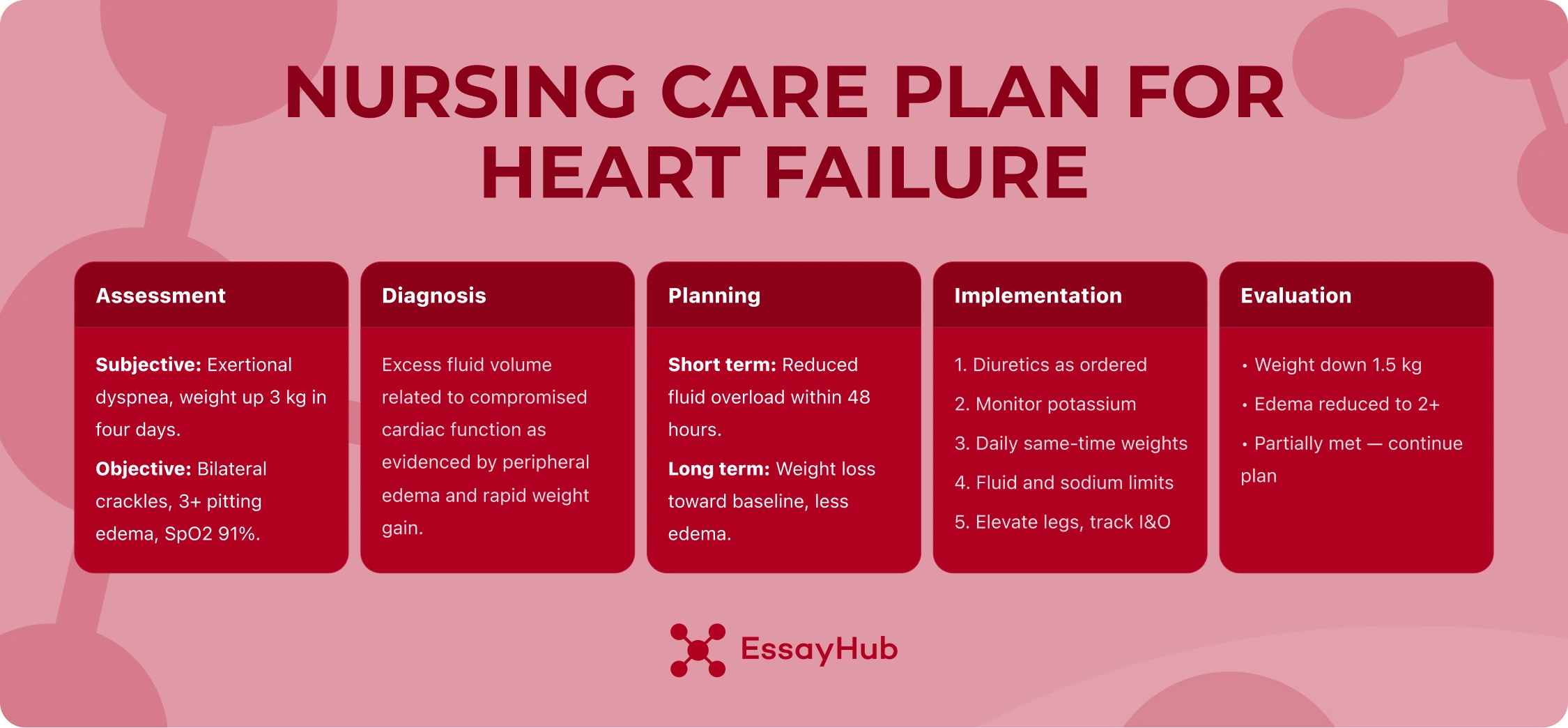
Nursing Care Example #9: Heart Failure
Patient with an exacerbation of chronic heart failure.
- Assessment: Bilateral crackles, 3+ pitting edema in both lower legs, weight up 3 kilograms in four days, shortness of breath on exertion, oxygen saturation 91 percent.
- Diagnosis: Excess fluid volume related to compromised cardiac function as evidenced by peripheral edema and rapid weight gain.
- Planning: Patient will show reduced fluid overload within 48 hours, with decreased edema and a measurable weight loss toward baseline.
- Implementation: Administer diuretics as ordered and monitor potassium. Weigh daily at the same time. Restrict fluids and sodium per orders. Elevate the legs and track intake and output.
- Evaluation: Partially met. Weight dropped 1.5 kilograms and edema improved to 2+. Continue the current plan.
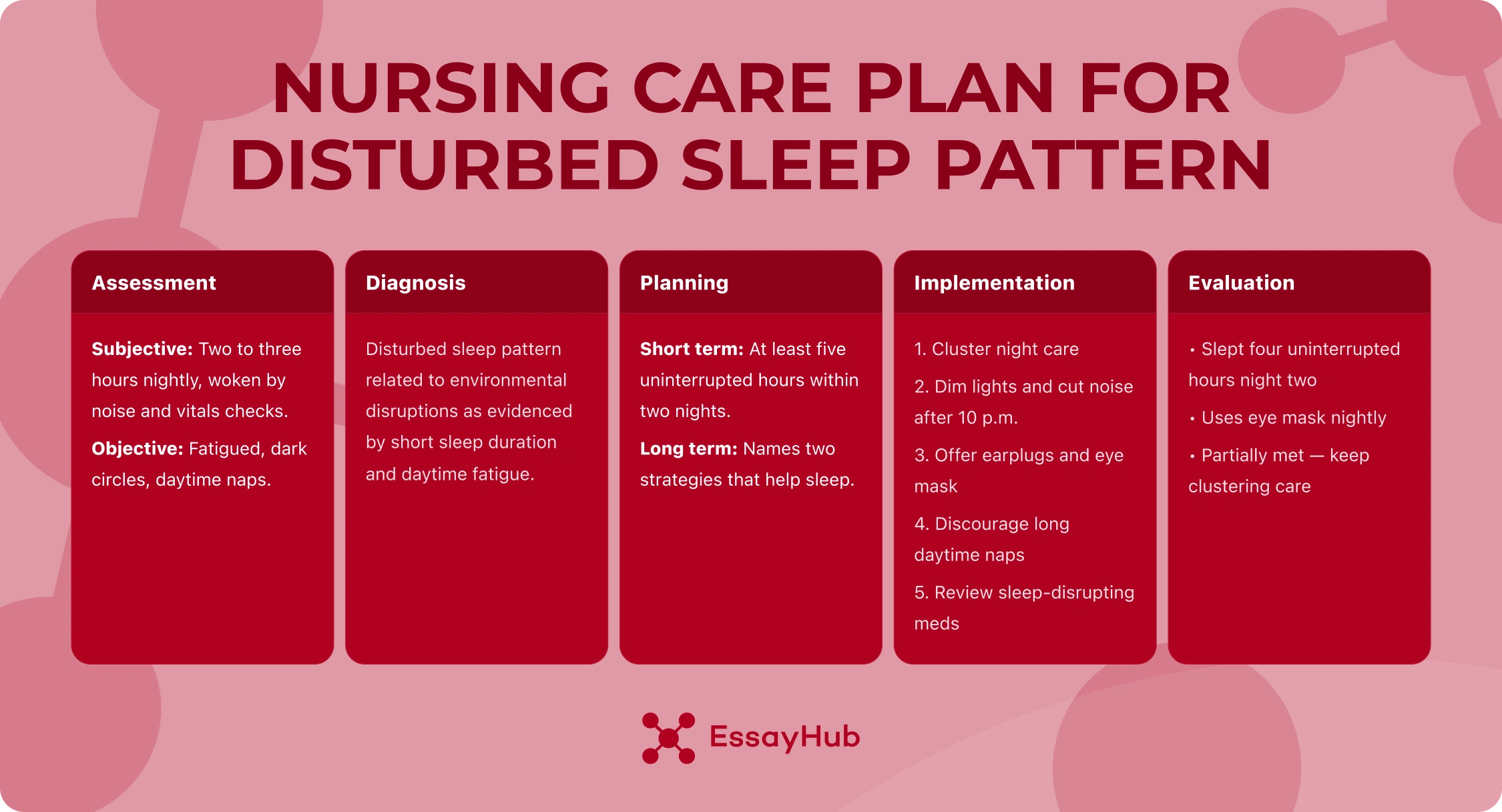
Nursing Care Example #10: Disturbed Sleep Pattern
Hospitalized patient struggling to sleep on the unit.
- Assessment: Patient reports sleeping only two to three hours a night since admission, appears fatigued with dark under-eye circles, and states the noise and frequent vitals checks keep waking her. Naps intermittently during the day.
- Diagnosis: Disturbed sleep pattern related to environmental disruptions and frequent care interruptions as evidenced by reported short sleep duration and daytime fatigue.
- Planning: Patient will report at least five hours of uninterrupted sleep within two nights and describe two strategies that help her rest.
- Implementation: Cluster nighttime care to limit interruptions. Dim lights and reduce noise after 10 p.m. Offer earplugs and an eye mask. Discourage long daytime naps and encourage light daytime activity. Review the need for any sleep-disrupting medications with the provider.
- Evaluation: Partially met. The patient slept four uninterrupted hours the second night and used the eye mask nightly. Continue clustering care.
Mistakes That Cost Marks on a Care Plan
Most deductions on a care plan have nothing to do with how much clinical knowledge a student has but rather comes from a small set of formatting and logic slips. These seven are the ones I see most often in graded nursing care plan examples.
- Using retired diagnosis labels. NANDA-I revises its list on a schedule, so if your textbook is old, the standard terms might not be standard in the current edition.
- Writing a medical diagnosis in the diagnosis column. Your column needs the nursing response, worded in NANDA-I terms. Instructors flag this swap more than any other, and it is easy to make when rushing.
- Goals with no timeframe or measure. A goal like "patient will feel better" is not a medical goal. Everything needs a number and a deadline, say an oxygen saturation target hit within 24 hours.
- "As evidenced by" data that doesn't appear in the assessment. Whatever you list as evidence has to trace back to something in your assessment column.
- Interventions with no rationale. An action listed on its own reads like a guess. Attach a brief reason to each so the grader sees you understand why it works, not just that it belongs.
- Rationales with no citation. Unless it points somewhere (a textbook, an evidence-based protocol, etc), the rationale looks like personal opinion. Name where the logic comes from and you have shown your work.
- Copying a template plan without individualising it. Standardized nursing care plan examples make a decent starting point, but a plan must be fitted to your patient.
Nursing Care Plan vs. Concept Map
It doesn’t help the confusion that sometimes both nursing care plans and nursing concept maps are both assigned for the same patient in the same week. They are genuinely different tools and are used for completely different things, no matter how often they get mixed up. This table will help you quickly differentiate between the two:
Final Thoughts
A nursing care plan is just the ADPIE process written down in order: assess, diagnose in NANDA-I terms, set a measurable goal, intervene with rationale, then evaluate. Most marks come down to precision and tailoring the template to your actual patient. Work through enough nursing care plan examples and the format stops feeling like a hurdle.
FAQ
Do You Need to Cite Sources in a Nursing Care Plan?
What's the Difference Between a Nursing Diagnosis and a Medical Diagnosis?
How Many Nursing Diagnoses Should a Care Plan Have?
What Is the PES Format?
What Is an Example of a Nursing Diagnosis?
How Do You Write a Nursing Care Plan Step by Step?
What Are the 5 Parts of a Nursing Care Plan?

Ryan Acton is an essay-writing expert with a Ph.D. in Sociology, specializing in sociological research and historical analysis. By partnering with EssayHub, he provides comprehensive support to students, helping them craft well-informed essays across a variety of topics.