
A dissertation is the long, original research project you complete to earn a doctoral degree. I think that framing how to write a dissertation as a writing task only is not exactly correct, as so many guides now claim. Rather, it tests your problem management skills. As you prepare to defend your PhD dissertation, you will have to move between deadlines, half-finished chapters, messy data, supervisor meetings, and revision after revision for months on end, and the writing itself is only one piece of that.
The structure of a dissertation is a whole other test of your discipline, so this article will spend a good deal of time teaching you how to build one, along with the entire writing process, plus tips on what to do and what not to do.

What Is a Dissertation?
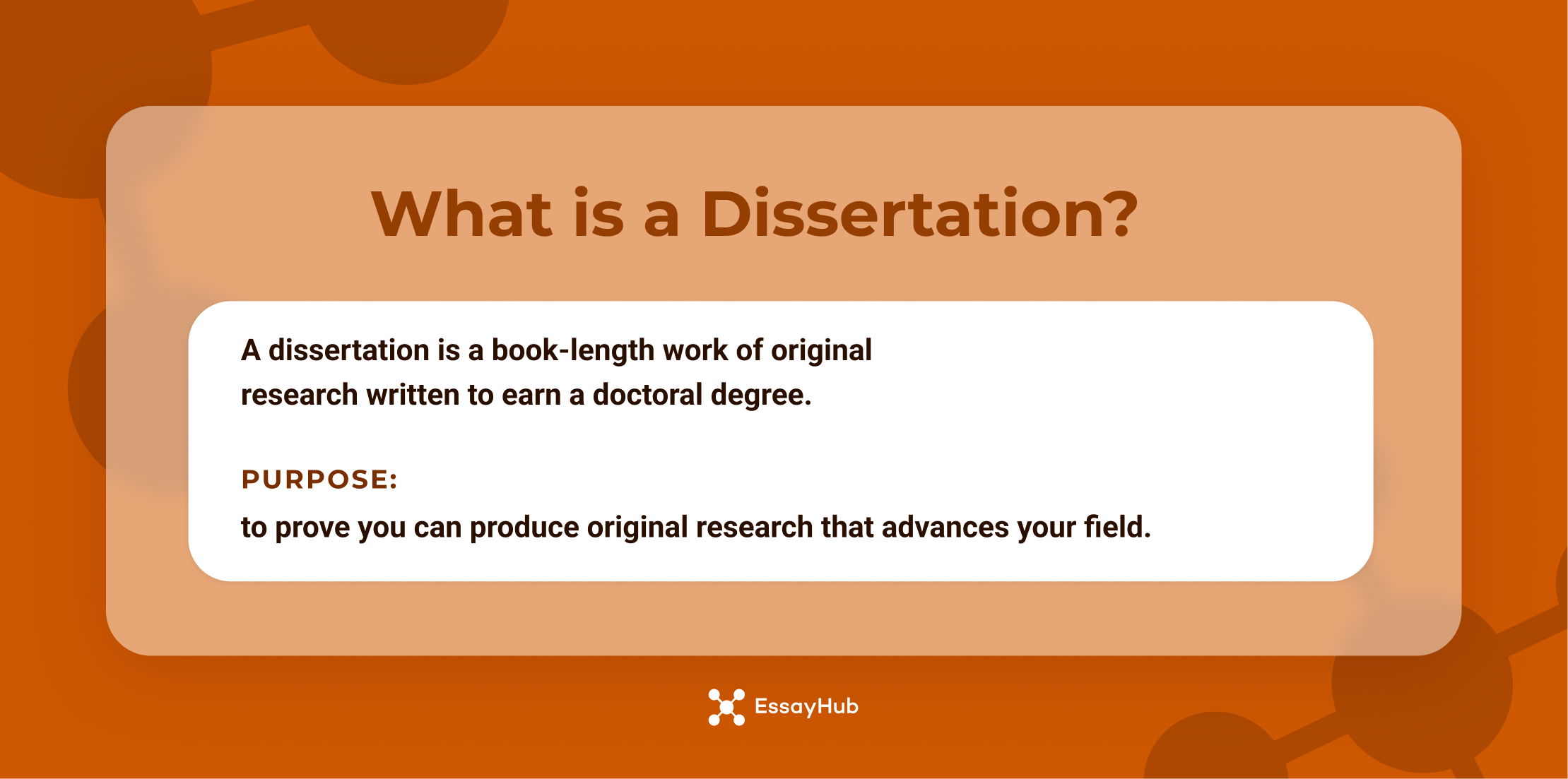
A doctoral dissertation is a book-length piece of original scholarship that you create toward the end of your PhD that presents a research question you chose, the methods you used to get to the results, and what those methods yielded.
Your dissertation is proof that you can design, carry out, and defend independent research that puts something new into your field. In short, it’s a test of your entire higher education. Unless you pass your defense, the academic world will not classify you as one of its own.
Dissertation Structure
Almost every doctoral dissertation follows a recognizable shape, though the exact chapters vary by discipline and university. Treat the table below as your master checklist, then we'll move through the dissertation chapters one by one.
Title Page
The dissertation format opens with a title page. It’s the first page an examiner sees, which is why they are pretty exact about it. It includes a fixed set of details:
- Full dissertation title
- Name and prior qualifications
- The degree you are pursuing
- Department and institution
- Submission date
Acknowledgments
There are undoubtedly people who support you during the years of your research who you need to thank. Any supervisors, funding bodies, colleagues, family, even. They all belong here. The tone is not as strict as in the rest of the document, and is personal, so you have to keep it sincere and under one page.
Abstract
The abstract is a 150-300-word-long version of the whole dissertation. Once the reader gets to the end, they should understand your research question, your methods, your findings, and your conclusion. A strong one answers four questions:
- What problem did you take on?
- How did you investigate it?
- What did you find?
- Why does it matter?
Pro tip: Write it once the work is complete, since an abstract drafted too early only has to be rewritten.
Table of Contents
Maps every chapter, section, and subsection against its page number. Your word processor generates it automatically once you apply proper heading styles, so set those styles up at the outset and never edit the page manually.
Front Matter Lists: Figures and Tables, Abbreviations, Glossary
These three short sections share one purpose, which is helping a reader locate material and understand your vocabulary:
- The list of figures and tables catalogs every chart, graph, and table with its page number.
- If your dissertation includes abbreviations, you should spell out the acronyms in alphabetical order.
- Define specialist terms in the glossary
Introduction
The substantive writing starts at the introduction of your dissertation. The introduction should name the topic and why it deserves any attention in the first place, then state your research questions, and briefly preview what the chapters will cover.
Literature Review
As you will see in the next section, preliminary research is an important part of any research project, and this chapter demonstrates that you took it seriously. Any existing studies you’ve used in your dissertation should be sorted into themes here, and you should identify the gap that your research fills. A good review does three things:
- Mapping what scholars already know comes first.
- From there, the debates and open questions rise to the surface.
- Your research then earns its place in the field.
Methodology
The methods section explains in precise detail how you conducted your research. The level of detail should be deep enough that another scholar could replicate it. Cover the following:
- Your approach (qualitative, quantitative, or mixed)
- Data-gathering methods, described step by step
- Which participants or sources did you draw on
- How you analyzed the material
- Limitations you ran into
Results
This is a dry description of what you found as a result of your study. You present the data through data only, and leave the interpretations out of it for now, because that is reserved for the discussion part. Sequence is obviously important here as well, and everything needs to be arranged so the reader can follow in order.
Discussion
Now comes the time to interpret your results. For many students, myself included, this is the most rewarding and satisfying part of writing. The discussion usually breaks into:
- What the findings mean, read against your research question
- How they fit or conflict with your literature review
- An honest account of the limitations
- Directions where future research should go
Conclusion
Draws the work to a close. You restate your key findings, answer your research question directly, and state your contribution. Avoid introducing new material here, as it unsettles examiners. A focused conclusion leaves them clear on what you achieved.
Bibliography
Lists every source you cited, formatted in your required style, whether APA, MLA, or Chicago. Inaccurate references irritate examiners and cast doubt on the rigor of the rest. My recommendation is to install Zotero or EndNote at the very start; it saves considerable time as the deadline approaches.
Appendices
Hold the supporting material that would otherwise clutter the main text: raw data, survey instruments, transcripts, consent forms, and overflow tables. Readers who want the detail can consult them while your core chapters stay readable. Label each one clearly (Appendix A, Appendix B) and reference them in the body so they are not overlooked.
How to Write a Dissertation, Step by Step
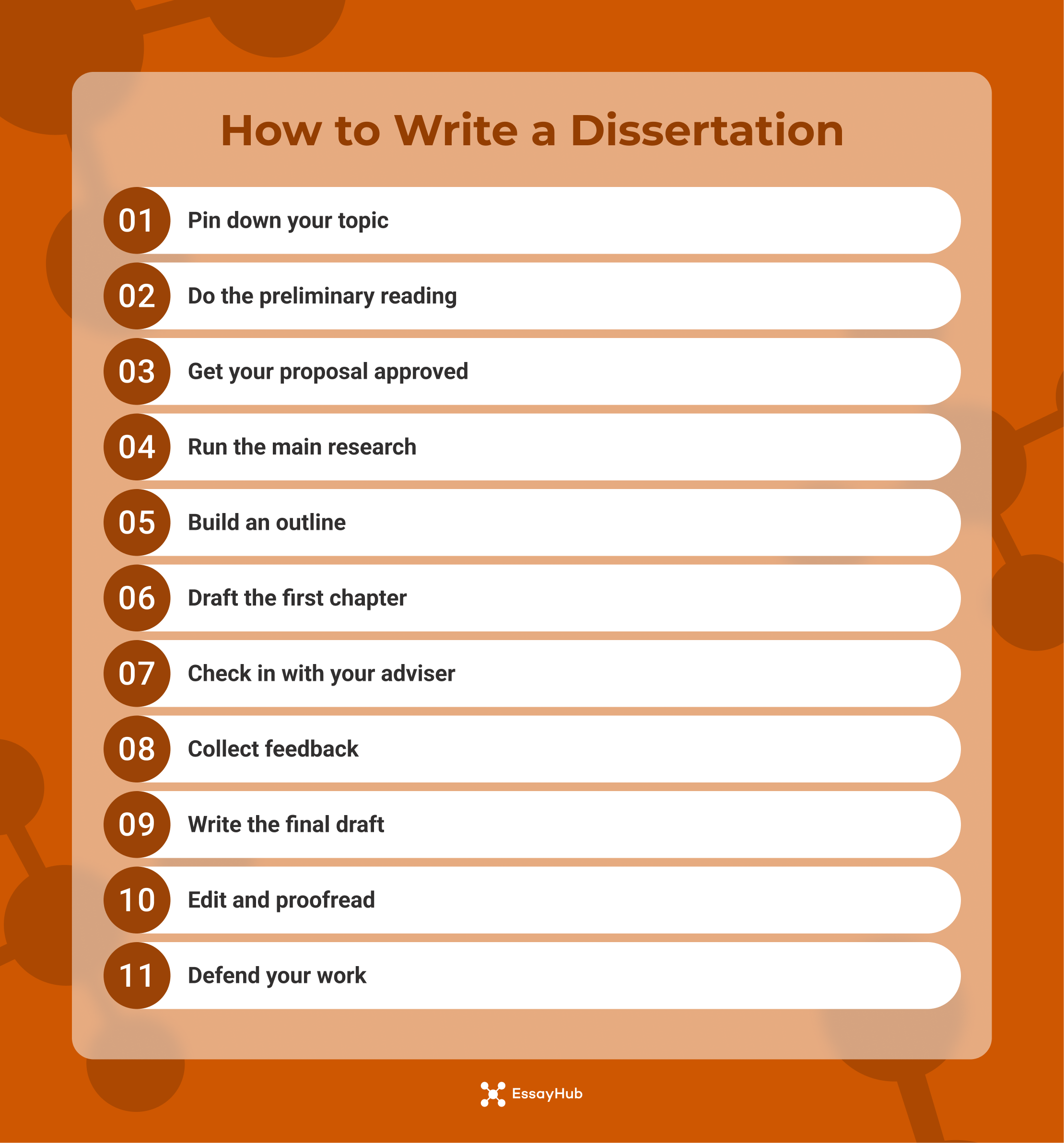
The dissertation process breaks into a sequence you can actually manage: settle on a topic, read around it, get a proposal approved, run your main research, outline, draft, consult your adviser, revise on feedback, finalize, proofread, and defend. What follows walks through each stage in order.
Pin Down Your Topic
This is perhaps the single most important choice you’ll make because everything else rests on it. Which obviously means that you should never rush it. The best marketing dissertation ideas combine:
- Your interest
- Gaps in your field
- Doability within your resources
Miss out on any of those, and trust me, you will feel the consequences sooner or later. A boring topic will inevitably feel unbearable after half a year. And what’s even the point of defending a dissertation on a question already answered ten times over?
Do the Preliminary Reading
Read as much existing research around your area before you commit to anything (this is also a part of not rushing your topic). This early lookaround helps you make sure that the gap that you’ve found is actually real and you haven’t missed something someone published last year. Keep notes on everything, including major debates, the methods that other researchers have used, the names of the researchers that you see again and again… All of it feeds straight into your proposal, so none of the effort goes to waste.
Get Your Proposal Approved
With the proposal, you get an institutional reality check. The committee decides whether your research holds together by reviewing your question, your methods, your timeline, and the significance of the work. A typical proposal covers:
Run the Main Research
The longest, most demanding stretch of the whole process. You get used to running experiments, conducting interviews, building a corpus, or digging through archives. First, keep meticulous records of everything, because a data point you can't trace back is a data point you can't use. Second, hold to your timeline while accepting that research almost never runs on schedule. Build in slack. Something will go wrong, and you want room to absorb it when it does.
Build an Outline
Sketch the skeleton before you write a full sentence. An outline turns a vague sense of "I have results now" into a concrete plan for the parts of a dissertation you actually need to produce. Work at the chapter level first, then split each chapter into sections. A rough version tends to look like this:
- Introduction: question, context, roadmap
- Literature review: themes and the gap
- Methodology: design and justification
- Results: what you found
- Discussion: what it means
- Conclusion: contribution and closing
Draft the First Chapter
Writing a dissertation from nothing intimidates almost everyone, so lower the stakes and start with a chapter you feel sure of. Plenty of people open with methodology, since it's mostly descriptive, and you know precisely what you did. Whatever you choose, let yourself write badly the first time. A dissertation ghost writer can help you refine your first draft or even help you build one from the ground up.
Check In With Your Adviser
Your adviser is the most valuable resource you have, so use them properly instead of vanishing for a semester and reappearing with a panic. Bring specific questions and concrete pages, not a cloud of general worry. Productive meetings run on preparation:
- Send material in advance, not across the table
- Arrive with a short list of decisions you're stuck on
- Take notes, because you won't recall half of what's said
- Agree on clear next steps before you leave
Collect Feedback
Look beyond your adviser too. Committee members, peers in your cohort, and writing groups all spot things you've gone blind to after weeks on the same paragraphs. Feedback stings occasionally, which is normal. Sort every comment into three piles:
- What you'll change now
- What you'll revisit later
- The points where you'll hold your ground with a reasoned defense
Write the Final Draft
Now you pull everything into one coherent whole. This draft threads your chapters together, smooths the joins between them, and confirms that your argument runs unbroken from the opening question to the closing answer. Check that each chapter speaks to the ones on either side, and that the research question you posed at the start actually gets resolved by the end. Consistency in terminology, formatting, and voice grows conspicuous at this stage, so keep an eye on it.
Edit and Proofread
Editing and proofreading are two separate jobs, and running them separately gives you a cleaner result than trying to do both at once:
Read the thing aloud if you can. Your ear catches clumsy sentences your eye slides right over. Then run it through your reference manager one final time so every citation matches its entry. And always keep in mind that a custom dissertation writing service can lend you a second pair of eyes to catch what you might have missed.
Defend Your Work
One last hurdle stands between you and the finish, which is the defense. You present your work to your committee and field their questions, which amounts to a structured conversation about research nobody in the room knows better than you. Anticipating the obvious challenges is how you prepare, but we’ll talk more about this by the end of the article. Your earliest chapters will have faded by now, so reread your own dissertation first.
Do you need letters of recommendation to continue your higher education? This brag sheet template will help you gather the relevant activities for strong personalized letters.
Expert Tips and Best Practices
The advice that actually moves the needle tends to be exactly what the official handbook leaves out. What follows is the stuff I wish someone had handed me on day one, grouped by where in the research/writing process it earns its keep.
Before You Start Writing
Get your systems running before you need them, because scrambling to organize things mid-draft costs you days you won't recover.
- From your very first source, build a reference library in Zotero or EndNote, tagged and annotated as you read.
- Track down a dissertation template that matches your university's formatting rules and write inside it from the start. Reformatting 200 pages the week before submission is its own special misery.
- Two backups, two locations. Hard drives fail at the worst conceivable moment, and one dead laptop shouldn't cost you a chapter.
- Settle a communication rhythm with your adviser now, while expectations are still easy to set on both sides.
While You're Writing
I know we’ve already covered the writing process itself, but a few more tips won’t hurt:
- Short, regular sessions outrun the occasional marathon. Five hundred words most mornings will carry you further than five thousand once a fortnight.
- Keep a running "parking lot" file for tangents, half-formed arguments, and ideas you can't place yet. It stops decent thoughts from evaporating before their chapter arrives.
- Log each citation as you write the sentence it belongs to. Reconstructing sources weeks later is genuinely awful work.
- Stop each session mid-thought, with a one-line note on what comes next. A cold start the following morning is far harder than picking up a sentence you already began.
Managing the Psychological Side
The dissertation process tests your stamina as much as your intellect, and pretending it doesn't helps no one.
- Keep your self-worth separate from your daily output. A slow week is a slow week and it doesn’t reflect your ability.
- Talk to people a year or two ahead of you. Nearly every doctoral student hits a stretch where quitting feels reasonable, and hearing that said aloud takes some of its power away.
- Guard something outside the work. Isolation makes every other problem worse.
Common Mistakes to Avoid
Some errors surface again and again the moment people sit down to write a dissertation, and nearly all of them can be headed off once you know where to look.
- Scope creep. Your question swells until nobody alive could finish it in three years. Draw firm boundaries early, and resist the pull of every interesting tangent that wanders past.
- Waiting until the research feels "done" to write. It never feels done. Draft alongside the research instead, so the writing and the discovery move together rather than one stalling behind the other.
- A purely descriptive literature review. Summarizing one source after another, with no argument threading them, puts examiners to sleep. Synthesize instead: cluster the work by theme and show precisely where the gaps open up.
- Brushing off your adviser's feedback. Ignore the early notes and you guarantee larger problems down the line. Engage with each comment seriously, even the ones you eventually decide to push back against.
- Careless references. Inconsistent citations seed doubt about the rigor of everything else. Run reference software and ask someone from an essay service to carefully look through every detail so you don’t miss anything important.
On their own, none of these will ruin your dissertation. Left unchecked across an entire project, though, they compound into the sort of trouble that costs whole months.
Dissertation Defense and Post-Submission Phase
With your final dissertation submitted, the defense becomes the last thing standing between you and the degree, so approach it deliberately. Build a deck of roughly 12 to 15 slides for a 15-minute talk, moving through your research question, the gap, your methodology, important findings, and your contribution. Rehearse it aloud, against a timer, more than once. The first run always overshoots. Your committee's questions tend to cluster on familiar ground:
- Why these methods rather than the obvious alternatives?
- Which limitations are you already aware of?
- How do your findings sit against the existing literature?
- Where might this research go from here?
Draft your answers ahead of time, then practice until they come out as a conversation instead of a recital.
Almost every defense closes with a list of required revisions, which is routine and has no reflection on your work. Note each one the instant it's raised, rank them by scale, and work down the list methodically. Before you resubmit, confirm with your adviser exactly what the committee expects.
Final Thoughts
A dissertation is a book-length piece of original research, and getting one finished is as much a project management challenge as a writing one. We walked through its structure, the process end to end, practical tips for each stage, the mistakes worth sidestepping, and the defense itself. Plan with care, write steadily, lean on your adviser, and the whole thing stays manageable.
FAQs
How Long Does a Dissertation Take?
What Is the Purpose of a Dissertation?
What Is a Dissertation?