
SOAP notes are structured documents that describe a patient encounter, split into four parts: Subjective, Objective, Assessment, and Plan. If you're a medical student, you already know that the main friction of the writing process is how to decide what goes into which section. There is often a boundary between what a patient reports and what you objectively observe, and the boundary gets fuzzy at best.
Some notes come together quite neatly, but any med student will tell you that that’s not the case for most of them. In this guide, we’ll go into the little details of how to write a SOAP note section by section with the help of a general template you can adapt and several specific examples.
What Is a SOAP Note?
The word SOAP itself is an acronym, which, obviously, is the first thing worth getting straight:
- Subjective: The patient's own account, in their words. Shortly put, what brought them in.
- Objective: Here goes the measurable data. Vitals, physical exam, lab results, imaging.
- Assessment: The interpretation part. What do the subjective and objective add up to?
- Plan: Decide what tests to order, what treatments to start, etc.
You’ve probably noticed that this is somewhat similar to a medical narrative report, but what is a SOAP note in healthcare, and what makes it especially useful is that anyone on the team can pick it up and, in a matter of a few minutes, know exactly where to look for what they need. Medical students write these more than almost anything else. You'll be writing SOAP notes on rotations, after interviews, and for daily progress notes on patients who are admitted. My honest take? The logic clicks after maybe your tenth one, and then it stops feeling like a form.
How Long Is a SOAP Note
A typical SOAP note is usually written on a single page, so around 200 to 500 words for a standard visit. The split across the sections is:
- Subjective: 50-150 words, and a lot of that depends on the patient because some talk, some don’t.
- Objective: 50-200 words, because you include the most (vitals, findings, labs, etc) here.
- Assessment: 30-100 words, often a line or two per problem.
- Plan: 40-150 words, one entry per next step.
Those numbers move, though, and the situation is what moves them:
- Routine follow-ups are roughly 200-300 words because you're really just recording what changed since last time.
- New patient evaluations and complex cases often exceed 600-800 words because the intake requires much more detail up front.
- Time to write is also worth a mention because a routine note might take you 3 to 10 minutes once you've got a rhythm. An initial workup or a genuinely complicated case can run close to 30.
One thing I'd tell you before we go further: when writing a SOAP note, don't chase a word count. A tight 220-word note that says the right things beats a padded one every time.
If you’re working on other academic/research assignments as well, you will need to know how to build an annotated bibliography, so check out our guide.

How to Write a SOAP Note Section-by-Section
Four sections, always in the same order, so someone else doesn’t have to spend time looking for things. First, you record what the patient tells you, then the data you can actually measure, then you read on the two together, and last, the plan. Here's what goes where.
Subjective (What the Patient Says)
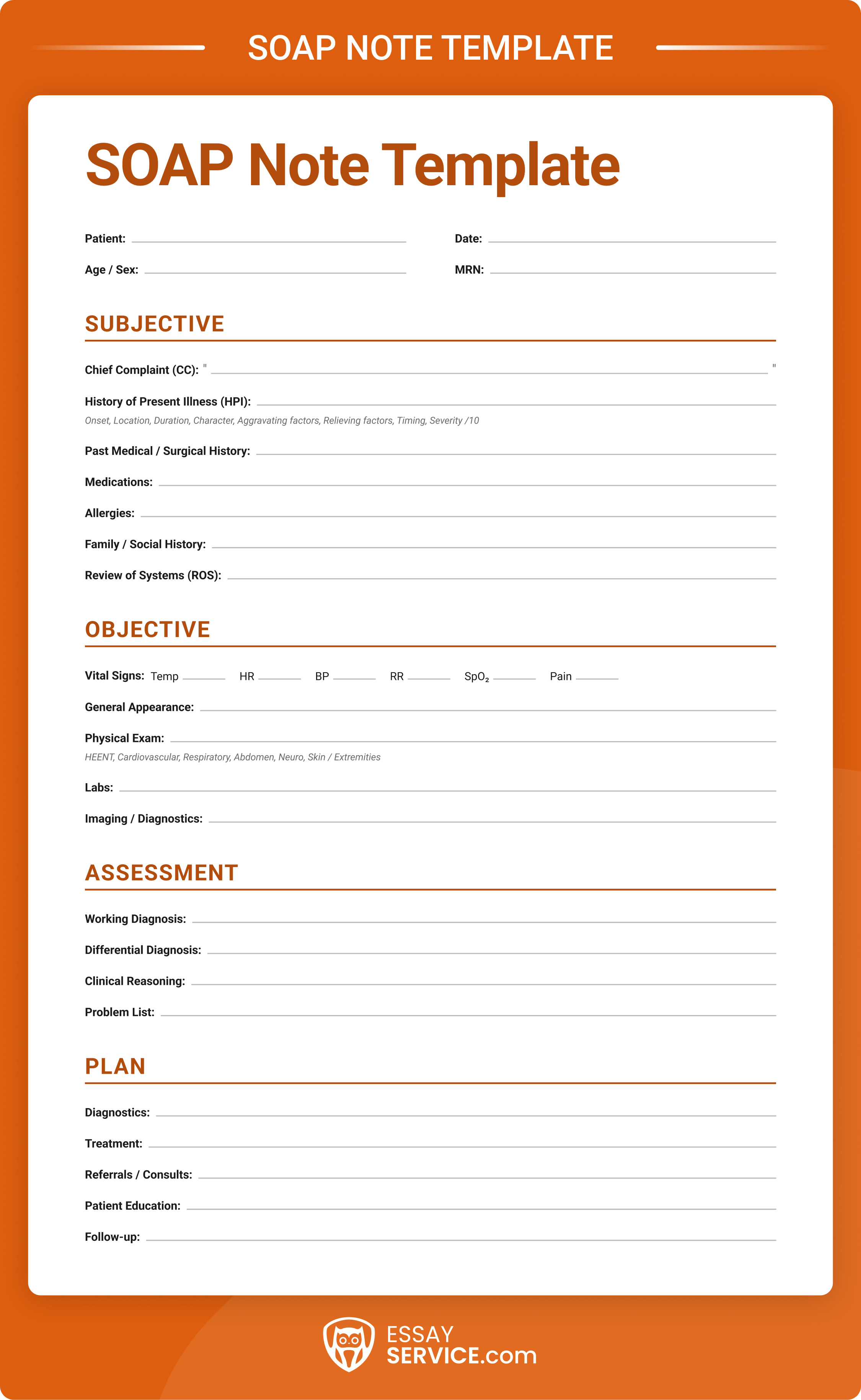
This is the patient's account, told in their own language wherever you can do so. This section covers why they showed up in the first place and how the symptoms feel from their side of the exam table. Include:
- Chief complaint (CC): the headline reason for the visit ("my chest hurts when I climb stairs").
- History of present illness (HPI): all the context around that complaint.
- Relevant history: the past medical, surgical, family, and social background.
- Medications and allergies: current meds, doses, reactions.
- Review of systems (ROS): your pertinent positives and negatives.
Pro tip: During the HPI description, OLDCARTS is the framework most people lean on: Onset, Location, Duration, Character, Aggravating factors, Relieving factors, Timing, Severity.
Objective (What You See and Measure)
Everything here is measurable and observable. These are the data points a second clinician could walk in and verify without asking the patient a thing. You'll cover:
- Vital signs: temperature, heart rate, blood pressure, respiratory rate, oxygen saturation, pain score.
- Physical exam findings: sorted by system, described with some specificity. "Lungs clear to auscultation bilaterally" does real work; "lungs normal" leaves the next reader guessing.
- Lab results: the values that matter, abnormal ones flagged.
- Imaging and diagnostics: the X-ray read, the EKG, whatever you've got back.
- General appearance: how the patient looks to you, objectively. Alert? In distress? Pale?
Pro tip: No patient quotes in this section, please. Objective means what you documented with your eyes, hands, and instruments, nothing more.
Assessment (Your Medical Conclusion)
The objective and subjective need to come together, and they do this in the assessment part, where you do most of the thinking and come up with an actual clinical judgment. For every active problem, aim to include:
- A working diagnosis: your best current explanation for what's happening.
- A differential diagnosis: the other contenders you haven't ruled out, each with a quick line on why it stays in play or drops off.
- Clinical reasoning: the compact logic that ties your findings to your conclusion.
- Problem list: every issue numbered, which matters a lot once a patient has three or four things going at once.
Plan (What You Will Do Next)
The assessment needs to turn into a plan so the patient’s problems are solved. In the final section, you need to connect each item to a numbered problem in the previous section, so nothing drifts off on its own. A complete plan runs through:
- Diagnostics: the labs, imaging, or tests you're ordering next.
- Treatment: medications with doses and routes, plus any procedures or therapies.
- Referrals and consults: the specialists you're pulling in.
- Patient education: what you explained, and what the patient should keep an eye on.
- Follow-up: when they return, and the red flags that should bring them back sooner.
Pro tip: Keep the plan matched to the assessment, one for one. Three diagnoses should produce three plans. When one goes missing, it reads like a problem you forgot about.
Writing a paper that asks you to put a direct excerpt without paraphrasing it? Quickly learn how to put a quote in an essay.
SOAP Note Template
Here's a blank template you can copy straight into your notes app or EHR and fill in patient by patient. I'd suggest keeping a version like this pinned somewhere for your first few weeks on rotation. A college essay ghostwriter can help you fill in the blanks with the relevant information if you’re struggling with the details.
SOAP Notes Examples
Reading about the four sections only takes you so far. Seeing an actual SOAP note example written out is usually what makes the whole thing click, so here are five worked samples across different presentations.
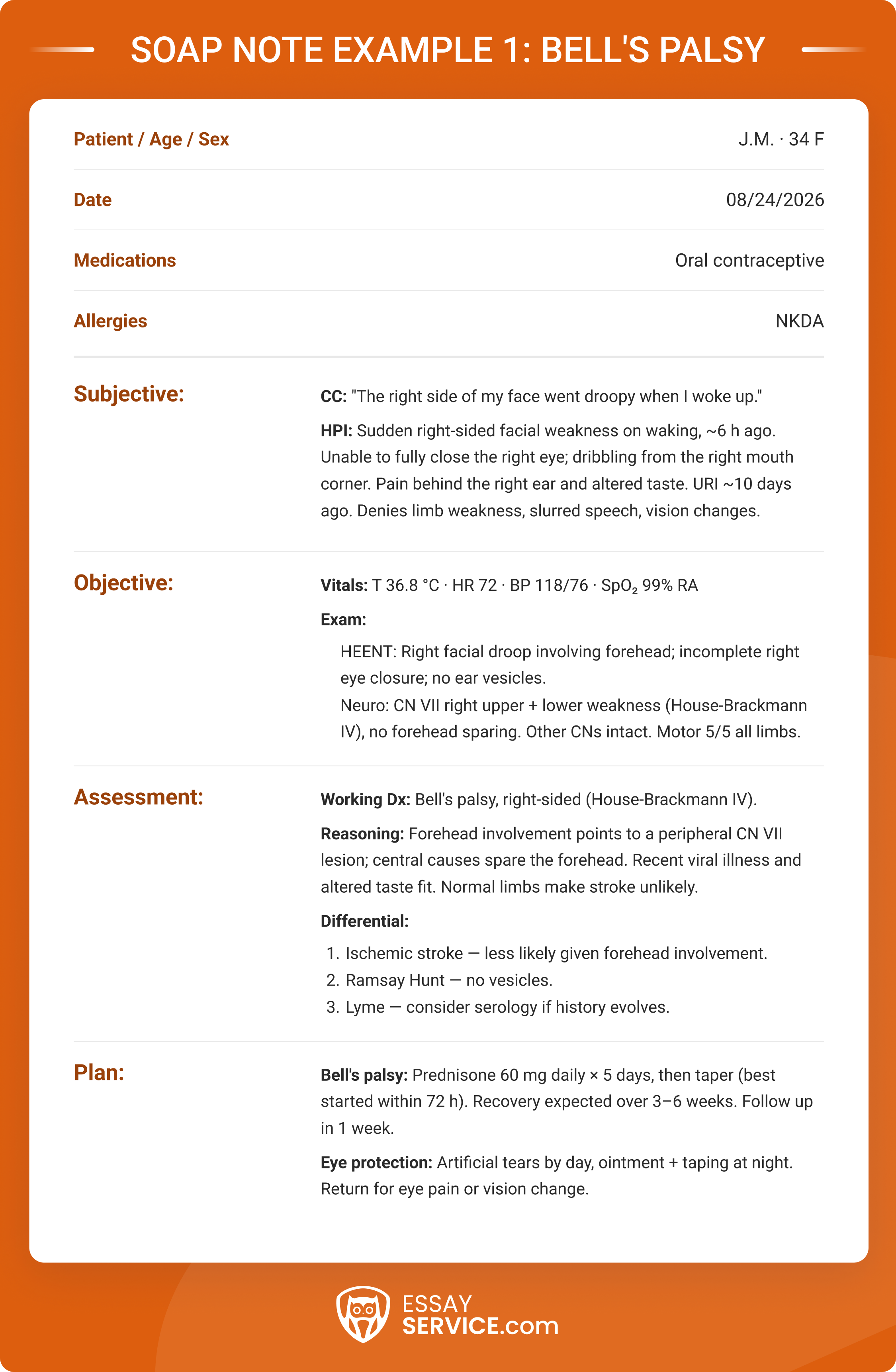
Bell's Palsy
A patient wakes up with a sudden facial droop on one side. What makes this note worth studying is the focused neuro exam and, maybe more so, the pertinent negatives. Those are what let you separate a peripheral facial nerve palsy from a stroke, and forgetting to document them is a mistake I saw over and over.
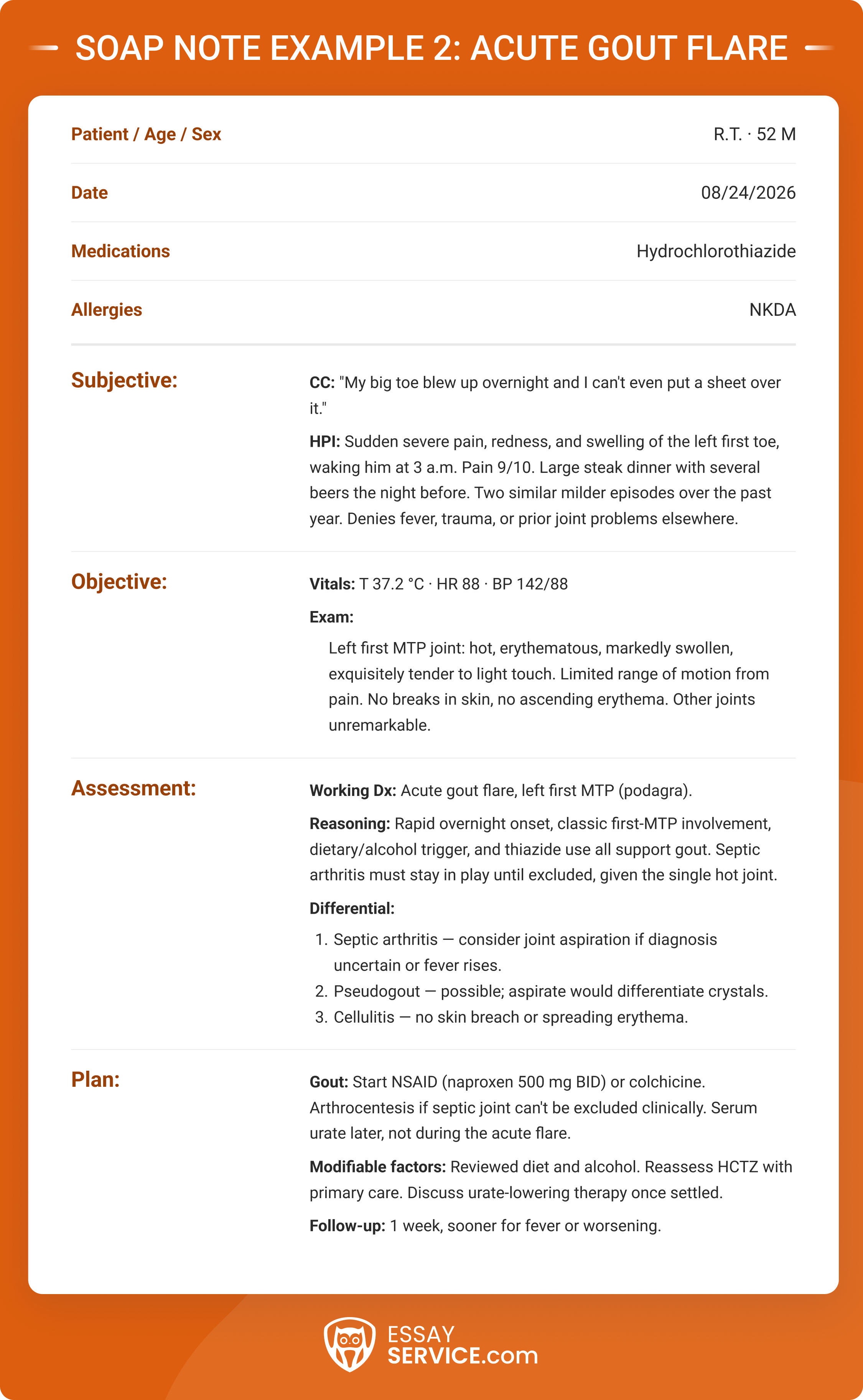
Acute Gout Flare
Here, the patient turns up with a hot, swollen, brutally painful first toe. The example shows how to capture that abrupt onset and the classic exam findings, but the real teaching point sits in the assessment: a septic joint has to stay on your differential until you've genuinely ruled it out, and the note needs to show you did.
Herpes Zoster (Shingles)
This example of SOAP note follows a patient with a painful, blistering rash creeping around one side of the trunk. You'll see how to describe a dermatomal distribution with actual precision, and how to handle timing, because the decision on antivirals rests almost entirely on how many days the rash has been there.
.webp)
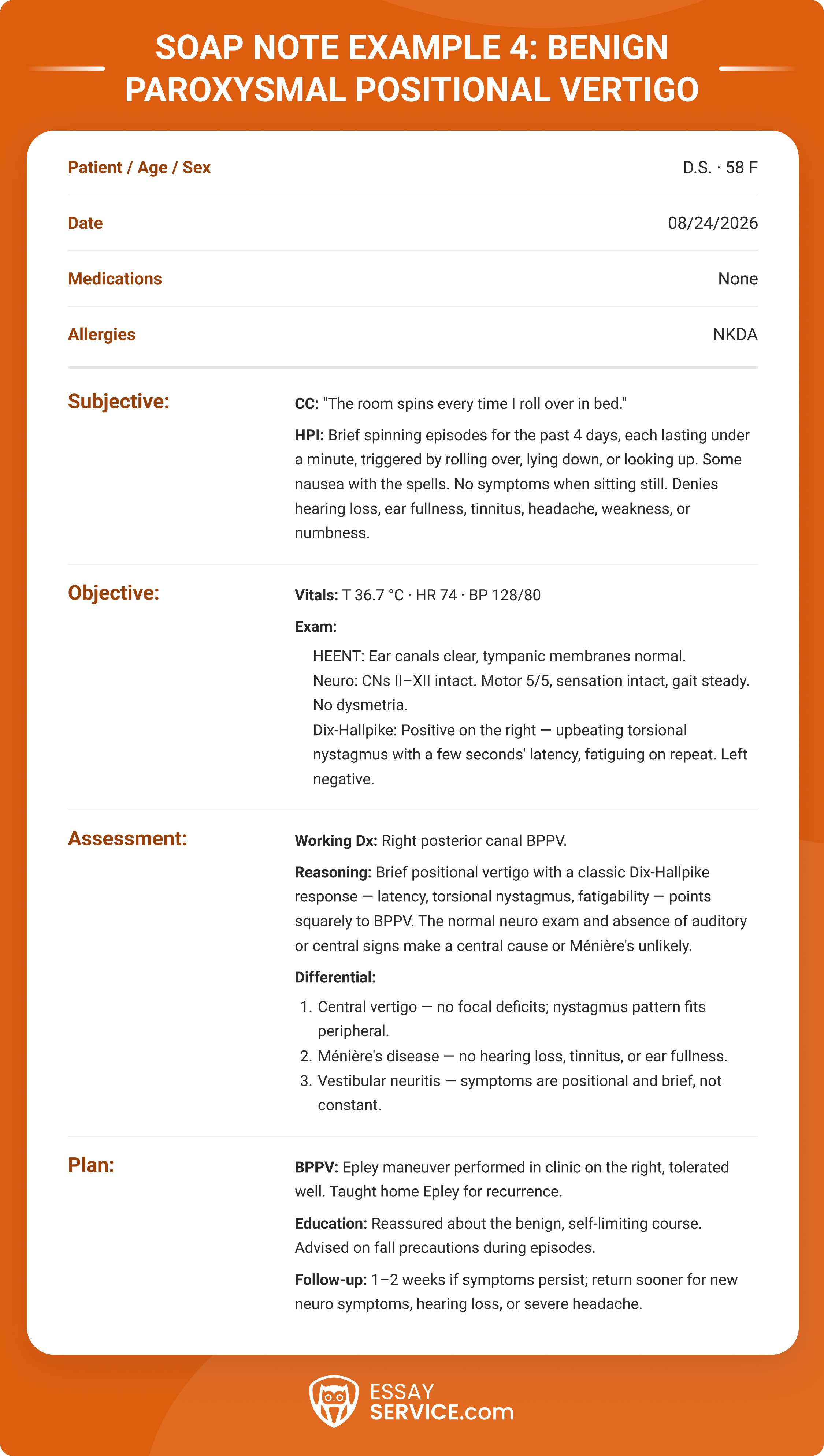
Benign Paroxysmal Positional Vertigo (BPPV)
Brief spinning dizziness, every time the patient rolls over in bed is the presentation here. It's a useful example for documenting positional symptoms and provocative testing like the Dix-Hallpike maneuver, and for keeping the subjective section from collapsing into a single useless word: "dizzy." Push past that word. Your future self, reading the note back, will thank you.
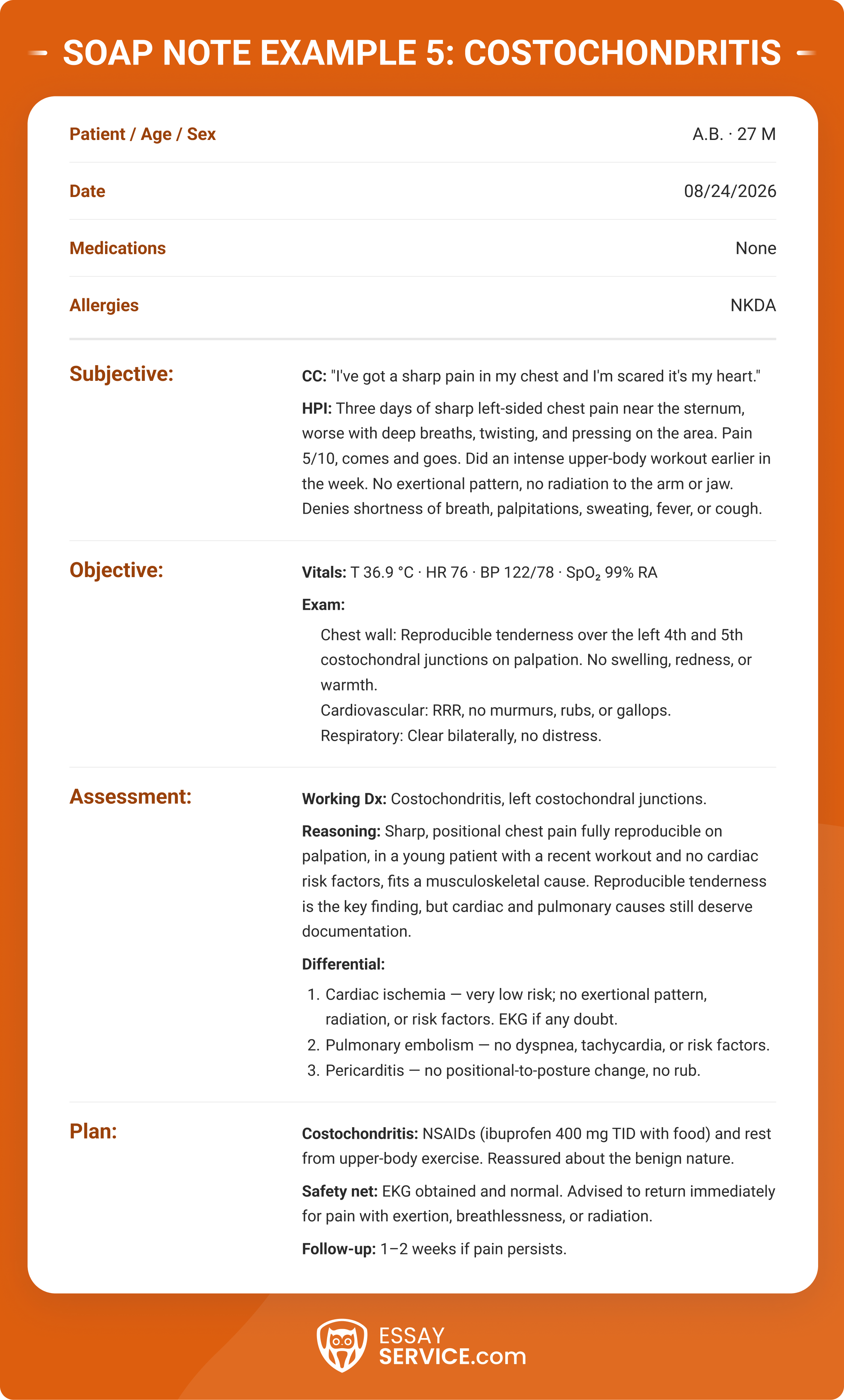
Costochondritis
Last one's a younger patient with sharp chest pain that worsens when you press on the chest wall. The note demonstrates how to write up a case where your main job is documenting a careful cardiac and pulmonary workup, so that when you land on a benign musculoskeletal cause, the reasoning behind it holds up to anyone who reads it later.
Tips for Writing SOAP Notes
You've got the structure down and five examples to work from, so here are a few working habits that tend to separate a clean note from a sloppy one. These are the things I wish somebody had pulled me aside and told me before my first week, and none of them show up in the standard "here's what the letters stand for" rundown.
- Write the note while the encounter is still fresh, not four patients later. Memory falls apart on a busy service, so scribble the key numbers down as you go, then transfer them properly.
- Stick to approved abbreviations, and mind your punctuations. A misplaced decimal point (1.0 mg reading as 10) has caused real harm. When you're not sure, spell it out.
- Quantify wherever you can. "Pain down from 8/10 to 3/10" gives whoever reads the note tomorrow an actual baseline to measure against.
- Number your problems and plans identically. Keep both lists on the same numbering so Problem 3 always lines up with Plan 3.
- Read it back as the covering clinician. If a person who's never met this patient couldn't act on your note without paging you, it isn't done yet.
- Resist copy-forwarding on autopilot. Pulling yesterday's note into today saves time, but stale findings like "day 2 post-op" for three straight mornings chip away at your credibility and can push a real error down the chart.
If you need any help with any of your other assignments while you handle clinical rotations, our essay writers can take over your deadlines.
Final Thoughts
A SOAP note breaks a patient encounter into four sections: Subjective, Objective, Assessment, Plan. Keep the patient's words apart from your own observations, take a real position in the assessment, and pair every plan with a problem. The structure turns automatic with practice, and clarity always outweighs length.
FAQs
What Are Common SOAP Note Mistakes?
What's the Difference Between SOAP Notes and Psychotherapy Notes?
How to Do a SOAP Note
How Long Should a SOAP Note Be?

Mark Bradford, a passionate and talented artist, utilizes his innovative spirit to support academic pursuits. In partnering with EssayHub, he leverages his artistic insights to assist students as a professional essay writer, helping them navigate and complete their academic assignments at every level of difficulty.