
Quoting means using someone else’s exact words in your writing. Sounds simple, right? Despite the clarity of this definition, I’ve seen more marks lost on essays due to quoting than nearly any other area.
Don’t quote to fill space or show authority. The right quote does what your words can’t: it captures a unique phrase or offers a specific claim to analyze. Otherwise, paraphrase.
In this article, I’ll cover how to put a quote in an essay, how to punctuate and format them, when you should be quoting vs paraphrasing, and common mistakes that cause students to lose marks.


How to Put a Quote in an Essay?
The most common error I find in student writing is dropping a quote into the middle of a paragraph, by itself, with no introduction or explanation. The quotation falls into the essay like a rock thrown into water, causing turmoil wherever it lands. Students call this a “hanging quote,” and it stops the flow every time. Remember: a quote is evidence, not an argument. It needs to be set up, and its significance must be explained. Never leave your reader to wonder where a quote came from or why you decided to use it.
To avoid this error, you need to integrate quotes smoothly. There are three primary methods of putting a quote in an essay. Which one you use depends on how much of the source you want to use and how much lead-in the reader needs:
Signal Phrases
Signal phrases attribute the quote to its source by naming the author and leading into the quote with a verb. This example of a quote in an essay is useful when your reader doesn’t need additional context. Your verb choice also matters: “argues”, “observes", “insists,” and “concedes” all mean different things. Choose one that accurately describes what the author is doing in that sentence.
Example: As Fitzgerald writes, "So we beat on, boats against the current" (180).
Example: Chen argues that remote work "fundamentally reshaped the meaning of the office" (42).
Introductory Sentences
These sentences use a whole sentence to introduce your quote. They are punctuated with a colon at the end of the introductory sentence. Use this format for longer quotes, or if your reader needs additional context before your quote will make sense. Your entire sentence should explain to your reader what they should look for in your quote.
Example: Orwell understood how euphemistic language could lead to political deceit: "Political language is designed to make lies sound truthful" (137).
Example: The authors of the study did not try to hide the flaws in their evidence: "Our sample skewed heavily toward urban participants" (Reyes 8).
Quote Integration
For this method, you integrate the quote into your own sentence. In my opinion, this is the smoothest way to incorporate a quote, but it is also more difficult to master. Your sentence structure will change based on the information you need to quote. Just remember to use proper grammar. The quote should not interrupt the flow of your sentence; it’s just another few words in your sentence.
Example: Gatsby’s fixation on a distant "green light" symbolizes a person trying to grasp something long gone (Fitzgerald 21).
Example: The article critiqued the policy as being "well intentioned but poorly executed," which was a sentiment shared by three other review panels(Hollis 12).
Exercise: Look for a sentence in your essay that uses a quote. Read it out loud. Does it sound weird, grammatically incorrect, or just plain awkward? If so, try rewriting it. Using quotes should be seamless.
If you're struggling with citations and formatting, you can hire essay writer professionals for academic support.
How to Cite a Quote in Different Citation Styles?
Any quote not your original thought must be cited. Citation rules for parentheses, period placement, and reference formatting depend on the style. Incorrect citations can cost points on an otherwise strong essay. Check your required style before writing.
You are most likely to encounter one of the following three styles when citing a quote in an essay.
APA Style
Favored by psychology, education, and other social sciences, APA emphasizes data, as cutting-edge research is important in these fields.
Formula: (Author's Last Name, Year, p. Page Number)
The period goes after the parenthesis. Author, date, and page all go in the citation. Block quotes (over 40 words) are indented, no quotation marks, and citation comes after the period.
Example: One study concludes that “sleep deprivation causes significant impairment to decision-making abilities” (Nakamura, 2024, p. 87).
Example with signal: Nakamura (2024) found that “sleep deprivation causes significant impairment to decision-making abilities” (p. 125).
MLA Style
Common in literature, languages, and humanities, MLA keeps parenthetical citations brief because the focus is on your discussion.
Formula: (Author's Last Name Page Number)
No comma, and don’t write “p.” before the page. If using a signal phrase, only include the page in parentheses. Block quotes are indented and omit quotation marks.
Example: The narrator insists that "the past is never dead" (Faulkner 73).
Example with signal: Faulkner's narrator insists that "the past is never dead" (73).
When preparing presentations, these easy demonstration speech ideas can help you practice using quotations effectively.
Chicago Style
History and some humanities programs use the Chicago Style, which allows two citation systems. Notes-bibliography uses footnotes, while author-date is similar to APA.
Formula (notes-bibliography): A superscript number after the quote, with full source details in the footnote.
Formula (author-date): (Author's Last Name Year, Page Number)
Example (notes): The author describes the period as "a decade of quiet upheaval."¹
Example (author-date): The author describes the period as "a decade of quiet upheaval" (Whitfield 2023, 114).
One of the best tips I can give you is to decide on the style you want before you start writing. Making sure your quoting in an essay is correct is frustrating enough without needing to also switch styles halfway through your draft.
Our history essay writing service can help you incorporate historical quotations accurately and effectively.
How to Alter a Quote in an Essay?
Occasionally, you may want to tweak a quote to fit your sentence. Perhaps it has a lengthy aside you don’t need or refers to “she” when you know you’re talking about a man. Good news! Altering a quote in an essay is possible, but you must indicate every alteration with one of these three tools, and you may never alter a quote’s overall meaning.
Use ellipses to remove words.
- Original: “The policy, which was passed in 2019 after years of partisan bickering, failed within eighteen months.”
- Edited: “The policy . . . failed within eighteen months” (Reyes 44).
Use square brackets to add clarification or fix grammar in a quote.
- Original: “She never forgave him for that.”
- Added clarification: “[Elizabeth] never forgave [Darcy] for that” (Austen 156).
- Grammar fix: The report notes that the team "[was] unprepared for the scale of demand" (Hollis 9).
Use [sic] to show an error was in the original quote, not your writing.
- Example: The memo stated that "their [sic] is no cause for concern" (Whitfield 3).
An advisory from decades of grading papers: alteration should be precise. I have students pass drafts that display careful vandalism of quotes they once ripped from their sources. By changing one or two words, their quotes communicate the opposite meaning of what the author meant. This is not a citation error; this is academic dishonesty. Before handing in your work, double-check your altered quotes. Read them alongside the original and ask yourself: would the author know this sentence as their own? If not, cut it out.
Many descriptive topics also benefit from carefully selected quotations that add depth and credibility.
How to Format Quotes in an Essay?
Formatting quotes in an essay is where it gets fussy. And it is also where marks quietly disappear. Your rules change based on the length of your quote and whether or not it contains a quote within itself. Once you memorize the three formats below, you’ll be able to format almost any quote you’ll ever need.
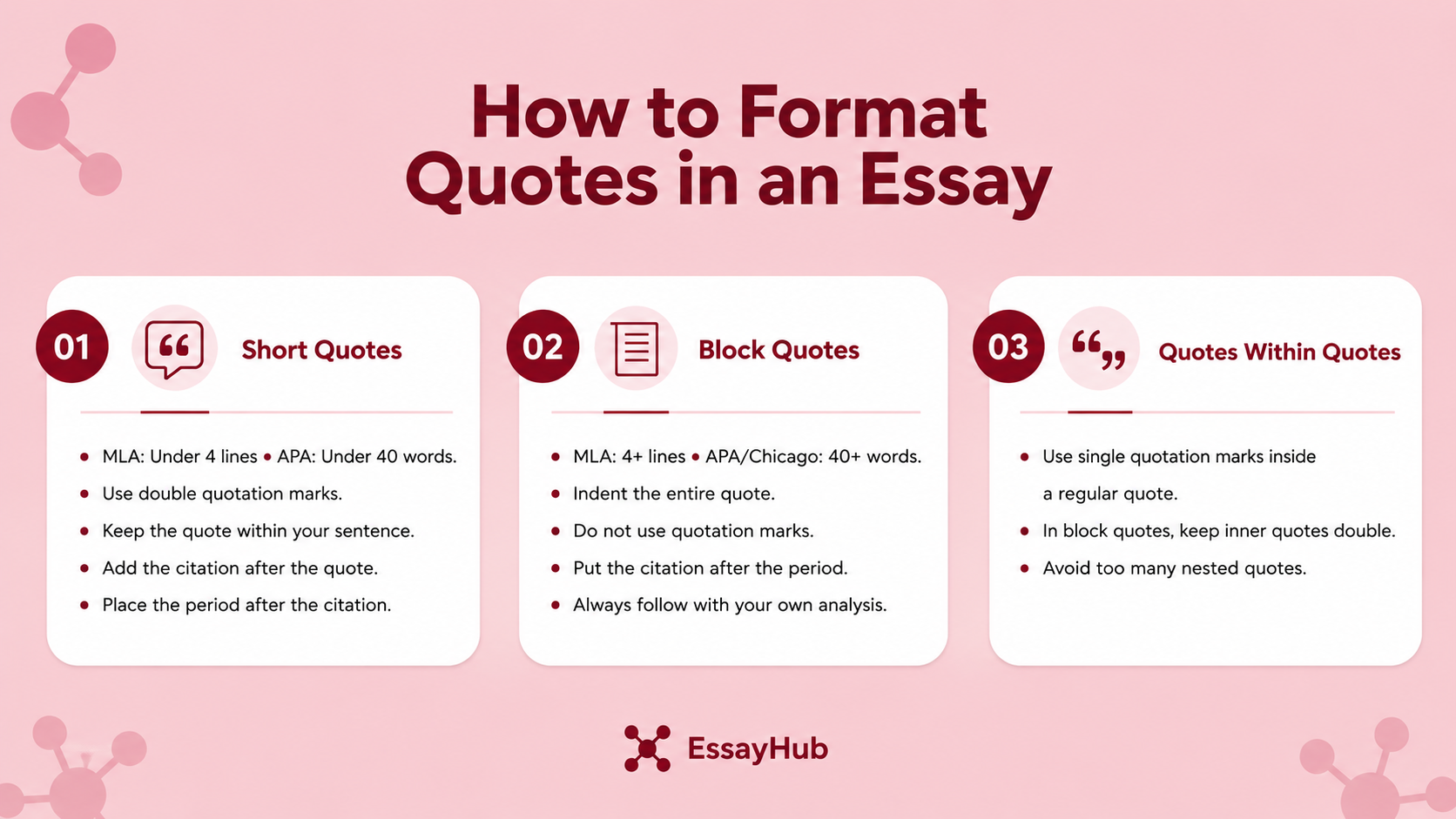
Short Quotes
The majority of your quotes will be “short”. That is, they will run within your paragraph instead of breaking free from it. The cutoff varies by style guide: MLA considers anything under 4 lines short. APA uses 40 words.
Whatever your style for using quotes in an essay, short ones go inside double quotation marks and run within the context of your own sentence. Place the citation after the closing quotation mark. Then add your punctuation after the citation, not before it. That last rule confuses more students than any other on this page.
Example (MLA): The narrator describes the town as "a place where time had simply stopped bothering" (Morrison 12).
Example (APA): The authors conclude that "engagement rose sharply after the redesign" (Patel & Chen, 2025, p. 33).
Notice that periods always go outside the parentheses. The one exception is block quotes. We’ll cover those next.
Block Quotes
Long quotes get big-league treatment. Give the quote its own indented line. Format like this for quotes of four or more lines in MLA or 40 words or more in APA and Chicago.
The three rules here flip everything you learned above. First, indent the quote half an inch from your left margin. Second, skip the quotation marks. The indentation shows you’re quoting. Third, place the citation after the period, not before it.
Example (MLA):
Fitzgerald closes the novel with an image that reframes everything before it:
Gatsby believed in the green light, the orgastic future that year by year recedes before us. It eluded us then, but that's of no matter. Tomorrow we will run faster, stretch out our arms farther. (180)
Never use block quotes unless you absolutely must. They devour your word count, and pulling up a block quote means you just wrote a paragraph-long sentence. If you’re dying to blockquote, follow it up with analysis. Never move immediately to your next point after a block quote.
Quotes Within Quotes
If your source quotes someone else, you must nest your quotation marks. The quote inside your quote swaps out double quotes for single ones.
Example: The reviewer notes that "the director called the ending 'a deliberate provocation,' which explains the audience walkouts" (Alvarez 7).
Here, Alvarez's words sit in double marks, and the director's words nested inside sit in single marks.
In a block quote, the logic flips. Since the block has no outer quotation marks, any quote inside it keeps its normal double marks.
One more tip: if you find yourself dealing with nested quotes too often, that’s a sign you should rephrase. Pull out only the nested quote, and paraphrase the rest.
The same citation principles apply when creating a powerpoint citation for presentations.
Why Use Quotes in an Essay?
Here's something I needed to hear when I was learning to insert quotes in an essay: a quote is not just decoration, and it doesn’t automatically make your argument sound scholarly. Only use quotes when they do what a paraphrase cannot. If you can say it just as well in your own words, paraphrase. Only quote if the exact wording truly matters. Really, only three things matter enough to quote instead of paraphrase.
When The Exact Words Matter
If you are analyzing how something is said, not just what is said, use the original text. In literary and rhetorical analysis, the specific words, tone, or language matter. Paraphrasing in these cases weakens your argument.
Example: When Homer calls the sea “a wine-dark” expanse, he attributes an unpleasant quality to the water rather than describing it as blue.
When You Need Solid Evidence
Precise wording matters when holding someone accountable. Quote legal testimony, official statements, incendiary claims, and quantitative results. Saying “He said he didn’t sell our data” isn’t as strong as quoting him directly.
Example: When asked about selling user data, the CEO said his company “has never and will never sell user data” (Ortiz 4).
When Discussing Someone’s Definition or Argument
Sometimes you’ll take a stance or use someone else’s as part of your argument. When this happens, quote the person you’re referencing. This matters most for definitions and less common positions, where even one word can alter the author’s meaning.
Example: For Sontag, camp is defined as “a certain mode of aestheticism,” not an appreciation of things (54).
That's it. Paraphrase everything else. Use fewer, more effective quotes.
Common Mistakes to Avoid While Using a Quotation in Essay
After years of reading student essays, I’ve noticed a few common pitfalls in quotations. Watch for these:
- Detached quotations. Quotations not connected to your sentence disrupt your reader, so make sure to connect them.
- Uncited quotations. Evidence alone is unclear, you should explain what the quote shows and why it matters.
- Copious quotations. Overusing others’ words hides your voice. Paraphrase when possible.
- Misplaced punctuation. If you’re putting your quote in your text (as opposed to letting it stand alone), the period comes after your citation, not before. Block quotes switch the order.
- Padding with quotations. Using unnecessary quotes to add length is obvious to your teacher.
- Misrepresenting quotes. Editing a quote to change its meaning is unethical.
- Lost citations. Perfect quotes without citations are still plagiarism.
- Bloated block quotes. Long block quotes often replace your own analysis.
Along with proper quotations, don't forget to format the cover page for essay according to your instructor's guidelines.
Wrapping Up
Quote wrap-up checklist:
- Always introduce quotes.
- Use proper punctuation for your citation style.
- Explain what each quote proves.
Only quote material when the specific wording is important. If not, paraphrase. Learn that, and you’ll never clutter your essays with unnecessary quotes again.
FAQs
Is It Plagiarism to Use Exact Words with a Citation but No Quotation Marks?
How Do You Handle a Quote Nested Inside Another Quote?
How To Write a Quote in an Essay?
How Many Quotes Should Be in an Essay?
Why Should I Use Quotes in an Essay?

Ryan Acton is an essay-writing expert with a Ph.D. in Sociology, specializing in sociological research and historical analysis. By partnering with EssayHub, he provides comprehensive support to students, helping them craft well-informed essays across a variety of topics.
- Quote Integration | Writing & Speaking Center. (n.d.). University of Nevada, Reno. Retrieved July 15, 2026, from https://www.unr.edu/writing-speaking-center/writing-speaking-resources/quote-integration
- Quotations - The Writing Center | Montana State University. (2026). Montana.Edu. https://www.montana.edu/writingcenter/writing_resources/quotations.html