Medical narrative reports simply tell the story of a patient’s care using straightforward, chronological sentences rather than random chart notes. I’ve authored and reviewed hundreds of medical narratives for hospitals, insurance carriers, and legal cases. The format remains virtually the same in every situation. An effective medical narrative follows 4 basic steps:
- Obtain a patient history,
- Document symptoms/treatment dates,
- Include the result,
- Add the provider's signature.
Leave out one of these steps, and your credibility will quickly erode. In this post, I’ll show you eight real medical narrative report examples, dissect the popular format that reviewers are looking for and point out mistakes that cause reports to be denied.
What is a medical narrative report?
The medical narrative report is a summary of the patient's diagnosis, treatment, and recovery in story form rather than as unrelated facts or figures.
Doctors, nurse case managers, and legal staff write it to describe what occurred without making the reader decipher note abbreviations. It's meant to do one thing and one thing only. Provide the insurer, attorney or future provider enough information about the patient's situation in several paragraphs. Help them understand what happened quickly and with less confusion.


Main parts of a medical narrative report
Regardless of hospital or specialty area, all narrative reports contain the same 8 basic elements. If you leave out a piece, your report is sure to be returned for edits.
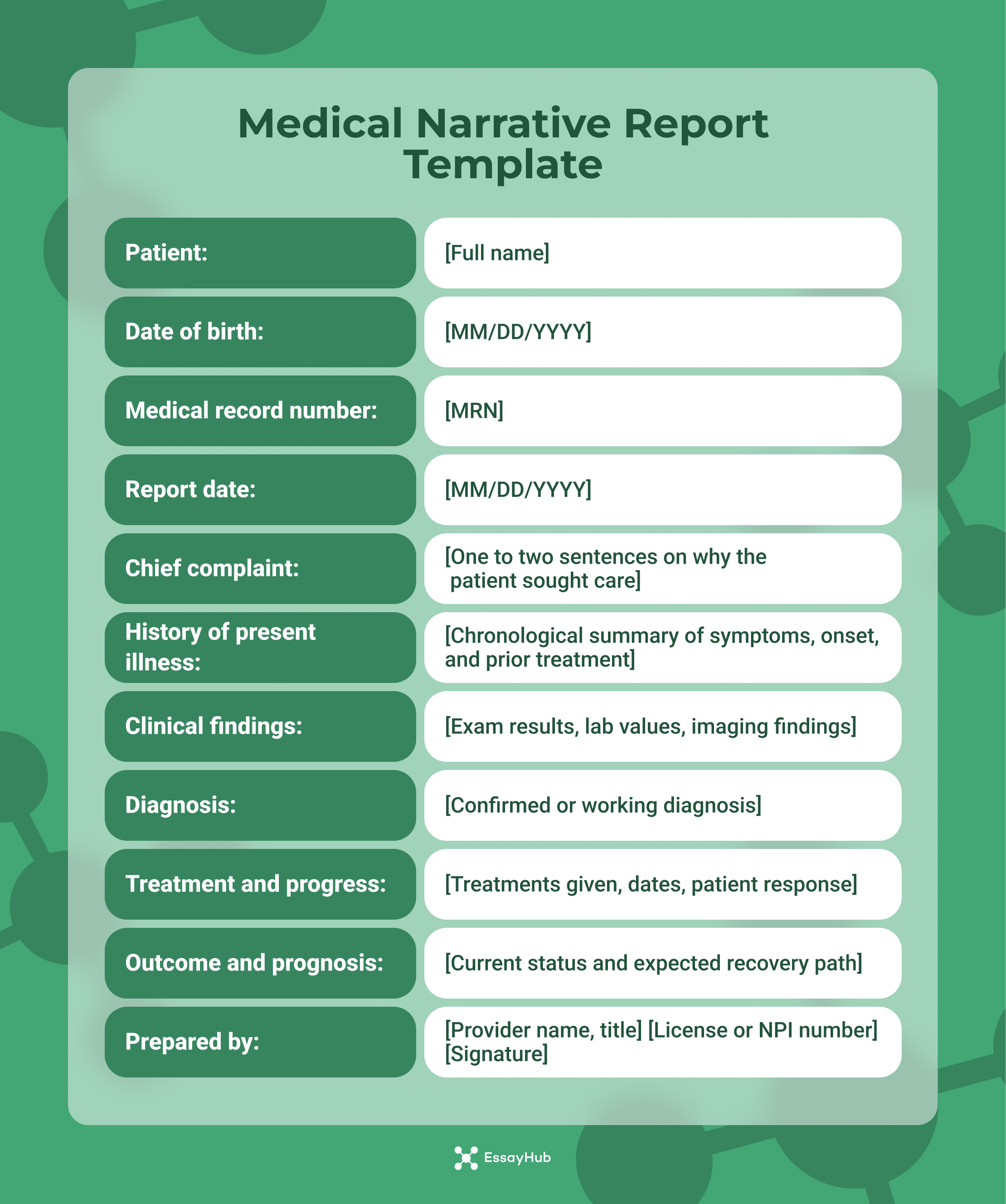
- Patient information: includes the patient's name, date of birth and medical record number and is confirmed at the top of the report.
- Chief complaint: why the patient sought treatment, typically one or two sentences.
- History of present illness: includes pertinent symptoms, their onset and any treatment that was attempted.
- Clinical findings: this includes any pertinent exam results, lab values or imaging that help to confirm the diagnosis.
- Diagnosis: state the confirmed or working diagnosis. Say the name of the diagnosis, don't just imply it.
- Treatment and progress: what you did and when, along with the patient's response over time.
- Disposition and prognosis: current condition and expected recovery.
- Provider signature and credentials: this includes the name, provider title and license or NPI number. This legitimizes the report.
If you're unsure how to organize your report, professional essay help can improve structure, clarity, and formatting.
Medical narrative report template
This is a general medical narrative report sample to follow, fill in using this as a guideline then edit wording to fit the patient's specific situation. Fill out every section, even if it is only for a few words. Leaving a blank section looks like you didn't finish writing your report to the majority of readers.

Our medical essay writing service can assist with healthcare assignments that require accurate terminology and evidence-based writing.
Medical narrative report examples
Ideally, your progress note should include patient identifiers, a concise chief complaint, an organized chronological history, supporting findings, and a signature line. Write notes in the past tense and avoid speculation so reviewers can quickly understand the episode of care. The following eight strong medical narrative report examples for students illustrate this format across specialties.
Medical narrative report example 1: Orthopedic injury
Patient: J. Reyes
Date of birth: 03/14/1989
Medical record number: MRN-104822
Report date: 06/02/2026
Chief complaint: Right knee pain following a fall at a construction site.
History of present illness: Pain began immediately after the fall and worsened over 48 hours. No prior knee injuries reported.
Clinical findings: MRI shows a partial tear of the anterior cruciate ligament. Range of motion limited to 90 degrees.
Diagnosis: Grade II ACL sprain.
Treatment and progress: Fitted with a hinged knee brace. Physical therapy started, twice weekly for six weeks.
Outcome and prognosis: Range of motion improving. Return to light duty expected in four weeks.
Prepared by: Dr. H. Alvarez, Orthopedic Surgeon
NPI: 1234567890
Medical narrative report example 2: Cardiac event
Patient: M. Okafor
Date of birth: 09/22/1971
Medical record number: MRN-118834
Report date: 05/19/2026
Chief complaint: Chest tightness and shortness of breath during physical exertion.
History of present illness: Symptoms began during a morning jog and resolved within ten minutes of rest. No prior cardiac history.
Clinical findings: EKG shows mild ST depression. Troponin levels within normal range.
Diagnosis: Unstable angina, myocardial infarction ruled out.
Treatment and progress: Started on a beta blocker. Referred to cardiology for stress testing.
Outcome and prognosis: Stable. No further chest pain reported at two-week follow-up.
Prepared by: Dr. T. Bianchi, Cardiologist
NPI: 2345678901
Reading personal narrative examples can help you understand how narrative techniques differ from clinical medical reports.
Medical narrative report example 3: Pediatric illness
Patient: L. Chen
Date of birth: 04/10/2020
Medical record number: MRN-129045
Report date: 04/28/2026
Chief complaint: Fever and ear pain for three days.
History of present illness: Fever peaked at 102°F. Increased irritability and reduced appetite noted by parent.
Clinical findings: Tympanic membrane inflamed and bulging on exam. No signs of mastoiditis.
Diagnosis: Acute otitis media.
Treatment and progress: Started on amoxicillin, ten-day course.
Outcome and prognosis: Fever resolved by day two of treatment. No follow-up required unless symptoms recur.
Prepared by: Dr. K. Osei, Pediatrician
NPI: 3456789012
Medical narrative report example 4: Mental health case
Patient: A. Patel
Date of birth: 11/03/1995
Medical record number: MRN-140271
Report date: 03/15/2026
Chief complaint: Persistent low mood and disrupted sleep over six weeks.
History of present illness: Symptoms gradual in onset, no prior psychiatric history. Patient reports difficulty concentrating at work.
Clinical findings: PHQ-9 score of 14, consistent with moderate depression.
Diagnosis: Major depressive disorder, single episode.
Treatment and progress: Started on an SSRI. Weekly therapy sessions initiated.
Outcome and prognosis: Gradual improvement noted at four-week check-in. Continued monitoring recommended.
Prepared by: Dr. N. Williams, Psychiatrist
NPI: 4567890123
Many nursing students also use a nursing essay writing service for support with research papers, care plans, and clinical assignments.
Medical narrative report example 5: Oncology follow-up
Patient: R. Thompson
Date of birth: 07/26/1968
Medical record number: MRN-152309
Report date: 02/10/2026
Chief complaint: Routine follow-up eight months after completion of breast cancer treatment.
History of present illness: Completed chemotherapy and radiation with no reported complications. No new symptoms since last visit.
Clinical findings: Mammogram clear. Tumor markers within normal range.
Diagnosis: No evidence of disease.
Treatment and progress: Continued tamoxifen therapy as maintenance treatment.
Outcome and prognosis: Stable. Next imaging scheduled in six months.
Prepared by: Dr. F. Nakamura, Oncologist
NPI: 5678901234
Medical narrative report example 6: Obstetric case
Patient: S. Nguyen
Date of birth: 02/18/1993
Medical record number: MRN-163417
Report date: 01/22/2026
Chief complaint: Routine prenatal visit at 28 weeks gestation.
History of present illness: Pregnancy uncomplicated to date. No bleeding, contractions, or fluid leakage reported.
Clinical findings: Fundal height consistent with gestational dates. Fetal heart rate normal at 140 bpm.
Diagnosis: Normal intrauterine pregnancy, 28 weeks.
Treatment and progress: Continued prenatal vitamins. Glucose tolerance screening ordered.
Outcome and prognosis: Patient and fetus stable. Next visit scheduled in four weeks.
Prepared by: Dr. C. Reyes, Obstetrician
NPI: 6789012345
Medical narrative report example 7: Workplace injury
Patient: D. Kowalski
Date of birth: 12/05/1982
Medical record number: MRN-174528
Report date: 12/08/2025
Chief complaint: Lower back pain following a lifting incident at work.
History of present illness: Pain began immediately after lifting a heavy object, radiating down the left leg.
Clinical findings: X-ray shows no fracture. MRI reveals a mild disc bulge at L4-L5.
Diagnosis: Lumbar strain with radiculopathy.
Treatment and progress: Started on NSAIDs. Referred to physical therapy.
Outcome and prognosis: Pain reduced by 50 percent after two weeks of treatment.
Prepared by: Dr. J. Meier, Occupational Medicine
NPI: 7890123456
Medical narrative report example 8: Post-surgical recovery
Patient: E. Martinez
Date of birth: 06/30/1975
Medical record number: MRN-185639
Report date: 11/14/2025
Chief complaint: Follow-up visit ten days after laparoscopic gallbladder removal.
History of present illness: Surgery performed without complications. Incision healing normally, bowel function returned.
Clinical findings: No signs of infection at incision site. Vital signs stable.
Diagnosis: Expected post-cholecystectomy recovery.
Treatment and progress: Activity restrictions lifted gradually per surgeon's instructions.
Outcome and prognosis: Cleared to resume normal activity at the two-week mark.
Prepared by: Dr. P. Singh, General Surgeon
NPI: 8901234567
Although both involve storytelling, a med school adversity essay focuses on personal experiences rather than clinical documentation.
5 Tips for writing a strong medical narrative report
Simple best practices separate clean reports from those returned for revision. Here are habits that have been recommended time and time again, regardless of specialty or case type.
- Put dates in order: Present events in the order they occurred rather than sorting by result or department.
- Be specific about your diagnosis: Don’t hedge with “possible problems.” Clearly state the working diagnosis.
- Support findings with your diagnosis: Ensure every impression links back to a specific exam maneuver, lab value, or radiograph you mentioned previously in your report.
- Use clear language: Your report should be readable by someone outside of the care team.
- Use specific dates: instead of saying “two days later,” use the actual date if possible.
- Spell out abbreviations: Don’t drop extra words into your dictation just to use an abbreviation.
- Double-check: Ensure the information in each field aligns with the rest of the report before you sign and submit.
If you're looking for your next assignment, explore medical topics for research paper across healthcare and medicine.
Final thoughts
The medical narrative report organizes the fragmented data of clinical care into a coherent chronological story of patient care. Standardized format with sound findings and a signature conclusion will ensure each report is clear, reliable, and ready to file.
FAQs
What makes a good medical narrative report example strong?
How do I use the medical narrative report template?
What does a completed medical narrative report look like?

Samuel Gorbold, a seasoned professor with over 30 years of experience, guides students across disciplines such as English, psychology, political science, and many more. Together with EssayHub, he is dedicated to enhancing student understanding and success through comprehensive academic support.
- Gutheil, T. G. (2004). Fundamentals of Medical Record Documentation. Psychiatry (Edgmont), 1(3), 26. https://pmc.ncbi.nlm.nih.gov/articles/PMC3010959/
- Colicchio, T. K., Dissanayake, P. I., & Cimino, J. J. (2021). The anatomy of clinical documentation: an assessment and classification of narrative note sections format and content. AMIA Annual Symposium Proceedings, 2020, 319. https://pmc.ncbi.nlm.nih.gov/articles/PMC8075472/
- Feng, C.-C., Agostini, M., & Bertiz, R. (n.d.). Documentation of Health Assessment Findings. Pressbooks.Montgomerycollege.Edu. Retrieved July 21, 2026, from https://pressbooks.montgomerycollege.edu/healthassessment/chapter/documentation-of-health-assessment-findings/
