
A personal narrative tells an important story and provides insight into something of importance to the writer, even if they realized the significance later on. The writer uses reflections on personal memory and selected scenes brought together into a focused point. A good personal narrative does not come across like an entry from a journal, it provides enough details for the reader to understand what is happening, how the author perceived event(s), and why they are still important.
In this article, I'll provide the characteristics of narrative writing and personal narrative essay examples for students in 2026, along with ideas to create an essay that is a representation of a real-life experience.
Characteristics of a Good Personal Narrative Essay
A good personal narrative starts with a real experience, though the experience alone is never enough. The writer still has to choose what belongs on the page, what should stay out, and how each detail helps the reader follow the point. An example of a personal narrative essay might focus on a first serious mistake, a family change, a difficult class, or one conversation that forced the writer to see themselves differently. The topic can be simple. The thinking behind it cannot be lazy.
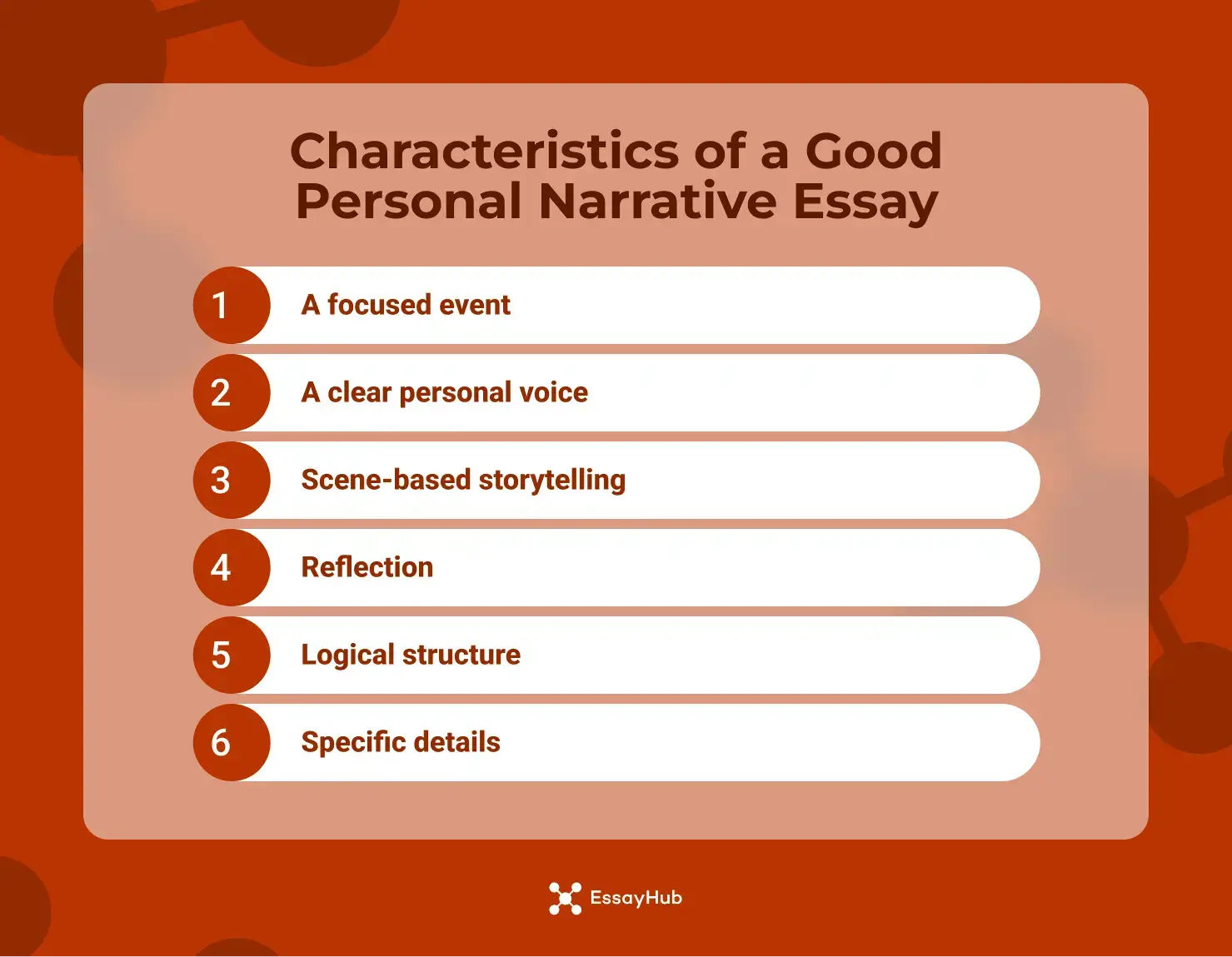
- A focused event: Personal narratives stay focused around one primary event and do their best to keep the reader engaged throughout, because they don't include unrelated memories or events.
- A clear personal voice: Each individual writer has his/her own voice and way of perceiving the events in which they were involved.
- Scene-based storytelling: Good personal narrative essay should use scene-setting elements (i.e. location, action, dialogue, etc.) where they allow the reader to understand the experience better.
- Reflection: The writer should make sure that they take the time to explain to the audience what changed by the event, along with how the changes affected their life.
- Logical structure: Make the story flow from one part to the next and build an understanding of the entire narrative.
- Specific details: Details are very important in good personal narrative writing. The use of very specific actions instead of broad statements is critical in helping the reader relate to the experience.


8 Personal Narrative Essay Examples
Examples make personal narrative writing much easier to understand because they show how memory, detail, and reflection work on the page. Below, we suggest eight personal narrative essay samples: one for middle school, one for high school, one for college, one about personal growth, one about a childhood memory, one about a turning point, one about failure, and one about entering a new place.
Personal Narrative Essay Example #1
Topic: The Afternoon I Lost My Little Brother at the Store
I only looked at my phone for a second. Maybe it was longer than that, but it felt like one second.
My mom took my little brother and me to the grocery store on a Saturday. The store was crowded, and I already wanted to go home before we even got a cart. My brother was seven, so he was doing what he always did. He asked for cookies, then gum, then a toy car, then cookies again.
Before we went inside, my mom told me, “Stay with him while I shop.”
I said okay. I thought it would be easy.
For a while, it was. He walked next to the cart and kept touching things on the shelves. I told him to stop a few times. He did not really listen, but he stayed close enough, so I thought I was doing fine.
Then we went into the snack aisle. My mom was looking at crackers, and my brother was standing near the bottom shelf. My phone buzzed. It was my friend asking about homework. I answered her because I thought it would take two seconds.
When I looked up, my brother was gone.
At first, I thought he was behind the cart. Then I thought he was with my mom. Then I checked the end of the aisle, and he was not there either.
“Where is he?” my mom asked.
I did not know what to say. That was the worst part. I had one job, and I could not even answer the question.
“I don’t know,” I said.
My mom left the cart in the aisle and started walking fast. I followed her. We checked the toy aisle first because that made the most sense. He was always asking for toys. He was not there. We checked near the cereal. He was not there either.
I kept saying his name, but the store was too loud. People were pushing carts, kids were talking, and someone dropped something near the freezer section. It felt like everything in the store got louder as soon as I needed to hear him.
My mom found an employee and told her what happened. The employee asked what he looked like. I said he had a blue shirt and messy hair. For some reason, saying that made me feel worse.
Then we found him near the bakery.
He was holding a pack of chocolate muffins and looking completely normal, like nothing had happened.
My mom ran over to him. “Why did you walk away?”
He held up the muffins. “I wanted these.”
I was so mad at him. I was also really glad he was okay, so I just stood there and said nothing.
In the car, my mom did not yell. I almost wanted her to, because the silence felt worse. She only said, “When I ask you to watch him, I need you to actually watch him.”
I looked out the window the whole ride home.
Before that day, I thought being responsible just meant people trusted you more. I liked that part. I liked feeling older. I did not think much about the part where someone can get hurt if you stop paying attention.
Now, when my mom asks me to watch my brother, I still get annoyed sometimes. He still runs around and touches things he should not touch. But I do not look at my phone the same way. I remember him standing in the bakery with those muffins, having no idea how scared we were.
That was the day I learned that a small job can become a big deal really fast.
Why This Essay Works:
This example works for middle school because the language is simple and believable, but the story still has a clear point. The writer focuses on one event, shows what happened in order, and explains what changed afterward without making the lesson sound too big or fake.
Personal Narrative Essay Example #2
Topic: The Night I Stayed Silent
I knew the joke was mean before everyone started laughing. That was probably why I looked down at my tray so quickly.
It happened during lunch in tenth grade. I was sitting with the same group I sat with almost every day, and most of the time, we got along fine. We talked about homework, complained about teachers, shared fries, and acted like everything was more dramatic than it actually was. It was normal lunchroom noise.
Then Daniel made a comment about a girl at the next table.
Her name was Maya. She was new that year, and she kept to herself. She wore large headphones around her neck even when she was not listening to anything, and she drew in the margins of her notebook during class. I did not know her well, but she had once helped me find the right page in biology when I had missed a lesson.
Daniel said something about the way she dressed. I will not repeat it because it was not clever. It was just mean, and everyone knew it.
A few people at our table laughed right away. Someone added another comment, and then the whole thing grew, as those things usually do. One person says something small and ugly, another person makes it louder, and suddenly the table feels like it has chosen a side.
I did not laugh. At least, I do not think I did. I remember staring at my sandwich and pretending to be very busy with the plastic wrap around it.
Maya heard them. I know she did because her shoulders changed. She did not turn around. She did not say anything. She just closed her notebook, put it in her bag, and left the cafeteria with her lunch untouched.
That should have been the moment I said something.
I had the words in my head. I could have said, “Leave her alone.” I could have said, “That was rude.” I could have even said something simple, like, “Stop.” None of those sentences were hard.
Still, I said nothing.
The rest of lunch went on like usual, which somehow made it worse. Daniel talked about a math quiz. Someone asked for gum. A carton of milk spilled at another table, and everyone turned to look. The world did not pause because I had failed to do the right thing.
For the rest of the day, I kept thinking about Maya walking out. I saw her in English later, sitting two rows ahead of me, and she did not draw in her notebook like she usually did. She kept her hands folded on her desk. I wanted to apologize, but I also knew that an apology would sound strange because I had not been the one who said the joke.
That was the excuse I gave myself at first.
By the time I got home, it sounded weak even in my own head. I had not said the cruel thing, true. I had also made it easier for the cruel thing to stay in the room.
The next morning, I saw Maya near the library before first period. She was putting books into her backpack, and for a second I almost walked past her. My face got hot before I even spoke.
“Hey,” I said. “I’m sorry about what happened at lunch yesterday.”
She looked at me for a moment. “You didn’t say anything.”
“I know,” I said. “That’s why I’m sorry.”
It was awkward. I wish I could say the apology fixed everything, but it did not turn into some perfect movie scene. She nodded, said “Okay,” and zipped her backpack. Then she walked into the library.
At lunch that day, I sat at the same table again. I wanted to act normal, but I could feel myself waiting for someone to say something about Maya. When Daniel mentioned her headphones, I interrupted him before he could turn it into another joke.
“Just leave her alone,” I said.
The table got quiet for maybe two seconds. Then Daniel rolled his eyes and said, “Fine.”
That was it. No huge argument. No dramatic speech. Nobody clapped, obviously. The moment passed so quickly that I almost felt embarrassed by how afraid I had been of it.
After that, I started noticing how often people stay silent because they think speaking up will cause a scene. Most of the time, it does not. Most of the time, the scene has already started, and silence just lets it continue.
I still do not always say the right thing at the right time. Sometimes I think of the better sentence five minutes too late, which is annoying and very human. But that day taught me something I needed to learn: staying out of it is still a choice.
I used to think courage had to look loud. Now I think it can be one plain sentence said before the damage gets bigger.
Why This Essay Works:
This essay works because the conflict feels realistic for a teenager. The essay does not turn the writer into a perfect hero. Instead, it shows hesitation, guilt, and a small attempt to do better. The reflection is more mature than the middle school example, but the voice still sounds like a student thinking through a real social moment.
Read also: Guide on a Narrative Essay.
Personal Narrative Essay Example #3
Topic: A Draft Covered in Comments
By the time my first college essay came back, I had convinced myself it was probably fine. Not great, maybe, but fine enough. I had finished it before midnight, cited the book correctly, and used several sentences that sounded like they belonged in college. That last part should have worried me more than it did.
The essay was for a first-year writing seminar about memoir. Our assignment asked us to analyze one chapter and explain how the author handled memory. I liked the book, which made the draft feel more embarrassing later. I had opinions about it. I had underlined pages. I had even talked about it in class once without sounding completely lost.
Then I opened the document with my professor’s comments.
There were too many.
“Interesting idea, but unclear.”
“Where do you see this in the text?”
“Can you state the claim more directly?”
One comment sat beside a paragraph I had been weirdly proud of: “This sounds more complex than it is.”
I stared at that one for a long time.
In high school, I had been good at writing in the way that worked there. I could build a paragraph quickly, use enough evidence, and make the ending sound thoughtful. Teachers usually knew what I meant, or at least they gave me the benefit of the doubt. College writing felt less forgiving. It kept asking me to explain the thought behind the sentence, and I was starting to suspect that some of my sentences had no thought behind them.
My professor had written at the bottom, “You’re close. Come by office hours.”
That should have sounded helpful. I read it like bad news.
I almost skipped. I had a class across campus afterward, and I told myself that was a real reason. It was not. The real reason was that I did not want to sit across from someone while they explained, out loud, that my paper was weaker than I wanted it to be.
On Thursday afternoon, I went anyway.
Her office was small, with stacks of books on the floor and a mug near the computer. I remember those details because I kept looking anywhere except at my own draft. She asked how I felt about the comments.
I said, “I think I understand them.”
Then, after a pause, I added, “Actually, I don’t.”
That was the first honest sentence I had said about the paper all week.
She turned the laptop toward both of us and asked me what I had wanted to argue. I gave a long answer. It had too many words, and I could hear myself trying to sound prepared. She listened, then pointed to the screen.
“Where is that idea in the draft?”
I looked at the first page. Then the second. The idea was there, sort of, but it was scattered around in pieces. A sentence in the introduction hinted at it. A body paragraph almost said it. The conclusion said something close, then drifted into a safer point because I must have lost confidence.
“I guess I didn’t really say it,” I admitted.
She nodded, not in a cruel way. “That’s normal. Sometimes the draft figures out the idea before the writer does.”
I wanted that to sound comforting. Mostly, it annoyed me because it meant revision was not just fixing commas and moving sentences around. I had to rethink the paper.
For the next half hour, we worked through the draft. She did not give me better sentences to copy. That would have been easier. Instead, she kept asking small questions that made the weak parts obvious. What does this word mean here? Why this quote? What changes if you remove this sentence? Where does the author show distrust in her own memory?
At one point, I deleted a sentence I had liked. It was long, polished, and useless. The paper became better the second it disappeared, which felt unfair.
When I left her office, my draft looked worse than before. Lines were crossed out. Notes were crammed into the margins. My thesis had been reduced to one rough sentence that sounded almost too plain. Still, for the first time, I knew what I was trying to write.
That night, I rewrote most of the essay. I kept the parts that actually made a point and cut the sentences that had been standing around pretending to help. The new version sounded less impressive in a quick glance, but it was clearer. I could explain every paragraph without hiding behind words like “complexity” and “identity,” which I had used too easily the first time.
The final grade was good. I cared about that, obviously. I would be lying if I pretended I did not. But the grade was not the part that stayed with me.
What stayed with me was the moment in her office when I said, “Actually, I don’t.” It was such a small sentence, and still it changed the whole meeting. Before that, I had treated confusion like something to cover up. Afterward, I began to see it as information. Annoying information, yes, but useful.
I still do not enjoy getting a draft back covered in comments. Nobody does, no matter how mature they claim to be. But now I read comments differently. I look for the question underneath them. I ask what the paper is trying to become, even when the answer is inconvenient.
College did not make me a better writer by rewarding the sentences that sounded smart. It made me a better writer by refusing to let those sentences pass when they had nothing solid under them.
What to Notice:
This example fits a college personal narrative because the main conflict is more internal than dramatic. The event itself is ordinary: a student goes to office hours after receiving comments on a draft. The essay works through the student’s pride, confusion, and slow acceptance that revision means rethinking the idea, not just cleaning up the wording. The voice is more mature than the middle school and high school examples, and the ending connects one specific meeting to a larger change in how the writer handles academic feedback.
Personal Narrative Essay Example #4
Topic: When I Stopped Apologizing for Everything
“Sorry,” I said, even though I had done nothing wrong.
The woman in the coffee shop had stepped backward into me while she checked her phone. My drink spilled over my hand, and the lid popped loose. She turned around, looked at the cup, then looked at me.
I said it again. “Sorry.”
She frowned a little and walked away.
My friend Tessa stared at me like I had just answered a math problem with the word “banana.”
“Why did you apologize?” she asked.
“I don’t know,” I said. “She bumped into me.”
“That makes it worse.”
I laughed because I thought she was joking, but she kept looking at me. That was uncomfortable. I suddenly became very interested in wiping coffee off my sleeve.
Until that afternoon, I had never thought much about how often I apologized. I said sorry when someone interrupted me. I said sorry before asking a question. I said sorry when a waiter brought the wrong order, as if I had personally confused the kitchen. The word came out before I had time to decide if it belonged there.
Tessa started counting.
At first, I told her that was annoying. It was. During the walk back to her apartment, she lifted one finger every time I apologized for no real reason. I said sorry for walking too slowly. I said sorry because she had to wait while I tied my shoe. I said sorry when my phone alarm went off, even though it was quiet and lasted maybe two seconds.
By the time we reached her building, she had counted seven.
“Seven is not that many,” I said.
“It was a twelve-minute walk.”
That shut me up.
The strange part was that I did not think of myself as shy. I had opinions. I talked in class. I could be funny around people I trusted. Still, some small part of me seemed convinced that taking up space required an apology first.
That bothered me more than I wanted to admit.
For the next week, I tried to notice the word before I said it. This sounds simple. It was not. The apology usually appeared before the thought did. I would bump someone’s backpack in the hallway and feel sorry forming in my mouth, even when we had bumped each other equally. I would start an email with “Sorry to bother you,” then stare at the screen because I was not actually sorry. I was asking a normal question.
The first time I stopped myself, I felt rude.
A classmate had borrowed my notes and returned them two days late. I needed them for a quiz, so I almost said, “Sorry, can I get those back?” Instead, I said, “Can I get my notes back today? I need them tonight.”
My voice sounded too sharp to me. It probably sounded normal to everyone else.
She said, “Oh, yeah, sorry,” and handed them over after class.
Nothing terrible happened. No one accused me of being mean. The room did not change. I had spent so much energy imagining conflict, and the actual moment lasted less than ten seconds.
After that, I started replacing sorry with what I really meant.
If someone held the door, I said thank you.
If I needed help, I said, “Can I ask you something?”
If I made an actual mistake, I still apologized. That mattered to me. I did not want to become careless or rude. I only wanted to stop treating every need, delay, and question like a personal failure.
The hardest moment came during a group project. One member kept sending her part late, which meant the rest of us had to fix the slides at the last minute. Usually, I would have softened the message until it barely said anything.
This time, I wrote, “We need your section by 6 p.m. so we can finish the presentation tonight.”
I read it five times before sending it. My thumb hovered over the screen. I almost added “sorry” at the beginning, then deleted the whole draft and typed it again without the apology.
She sent the section at 5:48.
I remember that exact time because I checked it like proof.
Personal growth did not arrive as a huge personality change. I did not wake up bold one morning. I just began to notice a habit that had been making me smaller in ordinary situations. Then, very slowly, I practiced a different response.
I still apologize too much sometimes. The word slips out when I am tired or nervous. Last week, I apologized to a chair after hitting my knee on it, which was not my strongest moment.
Still, I catch myself more often now.
That coffee shop moment stayed with me because it showed me something I had been doing for years. I thought I was being polite. Really, I was making myself responsible for everyone else’s comfort.
Now I try to save apologies for the moments that deserve them. The word means more that way. So do I.
What This Example Shows:
This is one of those examples that does not rely on a major crisis. The change comes through a small habit that the writer slowly begins to understand. That makes the essay useful for students because personal growth often looks ordinary while it is happening. The story has a clear before-and-after, but the writer still sounds imperfect at the end, which keeps the reflection believable.
Check other narrative essay examples for further understanding of narrative writing.
Personal Narrative Essay Example #5
Topic: The Blue Bike
My first bike was blue, too big for me, and scratched on one side because my cousin had owned it before I did. I did not care about the scratches. I cared that it had no training wheels.
That detail made it terrifying.
My dad brought the bike out on a Sunday afternoon and told me I was ready. I was six, maybe seven, and I did not agree with him at all. The street in front of our house looked longer than usual. The small hill near the corner looked much steeper than it had the day before. Even the sidewalk seemed like it had developed new cracks just to make things harder.
“You just have to pedal,” my dad said.
Adults love saying “just” before things that are clearly difficult.
I sat on the bike and gripped the handlebars so tightly that my fingers hurt. My dad held the back of the seat and told me to look ahead. I looked down at the front tire instead. It wobbled immediately.
“Look where you want to go,” he said.
“I want to go back inside.”
He laughed. I did not.
The first few tries were awful. I pedaled twice, leaned too far left, and jumped off before I could fall. Then I leaned too far right and scraped my ankle against the pedal. My dad kept saying I was doing fine, which felt dishonest. I was not doing fine. I was moving three feet at a time and making scared noises whenever the bike tilted.
After a while, my neighbor came outside with her dog. That made everything worse because now there was a witness. I pretended I needed water and walked to the porch slowly, as if I had not just decided to quit.
My dad followed me, but he did not tell me to try again right away. He sat on the front step and opened my water bottle.
“You know,” he said, “falling is part of it.”
I hated that sentence. I wanted riding a bike to be the kind of thing you understood before doing it. I wanted instructions that worked immediately. I wanted balance to make sense.
Still, after a few minutes, I went back to the bike.
This time, I made it past the mailbox. Then the driveway. Then, suddenly, I was moving without feeling my dad’s hand on the seat.
I turned my head. He was standing several steps behind me.
“Don’t look back!” he shouted.
Of course, I looked back.
The bike swerved, my foot slipped, and I landed on the grass near the curb. I did not get badly hurt, but my knee stung and my face felt hot. I wanted to cry mostly because I had been so close.
My dad walked over and crouched beside me.
“That was it,” he said. “You were riding.”
I looked at the bike lying on its side.
“For like five seconds.”
“Five seconds counts.”
I did not believe him completely, but I liked hearing it.
I got back on the bike one more time. Then one more after that. By the end of the afternoon, I could ride halfway down the street before stopping with both feet on the ground. My turns were terrible. My knees were dirty. I still panicked whenever the bike leaned too much.
But I had done it.
For years, that memory stayed in my head as the day I learned to ride a bike. Now I think about it a little differently. I remember how badly I wanted to be good before I was willing to be bad. That has followed me into other parts of my life, honestly. I still want to skip the awkward first stage of things.
That blue bike taught me something I did not have words for then. You can be scared, clumsy, and annoyed, and still be learning. Sometimes five seconds really does count.
What to Notice:
This childhood memory essay uses a simple event, yet the reflection gives it purpose. The writer does not pretend the moment was dramatic. The details stay concrete: the scratched bike, the mailbox, the scraped ankle, the grass near the curb. Those details help the memory feel real, while the ending connects childhood frustration to a pattern the writer recognizes later.
Personal Narrative Essay Example #6
Topic: After the Callback List
The callback list was taped to the music room door when I got there, and by then a small group had already gathered around it. Everyone was pretending to be calm. Nobody was calm.
I had auditioned for the spring musical two days earlier. I did not expect the lead role, at least that is what I told people, but I had imagined my name somewhere near the top of the list. I had practiced for weeks in my room with the door shut. My younger sister knew the audition song by accident because she had heard it so many times through the wall.
I waited behind two seniors while they checked the names. One of them squealed and hugged her friend. Another student stepped away quickly, staring at the floor.
Then I saw my name.
Ensemble.
One word. Very small. Very final.
For a second, I felt embarrassed before I even felt disappointed. That surprised me. I looked around like everyone had been waiting for my reaction, though no one was paying that much attention to me. My friend Lena found her name under callbacks for a supporting role, and she turned around with her hands over her mouth.
“You made it!” I said.
My voice sounded normal. That felt like a performance too.
The rest of the day had that strange, heavy feeling that comes after something does not go the way you pictured it. Nothing actually terrible had happened. I still had a part. I would still be in the show. Still, I kept replaying the audition in my head. Maybe I had chosen the wrong song. Maybe I had looked too nervous. Maybe the director had already decided before I walked in.
By the time rehearsal started the next week, I had created a private case against everyone involved.
The first ensemble rehearsal did not help. We spent almost an hour learning background movement for a scene where the main characters argued near the front of the stage. My job was to cross behind them with a stack of fake books and look “busy.” That was the director’s exact word.
Busy.
I remember thinking, I practiced for weeks for this?
During a break, I sat near the edge of the stage and watched the leads work through the same scene again. Lena missed a line twice. The director stopped her, gave a note, then made her repeat the section. Then he stopped her again. The whole room watched while she tried to fix one sentence.
That was the first time I felt my jealousy loosen a little.
I had wanted the role, but I had not thought much about what it would require. I had imagined the applause and the dramatic solo. I had skipped over the part where every mistake happened in public.
A few rehearsals later, one of the seniors in the ensemble pulled me aside. His name was Marcus, and he had been in every school production since freshman year.
“You keep disappearing in the back,” he said.
I looked at him. “I’m literally in the back.”
“Yeah, and everyone can tell you think that means you don’t matter.”
I hated that because it was too accurate.
He told me to make choices. If I crossed the stage, I needed a reason. If I reacted to a line, I had to actually hear it. If I stood in a group, I still had to be a person, not decoration.
That sounded dramatic for someone holding fake books, but I tried it.
In the next rehearsal, I gave myself a tiny story. I was late for class. I needed the books. I was annoyed by the argument happening in my way. No one in the audience would know any of this. That almost made it better. It was mine to carry quietly.
The scene changed.
Not in some huge, obvious way. The director did not stop rehearsal and praise me. Nobody pointed at me under the stage lights. But I felt the difference. I was no longer waiting for the important part of the show to happen somewhere else.
That was the turning point.
I had spent so much time treating recognition like proof that I had value. The callback list had felt like a verdict because I had let one role decide how I saw myself. Once I stopped doing that, rehearsal became more interesting. I noticed how much work held the show together outside the main roles: the quick costume fixes, the quiet harmonies, the scene changes that had to happen in the dark, the background reactions that made the stage feel alive.
Opening night came faster than expected. I still felt nervous, but the nerves were different. I was not waiting for people to notice me. I was paying attention to the show.
During the second act, I crossed the stage with those same fake books. I had done it so many times that my feet knew the path. Lena delivered her line perfectly. The audience laughed in the right place. For once, I was close enough to see the whole machine working.
After the show, my parents told me they saw me.
“You looked like you knew exactly what you were doing,” my mom said.
I did not tell her how much that meant. I just smiled and said thanks, which was easier.
That spring did not turn me into someone who stopped wanting bigger roles. I still wanted them. I still do. The difference was that I stopped seeing smaller parts as proof that I had failed. Sometimes a turning point is not a dramatic decision. Sometimes it is the moment you finally do the job in front of you with respect.
I did not get the role I wanted. I got the role that taught me how badly I had misunderstood being chosen.
What to Notice:
This turning point narrative centers on a clear before-and-after shift. At first, the writer sees the ensemble role as rejection. By the end, the same role becomes the reason they understand effort, attention, and value differently. The essay works because the turning point happens through action during rehearsal, not through a sudden speech or a forced realization.
Personal Narrative Essay Example #7
Topic: The Quiz I Was Too Confident About
I finished the quiz first.
That was the embarrassing part, or at least the part I kept thinking about later. I had walked into the classroom feeling almost relaxed, which never happened before a chemistry quiz. The topic was balancing equations, and for once, I thought I understood it. I had done the homework quickly the night before. I had watched one video online. I had even explained one problem to my friend Maya before class.
So when the quiz landed on my desk, I picked up my pencil like this would be simple.
The first two questions looked familiar. I wrote the answers fast. The third one had larger numbers, but I still thought I saw the pattern. I balanced the equation, circled the final answer, and moved on. Around me, people were still bent over their papers, crossing things out and counting atoms on their fingers.
I should have slowed down then.
Instead, I felt proud.
That kind of pride is sneaky because it does not feel loud while it is happening. It feels like comfort. It tells you that you already know enough, that checking your work is for people who are unsure, that a few correct homework problems mean you have mastered the whole idea.
I turned in the quiz with ten minutes left.
My teacher looked surprised. “Done already?”
“Yeah,” I said.
One word. Too much confidence packed into it.
The next day, she handed the quizzes back near the end of class. Mine was face down. I flipped it over and saw a red number at the top.
For a moment, I honestly thought it was someone else’s paper. Then I saw my name.
My face got hot so quickly that I put the quiz under my notebook, as if hiding it could change the score. Maya leaned over and whispered, “What did you get?”
“Not good,” I said.
That was all I could manage.
The worst part was looking through the mistakes. I had not failed because the quiz was impossible. I had failed because I skipped steps. I forgot to check both sides of the equation. I copied one formula wrong. On the last problem, I balanced oxygen and completely ignored hydrogen, which is the kind of mistake that feels personally insulting when you find it later.
After class, my teacher asked me to stay back.
I expected a lecture, and honestly, I deserved one. She only placed my quiz on the desk between us and said, “Walk me through your thinking on number four.”
I stared at the problem. “I don’t think there was much thinking.”
She almost smiled. “That’s useful to know.”
It was annoying how calm she sounded.
She took out a clean sheet of paper and made me solve the same problem again, this time slowly. Every time I tried to jump ahead, she stopped me. Count the atoms. Write the totals. Change one coefficient. Check again. It felt painfully basic, like learning how to tie my shoes in front of someone.
But when I finished, the answer was right.
“There,” she said. “You can do it. You just didn’t respect the process.”
I hated that sentence for about five minutes. Then I realized it was exactly true.
At home, I showed my mom the quiz before she had to ask. I wanted to get the awful part over with. She looked at the grade, then at me.
“What happened?”
“I thought I knew it,” I said.
That was the whole problem in one sentence.
For the next quiz, I studied differently. I did fewer problems, which sounds wrong, but I did them properly. I wrote every step. I checked each side before moving on. I made myself explain why the answer worked instead of just hoping the numbers looked balanced. It took longer. It was boring sometimes. It also made it much harder to lie to myself.
When the next quiz came back, I got an 88.
That grade felt better than an easy 100 would have. I had earned it through a kind of attention I usually tried to avoid.
Failure is a strange teacher because it does not always tell you something new. Sometimes it tells you something obvious that you ignored. I knew I should check my work. I knew rushing was risky. I knew confidence could become careless if I let it. The 54 made those facts harder to dismiss.
I still like finishing early. I probably always will. There is a small satisfaction in closing a test booklet before everyone else, even though I know that sounds terrible. Now, though, I use the extra time. I check the question I feel most sure about first because that is where my worst mistakes like to hide.
The quiz did not ruin my life. It did not even ruin my semester. It did embarrass me enough to change how I work when I think I already understand something.
That was the failure I needed: small enough to recover from, clear enough to teach me exactly where I had been careless.
What to Notice:
The failed quiz is the obvious problem, but the real failure is the writer’s overconfidence before the grade appears. That gives the essay more depth than a simple “I studied and improved” story. The ending also avoids pretending that failure became pleasant. The writer still dislikes the experience, yet understands what it exposed.
Personal Narrative Essay Example #8
Topic: Room 214
The first thing I noticed about the apartment was the sound of the refrigerator.
It hummed in the corner of the kitchen like it had been working too hard for years. The rest of the place was quiet. My suitcase stood near the door, my backpack leaned against the wall, and my new roommate had left a note on the counter that said, “Hi, I’ll be back around six. Help yourself to tea.”
I read the note twice because I did not know what else to do.
I had arrived in the city that morning with two suitcases, one backpack, and a folder full of papers my mother had checked at least five times. My college campus was only a twenty-minute bus ride away, but the apartment itself felt far removed the life I knew. The walls were plain. The street outside had different traffic sounds. Even the light in the room looked unfamiliar, thinner somehow, though that probably makes no sense.
For the first hour, I unpacked with too much energy. I folded shirts into the small dresser, lined up my books on the desk, plugged in my charger, and arranged my notebooks by class. These were not important tasks, but they gave my hands something to do. Every time I stopped, the room felt larger.
At home, I had complained about noise all the time. My brother played videos too loudly. My mother asked questions through my bedroom door. Someone always opened a cabinet or moved a chair or called my name for no urgent reason.
In Room 214, nobody called my name.
That sounded peaceful when I imagined it. In real life, it made me feel weirdly unnecessary.
Around four, I decided to find the grocery store. I had looked it up before arriving, and the map said it was seven minutes away. Seven minutes sounded simple enough.
I still got lost.
The streets near the apartment looked similar at first: brick buildings, small cafés, parked bikes, people who seemed to know exactly where they were going. I walked past the same pharmacy twice before I admitted I had made a wrong turn. My phone map kept spinning, which felt personal. A man with a small dog asked if I needed help, and I said no too quickly.
Then I stood at the corner and opened the map again.
The grocery store was not far. I had simply walked in the opposite direction.
Inside the store, everything felt slightly different in a way that annoyed me. The carts were smaller. The bread was in a place I did not expect. I could not find the kind of soup I usually bought, so I chose one with a label I did not recognize. The cashier asked if I needed a bag, and I answered too late because I was still counting coins in my hand.
By the time I got back outside, the sky had turned gray.
I carried my groceries back in one plastic bag that kept hitting my leg. Halfway down the street, it started to rain. Not heavy rain. Just enough to make my hair stick to my face and make the paper box inside the bag feel soft at the edges.
When I reached the apartment building, I could not find my key.
For about thirty seconds, I felt real panic. I checked my coat pocket, then my jeans, then the front pocket of my backpack. Nothing. The rain kept falling. Someone walked past me into the building and held the door open, but I was too embarrassed to rush in like I lived there, even though I did live there now.
Finally, I found the key at the bottom of the grocery bag, under the soup can.
I laughed once. It came out more like a tired sound.
Inside Room 214, the refrigerator was still humming. My roommate had not come back yet. I put the groceries away, changed into dry clothes, and sat on the edge of the bed.
That was when I cried.
Not loudly. No dramatic scene. I just sat there and cried because the whole day had been too much in small pieces: the wrong turn, the unfamiliar store, the missing key, the polite note on the counter, the room that was mine but did not feel like mine yet.
I wanted to call my mother. I picked up the phone, then put it down. I knew she would answer immediately, and I knew hearing her voice would make me cry harder. So I waited a few minutes. Then I called.
She did not say, “Are you okay?” right away, which helped.
She said, “Did you eat?”
That made me laugh, and then I cried again.
I told her about the grocery store and the key. I did not tell her everything. Some things felt too small to explain, and some felt too large. She listened anyway. Before we hung up, she said, “The first day in a new place is allowed to be bad.”
I needed that sentence more than I expected.
The next morning, the apartment looked less strange. Not familiar yet. Just less strange. I found the grocery store without using the map. I learned that the loud bus passed under my window at 7:10. I met my roommate properly, and she showed me which cabinet was mine. Nothing magical happened. The place did not suddenly feel like home.
Still, it became a place where I knew one more thing than I had known the day before.
That is how a new place begins, I think. You do not belong all at once. You learn the lock, the street, the bus sound, the shelf where your mug goes. One small fact attaches you to another until the room stops feeling borrowed.
Room 214 did not welcome me immediately. I had to meet it slowly. By the end of that first week, the refrigerator still hummed, the street still sounded different, and I still called home more than I admitted to anyone. But my key stayed in the same pocket. My books had a place. My name was on the mailbox downstairs.
That was enough for a beginning.
What to Notice:
This essay lets the new setting create the conflict. The problem is not one dramatic event, but the pressure of many unfamiliar details in one day. The apartment, grocery store, street, key, and phone call all show the same adjustment process. The ending stays realistic because the writer does not claim instant confidence. They only reach a small sense of beginning, which fits the experience.
Check out our article about argumentative essay examples as well, so you know how to defend your claim with evidence.
Common Mistakes While Writing a Personal Narrative Essay
A personal narrative can start with a good memory and still feel weak if the writer handles it too broadly. The problem usually comes from poor focus, rushed storytelling, or reflection that sounds added after the essay is already over.
- Choosing a huge topic: Large topics like “my childhood” or “the hardest year of my life” have too large of a scope, making it hard for readers to relate. You should only write about one event, one conversation, or one mistake.
- Summarizing instead of showing: Personal narratives require descriptive scenes so the reader feels like they are experiencing what has happened to the narrator themselves.
- Explaining the lesson too early: You should not reveal your current outlook too soon into the story. The resolution should develop through the narration.
- Adding too many side details: Writers tend to introduce too much unnecessary detail, people, locations that are irrelevant to the main event.
- Sounding too perfect: Real personal narratives often include moments of doubt, confusion, or bad judgment; these moments are also important parts of personal development.
Tips for Writing a Personal Narrative Essay
A strong personal narrative essay usually begins with a narrow choice. The writer does not need a huge life event. A small moment can work well if it is specific, honest, and connected to a real change in thought. Here are a few tips for writing from our student help company:
- Start near the main event: Skip the lengthy intro and get right to the action, problem, dialogue, or thought that will engage the reader.
- Determine the point: Before drafting too far, decide what your experiences tell about yourself to others.
- Use dialogue with purpose: But do it carefully, because when you do include full conversations, there is a risk of slowing down the paper.
- Choose details carefully: E.g., the people and places that are related to that experience, and nothing else.
- Keep the voice natural: The essay should sound natural to the reader, as if the narrator is reminiscing, and not as though they are trying to impress them.
- End with honest reflection: Make a concluding statement that reflects on what has changed for you, even if it is only a little.
Get narrative writing assistance from EssayHub so you’re sure you turn in a well-structured paper.
Final Thoughts
A personal narrative essay works when one real experience becomes focused, readable, and meaningful. Strong personal narratives use clear scenes, specific details, a believable voice, and honest reflection. The topic does not need drama. It needs a writer who understands why the moment still matters and can show that clearly.
FAQs
How Does a Good Personal Narrative Essay Example Look Like?
How to Start a Personal Narrative Essay Example?
What Is a Personal Narrative Essay Example?

Mark Bradford, a passionate and talented artist, utilizes his innovative spirit to support academic pursuits. In partnering with EssayHub, he leverages his artistic insights to assist students as a professional essay writer, helping them navigate and complete their academic assignments at every level of difficulty.
- Student Samples- Literacy Narrative – English 110 Freshman Composition. (2021). https://engl110spr19.commons.gc.cuny.edu/student-samples-literacy-narrative/
- Matric Support Programme Second Chance. (n.d.). https://www.education.gov.za/Portals/0/Documents/Manuals/2020%20Self%20Study%20Guides/Creative%20Writing/CREATIVE%20WRITING%20ENGLISH%20FINAL1.pdf?ver=2019-07-23-130420-000
