A nursing school personal statement is a short essay you submit along with your application that explains how this career path makes sense for your future. Here, you also include what experiences made you decide to apply to nursing school and what kind of a student the committee will be admitting. When figuring out how to write a personal statement for nursing school, you could write about a sudden career change after spending years in another field, or maybe an interest in patient care since childhood, even family care-giving from a young age.
With this guide, I want to help aspiring nurses of all ages write their statements so they can impress the admissions officers with both their stories and writing skills. The personal statement for nursing school examples I'll include will help you visualize how strong samples should look like.
Why Is a Nursing School Personal Statement Included in the Application?
The purpose of a personal statement for nursing school is simply helping the committee understand who they are dealing with. A transcript will show them how you handled anatomy or what grade you got in, say, statistics, but no GPA is enough for seeing who the actual person is, or how seriously they understand the great deal of responsibility that comes with this profession.
According to the American Association of Colleges in Nursing (AACN), more than 283,000 students apply to the BSN program each year. Can you imagine how many of them have nearly identical, or even identical GPA and grades? How is the committee supposed to differentiate between two applicants who have completed the same exact courses? A strongly written personal statement is often the deciding factor that determines who ends up with the acceptance letter in their mail.


What to Include in a Nursing School Personal Statement?
A nursing school personal statement should cover the main details an admissions committee needs before it can judge your fit for the program. The key elements are:
- Background
- Motivation
- Relevant experiences
- Career goals
Background
Your background gives the reader the starting point for your nursing path. This does not mean listing every class, job, or credential you have ever had. Choose the details that explain your preparation. You might mention a previous degree, science coursework, CNA training, EMT certification, LPN licensure, volunteer work, or a healthcare-related role. A traditional student may focus on academic preparation and early exposure to patient care. A career changer may need to explain how their earlier work connects to nursing.
Example: “After earning my bachelor’s degree in psychology and working as a behavioral health technician, I became more interested in the clinical decisions that guide patient care.”
Motivation
Your motivation should explain why nursing makes sense for you and why this particular program belongs in that plan. General statements about helping people will not do much on their own. The reader needs to see a specific reason. Maybe you became interested in nursing through patient care work, family caregiving, clinical observation, or a professional experience that showed you the value of skilled nurses.
This is also where you can name strengths you bring to the program.
Relevant Experiences
Relevant experiences prove that your interest has weight behind it. Clinical rotations, CNA shifts, caregiving, shadowing, volunteer work, and healthcare jobs can all work here if you explain what they taught you. The point is not to describe an event and move on. The point is to connect that event to nursing school readiness.
Example: “During my clinical rotation in a long-term care facility, I saw how nurses managed medication schedules, patient dignity, family concerns, and documentation during one shift.”
Revision check: If the paragraph only says what happened, add what the experience taught you about nursing responsibility.
Career Goals
Career goals help the committee see where your nursing education is headed. Short-term goals may include completing the program, preparing for the NCLEX, building clinical judgment, or becoming an RN. Long-term goals may involve advanced practice, community health, pediatrics, mental health, patient education, or service in an underserved area.
Connect these goals to the school’s mission when that connection is real. If the program emphasizes evidence-based care, leadership, service, or community health, show how your plans fit that focus.
Example: “My immediate goal is to build the clinical foundation needed for safe bedside care, and my long-term goal is to work in community health with patients who need clearer access to preventive care.”
Understanding nursing reflection examples well will help you better draft all sections of your statement.
How to Write a Nursing School Personal Statement?
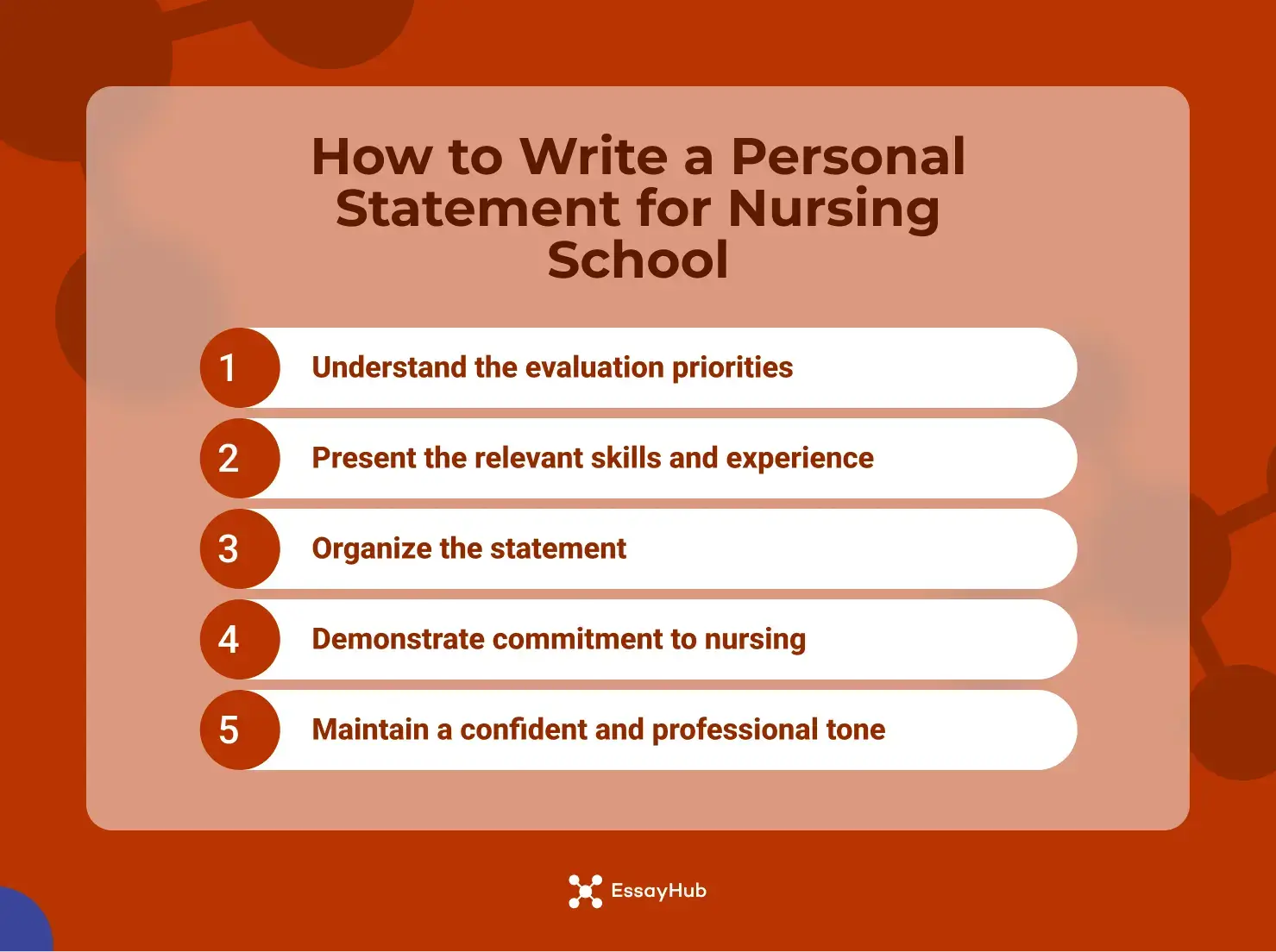
Writing a personal statement for nursing school requires more than arranging life events into a polite essay. You need to understand what the admissions committee looks for, choose the skills and experiences that actually support your application, structure the statement clearly, show serious commitment to nursing, and write with a confident tone that still sounds measured.
Understand the Evaluation Priorities
Before drafting the statement, read the program information with the admissions reader in mind. The committee already has access to your GPA, prerequisite record, test scores, and application form, so the essay has to explain what those documents leave unfinished. A strong statement should show readiness for academic pressure, patient contact, ethical responsibility, and clinical learning.
Look closely at the school’s mission, curriculum notes, clinical partnerships, and student expectations. Then choose the details in your background that connect with those priorities.
Example: “The program’s community health focus fits my goal of working with patients who need clearer preventive care education.”
Present Relevant Skills and Experience
The body of the statement should prove that your interest in nursing has substance behind it. Clinical rotations, CNA shifts, EMT work, caregiving, volunteer service, shadowing, and healthcare-related employment can all support the essay when you explain what each experience taught you. Academic preparation also belongs here if a course, lab, or degree helped you build discipline for nursing school.
Avoid flat claims such as “I am compassionate” or “I work well under pressure.” Those lines need evidence. A better paragraph shows what happened, what you did, and what skill the experience proves. Use this filter before keeping an example:
- Did this experience show patient contact?
- Did it involve responsibility with real consequences?
- Did it teach something specific about nursing work?
- Did it prepare me for this program’s demands?
Example: “My CNA shifts taught me to notice small changes in a patient’s behavior and report them before they became larger concerns.”
Organize the Statement
The structure should help the reader follow your case for admission. The introduction can establish the background or experience that made nursing a serious goal. The body paragraphs should develop the strongest evidence: preparation, motivation, relevant experience, and program fit. The conclusion should connect your goals with the school’s mission and the professional expectations of nursing.
Each paragraph needs one central job. A paragraph about CNA work should focus on patient care skills. A paragraph about the school should explain fit. A paragraph about career goals should show direction.
Example: “My experience in long-term care helped me understand why nursing requires clinical knowledge, steady communication, and respect for patient dignity.”
Demonstrate Commitment to the Nursing Profession
Commitment should appear through preparation, not through dramatic language. Admissions committees know that nursing school is demanding, and they need to see that your interest has survived contact with real work, real patients, or serious academic preparation. A strong statement can refer to clinical exposure, caregiving duties, healthcare employment, volunteer service, or a clear pattern of course choices.
The goal is to show that nursing is a considered decision. The essay should make it clear that you understand the profession involves documentation, teamwork, patient safety, emotional control, and continued learning.
Revision check: Find one sentence where you describe why nursing interests you. Add one sentence after it that proves how you tested that interest.
Example: “After working with patients in a long-term care setting, I understood that nursing requires patience and technical accuracy during the same shift.”
Maintain a Confident and Professional Tone
The tone should sound mature, direct, and self-aware. Many applicants weaken strong experiences because they overuse phrases such as “I believe,” “I feel,” or “I hope.” Those phrases can make preparation sound uncertain, even when the experience itself is solid. Use direct wording and let the evidence prove the confidence.
Medical essay writing assistance from a professional on our platform will help you with any of your assignments if you're low on time or energy to write.
Nursing School Personal Statement Examples
Proper personal statement examples for nursing school are specific enough to belong to one applicant, while still showing the structure other students can learn from. The eight samples below are for different levels of nursing and will show you how to write one of your own correctly.
Nursing School Personal Statement Example #1
For the past three years, I have worked as a certified nursing assistant in a long-term care facility, and that experience has changed the way I understand nursing. Before becoming a CNA, I thought nursing was mainly about medical knowledge and technical skill. Those things are important, of course, but my daily work has shown me that nursing also depends on attention, patience, communication, and the ability to notice changes that other people might miss.
My first months as a CNA were harder than I expected. I had completed my training and passed the required certification, but I quickly learned that classroom preparation and patient care are not the same experience. I had to become comfortable helping residents with bathing, dressing, feeding, transfers, and daily routines that many people would rather keep private. At first, I worried about doing everything correctly. Over time, I began to understand that respectful care was not only about completing tasks. It was also about how I entered a room, how I explained what I was doing, and how I responded when a resident felt embarrassed, tired, confused, or afraid.
One resident in particular helped me understand why I wanted to continue my education in nursing. She had dementia and often became anxious during morning care. Some days, she resisted getting dressed or refused breakfast, and I used to think I had failed when I could not move through the routine quickly. A nurse on our unit taught me to slow down, observe her mood, and change my approach before the situation escalated. I learned to speak in shorter sentences, offer choices, and watch for signs of discomfort. That shift changed her care, and it changed me too. I saw how clinical judgment begins with careful observation.
Working as a CNA has also shown me how much nurses carry during a shift. I have watched nurses assess symptoms, manage medications, speak with families, document changes, support aides, and respond to urgent situations with steady focus. I have reported changes in appetite, skin condition, confusion, mobility, and pain, and I have seen how those observations can affect the next step in a resident’s care. Those experiences made me want a deeper role in the clinical process. I want to understand the reasoning behind care decisions, not only support the routines around them.
My background has prepared me for the demands of nursing school because it has given me a realistic view of patient care. I know that nursing requires stamina and emotional control. I know that patients are not always easy to help, especially when they are in pain or unable to explain what they need. I also know that good care depends on teamwork. No nurse, aide, therapist, or family member can support a patient alone.
My short-term goal is to complete nursing school, become a registered nurse, and build strong clinical judgment in bedside care. In the long term, I hope to work with older adults and patients with chronic conditions, especially those who need patient education and consistent support after discharge. I am applying to this program because I am ready to move beyond assisting with care and toward the responsibility of planning, evaluating, and delivering it as a nurse.
Why This Example Works: This example is written for a CNA advancing their degree. It works because the applicant does not rely on general claims about compassion. The statement uses CNA experience as proof of readiness and shows direct contact with patients, teamwork, observation, and emotional maturity. It also explains why the applicant wants more responsibility, which makes the next academic step feel logical. The career goals feel connected to the applicant’s real background, so the essay sounds focused rather than invented for the application.
Nursing School Personal Statement Example #2
I spent seven years working in elementary education before I began preparing for nursing school. For most of that time, I thought I had already chosen my field. I understood lesson plans, parent meetings, classroom routines, and the strange mix of patience and quick judgment that teachers need every day. Then, during my fifth year of teaching, one of my students had a severe asthma attack during recess. I followed the school protocol, stayed with him until the nurse and emergency responders arrived, and called his mother after he was stable. The incident lasted only a few minutes, but it stayed with me far longer than I expected.
That day did not make me decide to become a nurse immediately. I kept teaching. Still, I became more aware of the work happening around student health, especially for children with chronic conditions. I started paying closer attention to care plans, medication forms, allergy protocols, and the way school nurses spoke with frightened parents. I had always cared about children’s learning, but I began to understand that learning depends on physical safety, emotional steadiness, and access to proper care. When a child cannot breathe comfortably, manage blood sugar, or explain pain clearly, academic progress becomes secondary. That realization changed the direction of my professional goals.
My education background has given me skills that I believe will transfer well into nursing. Teaching requires clear communication, close observation, and the ability to adjust quickly when a plan stops working. In the classroom, I learned how to explain difficult information in simple language, especially when a student felt frustrated or embarrassed. I also learned how to stay calm when several needs appeared at once. Those skills are not clinical skills yet, and I understand that nursing school will require a different level of scientific knowledge and technical discipline. Still, they have prepared me to work with people in moments when they need structure, patience, and careful attention.
To prepare for this transition, I completed prerequisite courses in anatomy, physiology, microbiology, and nutrition while continuing to work full time. Returning to science courses after years away was not easy. I had to rebuild study habits and accept that effort alone was not enough without a better system. I met with instructors, rewrote notes after class, and used lab time more intentionally. That process reminded me that professional change requires humility. I could not rely on past success in another field. I had to become a student again, in a very literal way.
I also began volunteering at a pediatric outpatient clinic, where I helped with check-in, patient flow, and basic family support. I was not providing clinical care, but I observed how nurses created trust in short conversations. One nurse could calm a nervous child before a vaccination by explaining each step in plain language. Another could recognize when a parent needed more time with discharge instructions. These moments felt familiar because they required communication, but they also showed me the clinical responsibility I still need to earn.
My goal is to become a registered nurse with a long-term interest in pediatric or community health nursing. I am drawn to this program because of its emphasis on clinical preparation and service-centered care. I am not entering nursing because I am leaving education behind. I am bringing the strongest parts of that background with me: communication, patience, and respect for how vulnerable people feel when they depend on someone else’s knowledge. Nursing school is the next step because I am ready to turn those strengths into safe, evidence-based patient care.
Why This Example Works: This example is written by a student who changed their career from elementary education to nursing. The applicant shows a gradual shift, explains transferable skills clearly, and acknowledges the need for new clinical training. That balance makes the statement sound mature and believable.
Nursing School Personal Statement Example #3
I did not grow up with one dramatic story that made nursing the only possible career for me. My interest developed more slowly, through science classes, volunteer work, and several experiences that made healthcare feel less distant. For a long time, I knew I wanted to work in a field connected to people’s health, but I did not fully understand what kind of role would fit me. Nursing became clearer when I began volunteering at a hospital during my junior year of high school and saw how often nurses were the people patients looked to first.
My volunteer role was limited, and I understood that. I delivered water, helped visitors find rooms, restocked basic supplies, and brought patients small items they requested. Still, those tasks gave me a closer view of patient care than I had before. I noticed how nurses moved between clinical duties and human reassurance, often within the same conversation. One patient might need medication education. Another might need help understanding why a test had been delayed. A family member might need someone to explain what would happen next. I began to see nursing as work that required knowledge, patience, and the ability to communicate clearly when people felt uncertain.
At school, my interest in nursing became stronger through biology and anatomy. I liked learning how body systems worked, although I also learned that interest alone does not create mastery. Anatomy required repetition, diagrams, lab review, and a level of discipline I had not needed in easier classes. That was useful for me. It showed me that healthcare careers demand steady preparation, not just good intentions. When I struggled with the muscular system unit, I changed how I studied. I made review sheets after each class, asked more precise questions, and practiced explaining concepts aloud. My grade improved, but more importantly, my habits improved.
During my senior year, I also helped care for my younger brother after he had surgery for a sports injury. My parents handled the medical decisions, but I helped with daily routines at home. I kept track of his ice schedule, helped him move safely, reminded him about exercises, and watched how frustration affected his mood. That experience was not the same as professional care, and I would not pretend it was. It did teach me something practical, though: recovery involves more than the instructions on a discharge paper. People need consistency, encouragement, and someone who notices when pain or discouragement begins to change their behavior.
I am applying to nursing school because I want the education and clinical training needed to become that kind of professional support for patients. I am especially interested in this program because it combines strong science preparation with early clinical exposure. I want a program that expects students to build knowledge carefully and then apply it responsibly, under supervision, in real care settings.
My short-term goal is to complete my BSN, pass the NCLEX, and begin practice as a registered nurse in a hospital setting. I am open to different clinical areas because I know my interests may become more specific through nursing school. At this point, I am drawn to pediatric or medical-surgical nursing because both require careful observation and patient education. In the long term, I hope to become a nurse who helps patients and families understand care plans in a way that feels clear, respectful, and usable.
I know I am still at the beginning of this path. That is exactly why nursing school matters to me. I have the academic interest, early exposure, and personal discipline to begin this training seriously. Now I need the clinical foundation to turn that preparation into safe patient care.
Why this example works: This is probably the most common type students ask for when they want to get help with nursing essay writing. It fits a traditional student because it does not exaggerate limited experience. The applicant uses school, volunteering, and family care honestly, then connects those details to readiness for nursing education. The tone feels young but serious, which makes the example believable.
Nursing School Personal Statement Example #4
I am applying to a traditional BSN program because I want my first degree to prepare me directly for the work I hope to do as a registered nurse. I did not come to this decision through one single event, and I think that is important to say plainly. My interest grew through coursework, volunteer experience, and time spent around people whose health needs required more patience and attention than I first understood.
In high school, I was drawn to biology because it made the body feel understandable in a way that was both exact and personal. Learning about disease processes, body systems, and recovery helped me see healthcare as a field where knowledge has immediate consequences. When I later took anatomy and physiology as part of my college prerequisites, I began to understand how much discipline nursing would require. Memorizing terms was only a small part of the work. I had to learn how different systems affected one another, why symptoms could point in several directions, and how easy it is to miss something when you are only looking at one piece of information.
My volunteer experience at a local rehabilitation center gave that academic interest a more practical meaning. My role was limited, and I was careful to respect that boundary. I helped with activity setup, escorted visitors, restocked supplies, and spent time with patients during slower parts of the day. Even in that limited role, I noticed how much nurses shaped the mood of the unit. They were the people patients asked for when pain changed, when a family member needed clarification, or when a routine task suddenly became stressful. I began to understand that nursing requires scientific preparation, yes, but it also requires steadiness in the middle of ordinary human discomfort.
One afternoon, I sat with a patient who had become frustrated during physical therapy. She was not angry at anyone in particular. She was tired, embarrassed, and scared that her progress had stalled. I could not give medical advice, so I listened and helped her call her daughter. Later, I watched the nurse speak with her in a way that was calm and direct. She acknowledged the frustration, explained the care plan, and gave the patient a clearer sense of what the next day would involve. That exchange stayed with me because it showed nursing as both clinical work and careful communication.
I have tried to prepare for nursing school with that same seriousness. My coursework in anatomy, microbiology, and psychology has strengthened my academic foundation, while volunteering has helped me understand the patient side of care more clearly. I know that a BSN program will be demanding. I also know that I need that full preparation before I can safely take on the responsibility of registered nursing.
I am especially interested in a BSN education because it offers clinical training, leadership development, and a broad view of patient care. I want to learn how nurses think through assessment, care planning, health education, and teamwork across different settings. My short-term goal is to complete the BSN program, pass the NCLEX, and begin practice in a hospital setting where I can continue building clinical judgment. My long-term goal is to work in community or medical-surgical nursing, with a focus on helping patients understand their care plans before they leave the clinical setting.
I am still early in my professional path, but I am not uncertain about the direction. Nursing school is the place where my academic preparation and patient care interest can become a real clinical foundation.
Why this example works: The statement for a taditional BSN applicant gives enough seriousness without pretending they already have advanced clinical experience. The strongest part is the connection between academic preparation and early patient exposure. The applicant shows that they understand BSN training as a foundation for clinical judgment, not just a required step before the NCLEX.
Nursing School Personal Statement Example #5
My first degree is in accounting, which surprises people when I tell them I am applying to an accelerated BSN program. For several years, accounting gave me a stable career and a clear professional path. I worked in a hospital finance department, far away from bedside care, and most of my day involved budgets, reimbursement reports, departmental spending, and long spreadsheets that showed how much healthcare costs before a patient ever sees the bill.
That work taught me more about healthcare than I expected, although not in the way I wanted. I learned how staffing affects a unit. I learned how delayed care becomes expensive care. I learned that a patient’s experience is often shaped by decisions made in offices they never enter. Still, after a while, I felt increasingly uncomfortable with my distance from the actual people behind the numbers. I could see patterns in the reports, but I wanted to understand what those patterns meant in a room, with a patient, during care.
The shift became clearer when I volunteered with a hospital patient support program on weekends. My role was basic. I helped patients complete forms, walked visitors to the correct unit, and sat with patients who were waiting for transport or discharge instructions. During one shift, I helped an older patient call her daughter because she was confused about the new medications listed in her discharge paperwork. I could not explain the medications, and I should not have tried. A nurse came in, reviewed each instruction, checked that the patient understood the timing, and asked her to repeat the plan in her own words. The difference was immediate. The patient’s anxiety did not disappear, but it became manageable because the information finally made sense.
That moment did not create a sudden revelation. It confirmed something that had been building for months. I did not want to spend my career only studying the systems around care. I wanted to earn the clinical knowledge required to participate in care directly and responsibly.
Preparing for this change has required more than enthusiasm. I completed anatomy, physiology, microbiology, and developmental psychology while continuing full-time work. I had to become efficient with my time in a way I had not needed during my first degree. Some evenings were plain frustrating, especially when a lab concept did not make sense after a full day of work. I learned to ask for help earlier, use office hours, and build study blocks around understanding rather than memorizing. That adjustment matters to me because an accelerated BSN program will not slow down for poor planning.
My accounting background may seem separate from nursing, but I do not see it that way. It trained me to be precise, organized, and careful with details that affect other people. In nursing, those habits must serve a different purpose. Accuracy becomes medication safety. Organization becomes timely care. Communication becomes a way to protect patients who may be too overwhelmed to ask the right question.
I am applying to this accelerated BSN program because I am ready for an intense path into registered nursing. My short-term goal is to complete the program, pass the NCLEX, and begin in an acute care setting where I can develop strong clinical judgment. In the long term, I hope to work in care coordination or patient education, especially with patients who struggle to understand treatment plans after leaving the hospital.
I am not choosing nursing because my first career failed. It gave me discipline and a clearer view of healthcare’s pressures. Now I want the training to meet patients more directly, with the knowledge, accountability, and skill that nursing requires.
Why this example works: This version gives the career change a less predictable route through the writing of an accelerated BSN applicant. Accounting becomes relevant through precision, healthcare systems, and patient cost awareness. The applicant sounds adult and grounded, and the statement avoids pretending that a previous career automatically equals clinical readiness.
Nursing School Personal Statement Example #6
I became a registered nurse through an associate degree program, and for the past four years I have worked on a medical-surgical unit. That route gave me exactly what I needed at the time: a direct path into nursing practice, strong clinical basics, and early experience with patients whose needs could change quickly. I am proud of that beginning. I also know that my work has reached a point where I need a broader education than the one that first prepared me for licensure.
My first year as an RN was mostly about survival in the honest sense of the word. I learned how to organize a shift, give report, manage medications, document accurately, call providers, speak with families, and recognize when a patient’s condition was moving in the wrong direction. Some of that learning happened through formal orientation. A lot of it happened because experienced nurses corrected me, questioned my reasoning, and showed me what I had missed. That was humbling, and it was necessary.
Over time, my focus changed. I no longer wanted only to complete the tasks in front of me. I wanted to understand the larger reasons behind unit policies, discharge failures, patient readmissions, and the uneven results I saw among patients with similar diagnoses. Two patients could receive almost the same instructions, yet only one had the family support, transportation, medication access, and health literacy needed to follow the plan at home. Bedside care showed me the problem clearly. It also showed me that I needed stronger preparation in leadership, research, community health, and evidence-based practice.
One situation has stayed with me. I cared for a patient with heart failure who had been admitted for the third time in two months. He was not careless. He was confused, overwhelmed, and afraid to say that he did not understand his medication schedule. During discharge teaching, I slowed the conversation down and asked him to explain the plan back to me. He mixed up two medications almost immediately. That changed the entire discharge conversation. We involved case management, clarified his pharmacy access, and arranged follow-up education. The experience made me think differently about nursing responsibility. Safe care cannot stop at the hospital door.
That is one reason I am applying to an RN-to-BSN program. I want to strengthen the parts of my practice that daily bedside work has made impossible to ignore. I am especially interested in courses that focus on public health, nursing leadership, research appraisal, and care coordination. I do not want a BSN only as a credential. I want the education to help me ask better questions about patient outcomes and participate more fully in improving care on my unit.
My current practice has given me a strong base. I am comfortable with clinical routines, patient communication, interdisciplinary teamwork, and the pressure of a busy floor. Still, experience alone can become narrow if I do not keep developing. A BSN program will help me connect what I see every day with wider nursing knowledge, especially in areas that affect quality, safety, and long-term patient outcomes.
My short-term goal is to complete the BSN while continuing to work as an RN, then use that training to take on more responsibility in patient education and unit-based quality improvement. In the long term, I may pursue graduate study in nursing leadership or care coordination. For now, I want to become a stronger bedside nurse with a wider view of the system my patients have to move through.
I entered nursing through direct practice. I am ready for the next stage because that practice has shown me exactly where I need to grow.
Why this example works: The RN-to-BSN applicant already has nursing experience, so the statement does not waste space proving basic interest in the field. It explains why a BSN is needed now: stronger leadership, research, public health, and patient outcome knowledge. The readmission example gives the essay a concrete reason for advancement.
Nursing School Personal Statement Example #7
I have worked as a licensed practical nurse in an outpatient primary care clinic for five years. Most of my work happens before the provider enters the room and after the appointment is technically over, which has taught me that patient care has many points where details can either hold together or fall apart. I take vital signs, review medication lists, prepare patients for exams, give injections, answer follow-up questions within my scope, and help patients understand the next steps in their care. It is steady work, and often it is busier than people imagine.
Being an LPN has given me close contact with patients, but it has also shown me the limits of my current role. I know how to carry out many parts of the care process safely, and I value that responsibility. At the same time, I want the broader clinical knowledge and decision-making authority that come with registered nursing. I want to understand assessment, care planning, patient education, and coordination at a deeper level, especially for patients with chronic conditions who need more than one good appointment.
A large part of my work involves patients with diabetes, hypertension, asthma, and other long-term health concerns. Some arrive with careful notes and clear questions. Others come in unsure of which medications they take, which symptoms matter, or why a follow-up visit was scheduled at all. I have learned that confusion can look like noncompliance if no one slows down long enough to ask the right questions. That lesson has influenced how I speak with patients. I try to use plain language, check what they already understand, and avoid making them feel judged when they admit they are lost.
One patient helped me see why I needed to continue toward RN practice. He came in for a blood pressure check after several high readings. During intake, he mentioned that he had stopped taking one medication because it made him dizzy at work. He had not called the office because he thought the problem would pass. I documented his concern, notified the RN and provider, and stayed with the patient while we clarified his symptoms and medication schedule. The RN’s assessment led to a change in the care plan and more detailed teaching. My role mattered, but I could feel the gap between recognizing a concern and being prepared to evaluate it more fully.
That gap is the reason I am applying to an LPN-to-RN program. I am not entering nursing as an outsider. I already understand patient routines, clinic flow, documentation demands, and the trust patients place in the person taking care of them. What I need now is the education that will expand my clinical reasoning and prepare me for the responsibilities of registered nursing.
I am drawn to this program because it respects prior nursing experience while still demanding growth. I want training that builds on what I already know without allowing me to stay too comfortable. My short-term goal is to become an RN and work in a setting where I can strengthen assessment skills, patient teaching, and care coordination. In the long term, I hope to work with adults managing chronic illness, possibly in primary care or community health, where education and follow-up can change how patients live day after day.
My LPN experience has made me careful, practical, and aware of how much patients need nurses who can explain, notice, and act. Becoming an RN is the next step because I am ready to carry more responsibility and develop the clinical judgment that responsibility requires.
Why this example works: This LPN-to-RN applicant’s statement does not treat LPN experience as a stepping stone with no value. It shows what the applicant already does well, then explains the limits that make RN training necessary. The blood pressure example gives the advancement goal a specific clinical reason.
Nursing School Personal Statement Example #8
My undergraduate degree is in sociology, and much of my academic work focused on poverty, family systems, immigration, and access to public services. At first, I imagined that I would work in social policy or nonprofit administration. That path made sense on paper. I cared about systems, and I wanted work that dealt with real consequences in people’s lives. During my final year of college, though, my internship at a community health center made me realize that I wanted to work closer to the point where those consequences were felt.
At the health center, I helped with patient intake support, appointment reminders, translation coordination, and resource referrals. I worked under supervision, so my role was non-clinical, but I saw how closely social problems and health problems sit beside each other. A patient with uncontrolled diabetes might also be worried about rent. A pregnant patient might need transportation before she could even think about prenatal education. A parent might miss a child’s follow-up visit because the work schedule changed without notice. Those situations were not abstract anymore. They were sitting at the front desk, calling after missed appointments, and trying to understand instructions written in language that felt too formal for the moment.
The nurses at that clinic became the people I watched most closely. They did not solve every problem, and they never pretended they could. What they did was more precise than that. They assessed symptoms, explained medications, recognized when a patient needed urgent attention, and adjusted their communication based on the person in front of them. One nurse spent nearly twenty minutes with a newly diagnosed patient who was afraid to start insulin. She did not rush into reassurance. She asked what the patient had heard about insulin, what scared her, and what would make the first week feel manageable. That conversation changed how I understood patient education. It was clinical work, and it was also careful listening with a clear purpose.
After that internship, I began looking seriously at nursing, especially direct-entry MSN programs. I knew I was not prepared to become a nurse simply because I cared about health equity. I needed rigorous clinical education, supervised practice, and a much stronger scientific foundation. I completed prerequisite courses in anatomy, physiology, microbiology, chemistry, and statistics after graduation while continuing part-time work at the clinic. The science courses were demanding in a different way than my sociology classes had been. They required precision, repetition, and comfort with material that did not respond to broad interpretation. I had to change how I studied, and that process made me more confident about entering an intensive graduate pathway.
I am applying to a direct-entry MSN program because I want nursing to become the center of my professional training, not an added interest beside my previous degree. My background in sociology has prepared me to think about patients within families, communities, and unequal systems. Nursing will give me the clinical knowledge to respond safely when those larger pressures show up in a person’s health.
I am especially drawn to graduate-level nursing education because I want a program that expects both clinical seriousness and leadership development. My short-term goal is to become licensed as an RN and build strong bedside experience, likely in community health, women’s health, or medical-surgical nursing. I do not want to rush past direct patient care. I see it as the foundation I need before any advanced role can mean much.
In the long term, I hope to work in community-based nursing or pursue advanced practice with underserved patients. I want to help patients understand care plans, access preventive services, and feel less lost inside healthcare systems that often assume people have more time, language access, and support than they actually do.
A direct-entry MSN program is the right path because it matches the seriousness of the transition I am making. I am bringing a background in social analysis, patient-facing community work, and academic preparation, but I am also entering with respect for what I still need to learn. That is the point of this program for me: to turn concern for health access into nursing practice that is clinically safe, informed, and useful.
Why this example works: This example fits a direct-entry MSN applicant because it makes the non-nursing degree relevant without overstating it. The applicant shows why graduate nursing makes sense, acknowledges the need for clinical training, and connects long-term goals to underserved patient care.
If you're already about to finish your education in this part of the medical field, some engaging nursing capstone project ideas will help you get started with your final work.
Mistakes to Avoid in a Nursing School Personal Statement
Writing your personal statement for nursing school requires judgment, because even a meaningful story can lose strength when it is handled poorly. According to the professionals from our writing services, the most common mistakes usually come from vague language, weak focus, or too much personal detail without enough application value.
- Using worn-out phrases instead of specific proof: Lines about “always wanting to help people” sound familiar because admissions readers see them constantly. Replace broad claims with real examples that show how you think, act, and respond around patients.
- Letting the essay run past the point: A long statement can make a strong applicant seem unfocused. Stay within the required word count and cut any sentence that repeats an idea already made clearly.
- Centering hardship without connecting it to nursing: Personal struggles can belong in the essay, but they need purpose. Explain what the experience taught you about care, responsibility, resilience, or the kind of nurse you hope to become.
Final Words
A strong nursing personal statement explains who you are, why nursing fits your path, and what makes you ready for the program. The best essays use specific experience, clear structure, and honest reflection. Keep the focus on preparation, motivation, program fit, and future goals, so the admissions committee sees a serious applicant with real direction.
FAQs
What Mistakes Should I Avoid in a Nursing School Personal Statement?
What Is an Example of a Personal Statement for Nursing School?
How Long Should a Personal Statement Be for Nursing School?
What Is a Personal Statement for Nursing School?

Ryan Acton is an essay-writing expert with a Ph.D. in Sociology, specializing in sociological research and historical analysis. By partnering with EssayHub, he provides comprehensive support to students, helping them craft well-informed essays across a variety of topics.
- Lancashire, U. of. (2025, June 19). How to write a nursing personal statement. University of Lancashire. https://www.lancashire.ac.uk/articles/advice/how-to-write-a-nursing-personal-statement
- Compelling Personal Statement for a Nursing Program: 5 Tips. (2020). https://www.alliant.edu/. https://www.alliant.edu/blog/personal-statement-for-nursing-program