.webp)
Key Takeaways
- A theme statement is a sentence that reveals the message about life that the work communicates.
- Topic is a noun while a theme is a CLAIM about the topic.
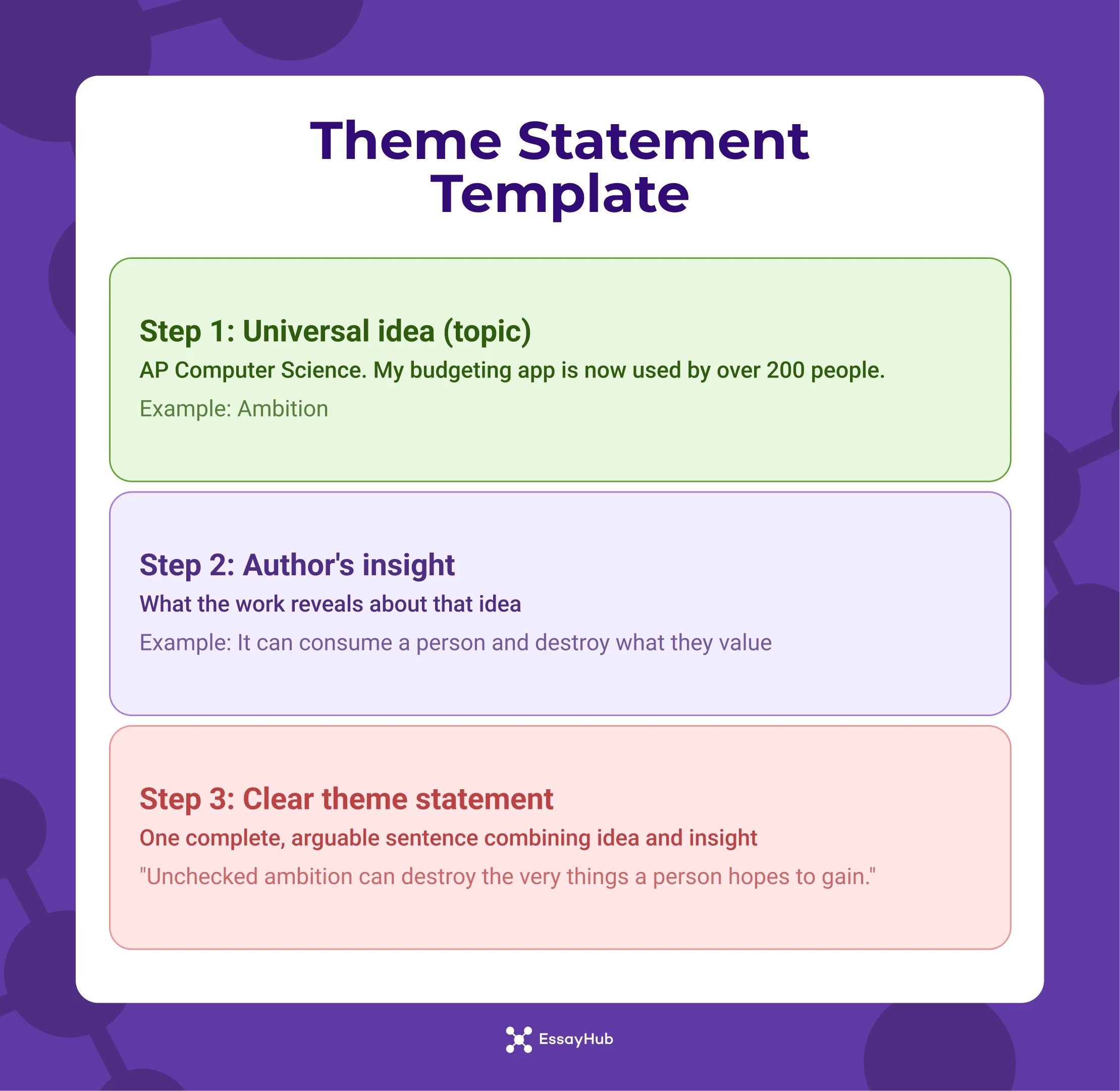
- Formula: universal idea + your insight about that idea = a clear theme statement.
Writing an effective theme statement is one of the toughest skills in literary analysis, and students struggle with it daily. It’s easy to mistake a theme for a topic, write something too broad, or fall back into summarizing the plot rather than analyzing the theme. The result can feel empty or 'Well, duh!' instead of actually insightful.
This guide explains how to write strong statements by providing theme statement examples, and clarifies the difference between themes and topics.
What Is a Thematic Statement?
A thematic statement is a sentence that expresses the central message or insight a literary work reveals about life, humanity, or society. It explains the story in greater depth.
Many students confuse theme and topic. A topic is a word like love, power, or freedom. A theme statement expands on the topic into a full, arguable sentence about something universal. For example: "Unbridled ambition will destroy everything a person cares about."
How Theme Differs from Topic
Confusing theme and topic is a common mistake in student writing. Understanding their differences is key to crafting effective theme statements.
The topic is the subject, expressed as a noun or noun phrase, and often found in the book description. The theme makes a statement about that topic, always as a complete sentence.
Look at these topic and theme statement examples.
- Topic: Ambition → Theme: Ambition can cause people to destroy everything they love.
- Topic: Friendship → Theme: Friends will often go through great struggles together.
- Topic: Freedom → Theme: Freedom is never free.
The topic names the subject; the theme makes a statement about it. Turning a one-word topic into a sentence claim creates a thematic statement.
If you're short on time, a last minute essay writing service can help you complete your literary analysis before the deadline.


Theme Statement Template
Here's a quick formula that will make constructing theme statements much easier. Take a universal concept (your topic), + what the author says about it (what the work shows), = one concise, arguable sentence. That sentence is your theme statement. See the theme statement template below for how it all fits together.
While theme statements analyze literature, you can also use our personal statement writing service that focuses on presenting your own experiences and goals.
Theme Statement Examples
The easiest way to learn how to create a thematic statement is to read good ones. Here are some thematic statement examples divided into categories: easy ones for students to understand, themes from familiar literature, and themes organized by common topics (love, power,identity, etc.). Take notice of how they don't simply state a topic, but make a debatable assertion about life.
Theme Statement Examples for Students
- Hard work often matters more than natural talent in achieving success.
- Fear can hold us back far more than any external obstacle.
- True friendship is tested most during times of difficulty.
- Honesty, though difficult, builds trust that lies never can.
- Growth usually requires stepping outside of our comfort zone.
- Failure can teach lessons that success never could.
- Kindness has the power to change lives in unexpected ways.
- Standing up for what is right often comes at a personal cost.
- Understanding others begins with listening rather than judging.
- The choices we make shape who we ultimately become.
Universal Theme Statement Examples
- Love has the power to both heal and destroy.
- The pursuit of power often corrupts those who seek it.
- Sacrifice is frequently the price of true freedom.
- Suffering can lead to profound personal growth.
- Greed blinds people to what truly matters.
- Hope can survive even in the darkest circumstances.
- Prejudice harms both the victim and the one who holds it.
- Time changes everything, whether we are ready or not.
- The desire to belong can drive both connection and conflict.
- Truth, however painful, is ultimately freeing.
Theme Statement Examples in Literature
- In "Macbeth," unchecked ambition leads to self-destruction.
- In "To Kill a Mockingbird," true courage means standing for justice despite the cost.
- In "The Great Gatsby," the American Dream can become a hollow illusion.
- In "1984," unchecked power erodes truth and individual freedom.
- In "Romeo and Juliet," passionate love can lead to tragic consequences.
- In "Of Mice and Men," dreams give life meaning even when they remain out of reach.
- In "Lord of the Flies," the absence of order reveals humanity's darker nature.
- In "Frankenstein," the pursuit of knowledge without responsibility brings ruin.
- In "Animal Farm," power corrupts, and absolute power corrupts absolutely.
- In "Pride and Prejudice," first impressions can blind us to a person's true character.
Using a thesis statement formula can help you develop a clear argument before identifying a work's central theme.
Thematic Statement Examples for Love and Relationships
- Love often requires sacrifice to endure.
- True love accepts a person's flaws rather than ignoring them.
- Jealousy can quietly poison even the strongest relationships.
- A genuine connection depends on honesty and trust.
- Love lost can teach as much as love gained.
- The fear of vulnerability often keeps people from real intimacy.
- Family bonds can withstand hardships that break other ties.
- Unconditional love asks for nothing in return.
- Love blinded by idealism often ends in disappointment.
- The deepest relationships are built through shared struggle.
Thematic Statement Examples for Power and Corruption
- The pursuit of power often corrupts a person's morals.
- Absolute power destroys those who wield it without restraint.
- Fear is a common tool used to maintain unjust power.
- Corruption spreads when good people choose silence.
- Power built on deception cannot last forever.
- The hunger for control can blind leaders to the harm they cause.
- Those who abuse power often become prisoners of it.
- True strength lies in restraint, not domination.
- Power without accountability leads inevitably to injustice.
- The corrupt often justify their actions in the name of the greater good.
Thematic Statement Examples for Identity
- Our true identity is often discovered through hardship.
- The desire to fit in can cause us to lose ourselves.
- Identity is shaped by both our choices and our circumstances.
- Embracing who we are requires courage in the face of judgment.
- The search for identity is a lifelong journey, not a destination.
- Denying our true selves often leads to inner conflict.
- We define ourselves as much by our values as by our actions.
- Cultural roots play a powerful role in shaping identity.
- Self-acceptance is the foundation of genuine confidence.
- The masks we wear can slowly become who we are.
Theme Statement Examples on Personal Growth and Courage
- True courage means acting despite fear, not without it.
- Personal growth often begins at the edge of our comfort zone.
- Overcoming adversity reveals the strength we never knew we had.
- Growth requires letting go of who we used to be.
- Facing our fears is the first step toward freedom.
- Failure is often the greatest teacher of resilience.
- Courage is found not in the absence of doubt but in moving through it.
- Change, though painful, is essential to becoming our best selves.
- The hardest battles often lead to the greatest transformations.
- Real bravery lies in staying true to yourself under pressure.
You might also be interested in a personal statement for nursing.
Loyalty Theme Statement Examples
- True loyalty is tested most in times of hardship.
- Blind loyalty can lead a person to betray their own values.
- Loyalty and love are often deeply intertwined.
- Standing by someone through difficulty is the truest form of loyalty.
- Misplaced loyalty can cause as much harm as betrayal.
- Loyalty earned through trust is stronger than loyalty demanded.
- True friends remain loyal even when it costs them.
- Loyalty to oneself is as important as loyalty to others.
- Betrayal cuts deepest when it comes from those we trusted most.
- Loyalty without honesty is a fragile foundation.
Theme Statement Examples for Freedom
- Freedom often comes at a great cost.
- True freedom begins in the mind before it exists in the world.
- The desire for freedom is a fundamental part of human nature.
- Freedom without responsibility can lead to chaos.
- Those who have never lost freedom rarely understand its value.
- Real freedom means the courage to make your own choices.
- Oppression often strengthens the human desire for freedom.
- The freedom of one person should never come at the expense of another.
- The fight for freedom shapes both individuals and nations.
- Sometimes the greatest prison is one we build for ourselves.
Theme Statement Examples for Hope
- Hope can sustain the human spirit through the darkest times.
- Even a small hope can inspire great change.
- Hope gives meaning to struggle and reason to persevere.
- Losing hope is often more dangerous than facing hardship.
- Hope connects people and helps them endure together.
- True hope is grounded in action, not just wishful thinking.
- Hope can survive even when everything else is lost.
- The absence of hope reveals the fragility of the human spirit.
- Hope allows us to imagine a better future and pursue it.
- Holding onto hope is itself an act of courage.
Reviewing argumentative thesis examples can help you distinguish between an argumentative claim and a literary theme statement.
6 Tips for Writing a Theme Statement
A good theme statement requires finesse. Here’s how to ensure it reads as a genuine observation about life, not a fortune-cookie saying or a plot summary.
- Omit character and plot names. If it’s a universal truth, it should resonate with anyone, regardless of whether they’ve read the book. Say “love leads to jealousy” instead of “Rosencrantz and Guildenstern’s love for Ophelia leads to jealousy.”
- Avoid absolutes. Few things in life are black or white. Use words like can, often, and may.
- Make sure your statement can be argued. If no one can disagree, it’s too obvious. Aim for something debatable.
- Avoid clichés and phrases that sound like moral rules. No “love conquers all” or “Don’t be prejudiced.” Push yourself to go deeper than what everyone knows.
- Keep it to one sentence. Theme statements aren’t paragraphs. If you write more, you’re likely including too much.
- Ensure your theme applies to the entire work. If it only fits part of the book, it’s probably not the true theme.
Follow these guidelines when writing a thematic statement, and your results will be insightful and focused, not vague or tired.
Final Words
To put it shortly, good theme statements are about one thing and one thing only: boiling a topic down into an insight. If you can trade that noun “ambition” above for an arguable statement about the human condition, you’ve got it. Start with the examples above, keep practicing, and you’ll find your analyses improving with each essay you write.
FAQs
What Is a Thematic Statement?
What Is an Example of a Theme Statement in AP Lit?
What Is a Good Example of a Theme?

Mark Bradford, a passionate and talented artist, utilizes his innovative spirit to support academic pursuits. In partnering with EssayHub, he leverages his artistic insights to assist students as a professional essay writer, helping them navigate and complete their academic assignments at every level of difficulty.
- Kinglove. (2019, March 27). Theme vs. Thesis Statement vs. Topic Statement | Servants University | Training Servants for Christ. Servants University | Training Servants for Christ |. https://www.servantsuniversity.com/theme-vs-thesis-statement/
- WHAT IS A THEME STATEMENT? (n.d.). Retrieved July 1, 2026, from https://shslboyd.pbworks.com/f/What+is+a+THEME+STATEMENT.pdf