Key Takeaways
- A position paper states a clear opinion and supports it with facts, examples, and a response to opposing views.
- It follows a clear structure: introduction, background, main points, counterargument, solutions, and conclusion.
- The process depends on a clear thesis, focused research, and well-structured paragraphs.
- Each section must stay on topic and support the main argument without going off track.
A position paper is a structured piece of writing that argues a clear stance on a disputed issue using logic and evidence. To write a position paper, you narrow the issue, gather targeted research, define a precise claim, test it against opposing views, and reinforce it with proof.
This guide walks through each step of the writing process with concrete advice, shows what a solid position essay should look like, and includes examples you can download and adapt to your own topic.
What Is a Position Paper?
A position paper is a formal document used in academic settings and legal contexts to persuade an audience that your argument holds the strongest ground in a debate. The purpose of a position paper is to state a position, justify it with credible evidence, and address competing views with control. A position paper format consists of three elements:
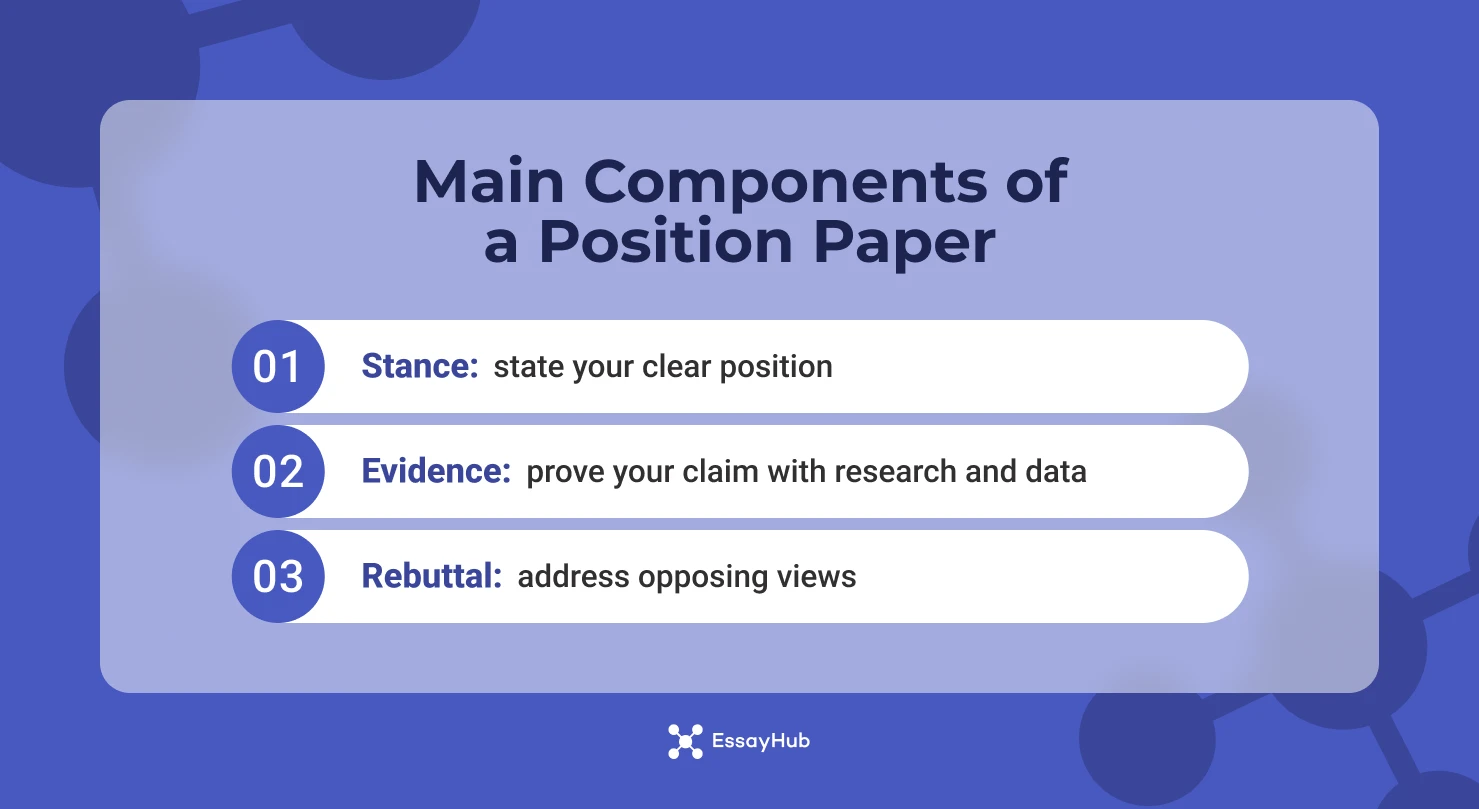
- Stance: sets your position in one clear statement
- Evidence: builds that claim using research, data, and examples tied directly to your argument.
- Rebuttal: handles opposing views by exposing gaps and reinforcing your own logic.


How to Write a Position Paper in 5 Steps
Writing a position paper follows a clear sequence. Each step helps tighten the argument and catch weak points early. You can use the section below as a practical process you can follow while drafting.
Step 1: Choose a Narrow, Debatable Issue
Start a position paper with a question that demands a clear stand. Skip broad themes and pin the issue to a specific context. Instead of picking ideas that sound like informative essay topics for middle school, narrow them down so they’re specific enough. For example, turn ‘climate policy’ into “Should Germany expand offshore wind subsidies by 2030?” Write your topic as a question first, then rewrite it as a statement you can defend. Check recent sources to confirm the issue still matters and has an active debate. This step prevents you from building an argument around outdated or settled points.
Step 2: Gather Relevant Research
Research should answer one question: what proof strengthens your position? Start with academic databases, government reports, and policy briefs. Save your sources as you go and label them by argument point. Note key statistics, expert claims, and case examples in short summaries. Track opposing views in a separate section. That habit helps you prepare counterarguments without scrambling later. Writing a position paper becomes easier when your research is organized by purpose, not by source.
Pro tip:
Build a quick claim-evidence matrix before drafting: list each main point in one column and match it with specific sources in the next.
Step 3: Build a Defensible Thesis
Your thesis directs the entire paper, so base it on your research. Draft it early, then refine it after reviewing your sources. Keep it precise and specific.
A simple structure will help: [Issue] - [your stance] - supported by [reason 1] and [reason 2]. Now check each reason against your notes.
You should already have evidence that backs it. If something feels unsupported, revise the claim or strengthen your sources. A strong position paper rests on a thesis that can carry weight under close reading.
Step 4: Challenge Your Own Position
Before you start writing a strong position paper, challenge your argument on purpose. List the strongest objections someone might raise, then find evidence that supports those opposing views and write short responses to each one. This step sharpens your reasoning and prevents weak sections in your paper. It also improves your ability to stay consistent when addressing criticism. Creating a position paper without this step often leads to gaps that readers notice quickly.
Step 5: Back Up Claims with Supporting Evidence
Now build your draft using structured support. Each paragraph should open with a clear claim, followed by evidence and a short explanation of why it matters. Use statistics, research findings, and concrete examples that connect directly to your point. Cite sources as you write to avoid missing references later, and learn how to cite a book in APA or MLA so you can keep everything clean. Keep your argument focused and avoid adding ideas that do not serve your thesis. Strong support turns your paper into a convincing, credible argument rather than a collection of opinions.
Position Paper Outline
A position paper outline includes the introduction with a clear thesis, a background section with key context, main argument points with supporting evidence, a counterargument with rebuttal, proposed solutions, and a concise conclusion.
Introduction
- Brief context that defines the issue
- Clear thesis statement with your position
- One sentence that signals your main points
Background
- Key facts and context needed to understand the issue
- Short overview of past decisions, policies, or history
- Relevant definitions if the topic includes technical terms
Position and Argument
- Clear statement of your position
- Main argument points, each focused on one idea
- Supporting evidence under each point (data, research, examples)
Counterargument and Rebuttal
- Strong opposing view presented fairly
- A response that addresses weaknesses in that view
- Evidence that reinforces your original position
Proposed Solutions
- Practical solutions tied directly to your argument
- Explanation of how each solution works in practice
- Brief note on feasibility or impact
Conclusion
- Restate your position clearly
- Summarize key arguments in a tight form
- Final statement that reinforces the importance of your stance
Effective ending words for essays will help you conclude your paper correctly.
Check out the PDF of a position paper outline example on a specific topic:
Practical Tips on Writing a Strong Position Paper
A solid academic position paper depends on how arguments are structured, how paragraphs are built, and how each point is supported. The practical tips listed below will help you during the writing and researching processes:
- Write your thesis, then test it by summarizing it in one sentence out loud. If it sounds vague or overloaded, tighten the wording before drafting anything else.
- Draft body paragraphs before the introduction. This helps you see what your argument actually proves, so the opening stays precise and grounded.
- Use a quick structure rule for paragraphs: first sentence makes the claim, next adds proof, last explains why it matters. No extra sentences.
- Mark weak spots during drafting with comments like “need data” or “unclear link.” Fix them after the draft instead of interrupting your flow.
- Read the paper once only for logic. Ignore grammar and check if each paragraph clearly pushes the argument forward.
Position Paper Example
A good position paper example shows a clear stance from the start, builds each point with relevant evidence, addresses opposing views directly, and maintains logical flow. Each section connects tightly, so the argument develops step by step without gaps or unnecessary repetition. Take a look at the example of position paper below:
Should Cities Introduce Congestion Pricing for Private Cars in Central Areas?
Introduction
Traffic in city centers has reached a point where delay feels built into daily life. Public transport struggles to keep pace while private cars continue to dominate limited road space. This position paper argues that cities should introduce congestion pricing in central areas because it reduces traffic volume, improves mobility, and creates a reliable funding source for transport systems without banning car use outright.
Background
Congestion pricing charges drivers a fee for entering high-traffic zones during peak hours. Cities like London and Stockholm already use this system with measurable results. Traffic levels dropped, travel times became more predictable, and public transport usage increased. These systems rely on cameras and automated billing, which makes enforcement consistent. The idea has gained attention in other cities facing similar pressure on infrastructure and air quality.
Position and Argument
Road space is limited, yet demand keeps rising. Pricing access changes behavior in a way that static rules cannot.
First, congestion pricing directly reduces unnecessary trips. When driving into the center has a cost, people rethink short or non-essential journeys. Some switch to public transport, others adjust travel time. This leads to fewer vehicles on the road during peak periods and smoother traffic flow.
Second, it improves reliability across the system. Buses move faster, delivery vehicles face fewer delays, and emergency services benefit from clearer routes. Travel time becomes more predictable, which matters more than raw speed in dense urban areas.
Third, it creates a steady funding stream. Revenue from congestion charges can support public transport improvements, cycling infrastructure, and road maintenance. That reinvestment strengthens alternatives, which further reduces pressure on roads.
Counterargument and Rebuttal
Critics argue that congestion pricing places a financial burden on drivers and limits access for lower-income groups. The concern is valid at face value, but it assumes no adjustment in policy design.
Cities can address this by structuring exemptions, discounts, and reinvestment strategies. Reduced rates for residents, exemptions for essential services, and improved public transport funded by the charges help balance the impact. When alternatives become reliable and accessible, the system shifts from restriction to choice management.
Proposed Solutions
- Cities should define a clear congestion zone with boundaries based on traffic density.
- Set variable pricing that changes by time of day to target peak congestion.
- Introduce resident discounts and exemptions for essential vehicles.
- Invest collected revenue into public transport upgrades and last-mile solutions.
- Run a pilot phase with transparent reporting to measure impact before full rollout.
Conclusion
Congestion pricing offers a controlled way to manage demand in crowded city centers. It reduces traffic without bans, improves system reliability, and funds better alternatives. Cities that act early gain long-term mobility stability while avoiding deeper infrastructure strain later.
Here's the same essay in downloadable format:

If you still need help in drafting your position paper, you can always contact a professional from our essay writing service.
What to Avoid in Making a Position Paper?
Mistakes in a position paper usually come from weak control over structure and argument flow. They build up quietly and start affecting clarity and credibility.
- Letting the argument drift across paragraphs, so each section feels loosely connected instead of building toward one clear position
- Expanding background sections too much, which delays the actual argument and weakens the paper’s focus
- Introducing new claims late in the paper that were never set up earlier, which breaks the logic chain
- Treating counterarguments as a checkbox instead of engaging with their strongest version and responding directly
- Overexplaining obvious points while skipping deeper analysis where it actually matters
- Writing paragraphs that mix multiple ideas without a clear main point, which makes the argument harder to follow
Pro tip:
Standardize your citations as you write using one style guide. Switching formats at the end leads to inconsistencies and wasted time.
You can always pay for research paper if you don’t have enough time to write your own project.
Wrapping Up
A position paper builds a clear stance on a focused issue and supports it with structured reasoning and evidence. The process starts with a precise topic, continues with targeted research, and develops through a strong thesis, tested arguments, and clear support. Each section has a role, and a tight structure keeps the argument consistent, readable, and convincing.
FAQs
How to Write a Good Position Paper?
How to Start a Position Paper?
What Is the Format for a Position Paper?
What Does a Position Paper Look Like?
How Long Should a Position Paper Be?

Ryan Acton is an essay-writing expert with a Ph.D. in Sociology, specializing in sociological research and historical analysis. By partnering with EssayHub, he provides comprehensive support to students, helping them craft well-informed essays across a variety of topics.
- LibGuides: Academic Writing: Position Paper. (2026). https://bowiestate.libguides.com/academic_writing/position_paper
- admin. (2007, September 26). Guidelines for Position Papers & Issue Briefs. Young Adult Library Services Association (YALSA). https://www.ala.org/yalsa/aboutyalsa/yalsahandbook/whitepapers
- How to Write a Position Paper. (n.d.). Retrieved April 2, 2026, from https://www.spcc.edu.hk/internationalconferences/spccmun2015/10._How_to_Write_a_Position_Paper.pdf