.webp)
A quality discussion post example consists of a strong premise backed by original ideas, along with adequate materials to encourage meaningful exchanges between participants. The best discussion posts I've read (and, trust me, I've seen and written a lot of them) demonstrate a high level of knowledge, of course, but they should also show respect and consideration for those you are communicating with.
Typically, a discussion board serves as a replacement for a live classroom discussion session, where you would normally provide responses, pose questions, express disagreements, and allow opinion changes to happen in real time. This article looks closely at several discussion board examples, outlines the posts' structural components, and provides guidelines for how you can develop a post that will move any conversation forward.
What a Successful Discussion Post Looks Like
The first time I had to create a discussion post, I treated it like a rushed mini essay. After no one replied, I realized that was the wrong approach. How can a discussion post be considered good if no one engages in the discussion? The determining factor of a successful discussion post, I think, is that it invites a response. Here's what it should include:
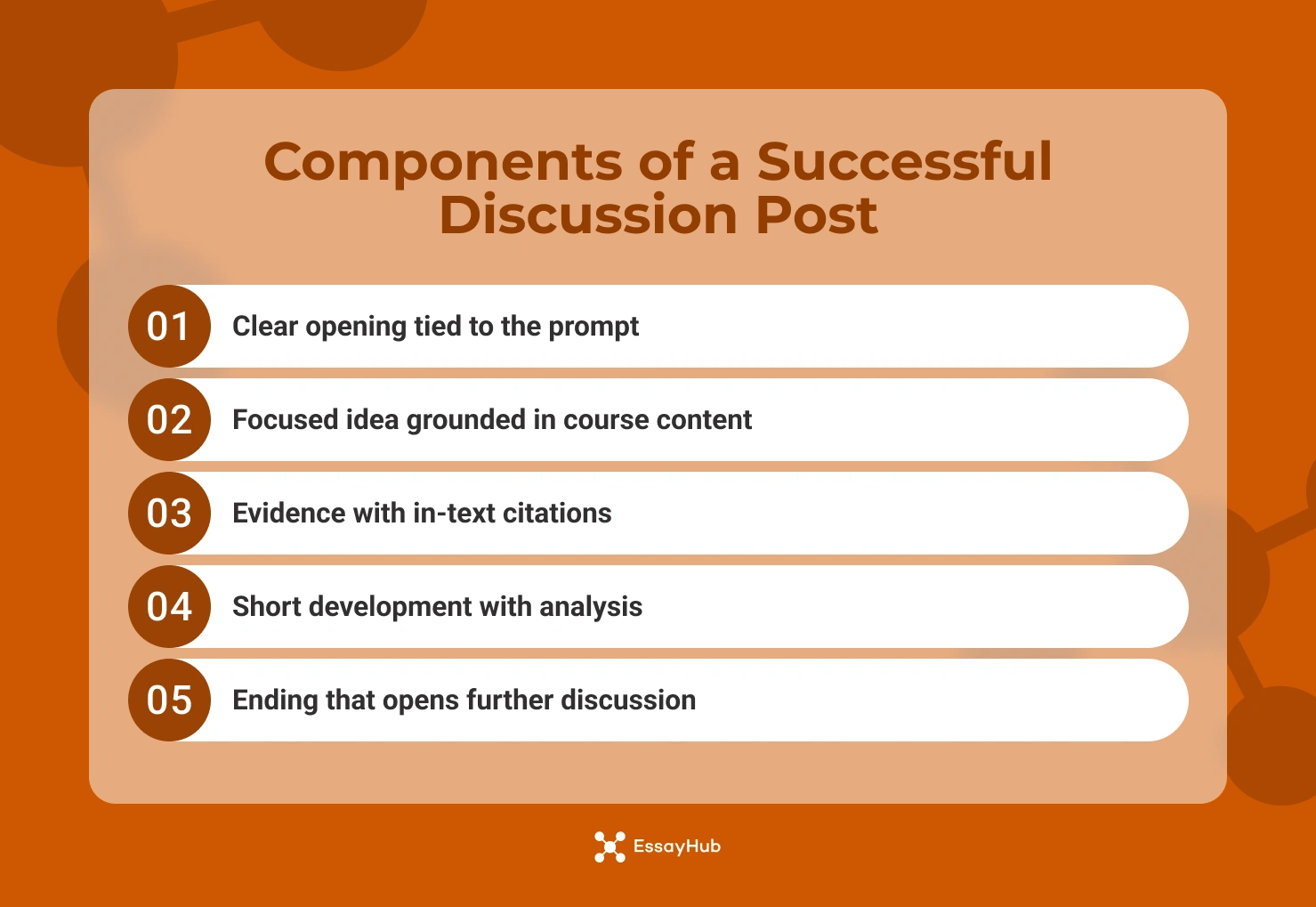
- Clear opening tied to the prompt. Start with a direct answer that addresses the discussion question. Don’t circle around it. Say what you think, then let the rest build.
- Focused idea grounded in course content. Bring in specific material from the course. A concept, a reading, even a small detail. This anchors your post in shared knowledge.
- Evidence with in-text citations. Use research or references to support your point. Cite properly. It shows you know where your argument stands.
- Short development with analysis. Add your take. Explain the reasoning behind your point. This is where your voice comes through.
- A line that opens further discussion. Close with a thought that gives classmates something to respond to. Not a forced question. More like a door left slightly open.


Good vs. Bad Discussion Post Examples
The two posts below represent two different approaches to writing discussion forum examples. The first one appears as if the writer only cares about completing the task and moving on with their day. The second one, on the other hand, reads as if the author has actually taken the time to give the topic some real thought. You can easily see the difference in structure, the use of evidence, and the way the author treats the idea itself.
Bad example
The author talks about social identity theory and how people behave differently in groups. I agree because we see this all the time. In my opinion, people follow others even when it’s wrong. This connects to real-life situations.
This post fails by repeating the course material without quoting or doing anything else with it. No evidence is presented, no references are given, and it is based solely on the author's opinion. This creates a sense of vagueness for the reader, leaving them with nothing to work with, thus giving no potential for future discussion.
Good example
Social identity theory explains group behavior, yet the reading on crowd dynamics adds a layer I hadn’t considered. The study by Reicher shows that group action often follows shared norms rather than blind imitation (Reicher, 2001). That detail shifts how I see protest behavior. It suggests people act within a perceived moral frame, even in chaotic settings. This makes me question how media coverage shapes those norms in the first place.
This post works because it starts with course content, then builds on it with research and clear references. Evidence grounds the claim, and the analysis moves beyond summary. The final line opens space for responses without forcing them, which keeps the discussion active.
10 Discussion Post Examples
After a while and enough reading, you start recognizing the successful college discussion post examples. In such samples, you see that each sentence contributes to the argument, and nothing is written just for the sake of the word count. The best ones are always grounded in course material, develop a clear idea backed by evidence, and give others space to respond.
Discussion Post Example 1: Initial Post
The first post establishes the tone for the rest of the thread. If the post is weak, then the entire thread will be weak. However, if the tone is strong, other students will also try to match it.
Example
The prompt asks how social identity theory explains group behavior in high-pressure situations. Social identity theory suggests that individuals act based on shared group norms rather than personal beliefs alone. In the assigned reading, Tajfel explains that group membership shapes perception and behavior through internalized standards (Tajfel, 1979). That idea becomes visible in emergency response scenarios. During crisis events, people often follow group cues even when individual judgment might suggest hesitation. This pattern appears in documented evacuation studies, where individuals delayed action until others reacted.
This raises a practical concern. If group norms guide behavior under stress, then leadership communication becomes critical. Clear signals from authority figures can shape those norms in real time, which may influence outcomes during emergencies.
Analysis: You can see where this post is coming from and why it holds, which is its strongest trait. It provides clear definitions, uses a good source for its examples, and gives an example of how that theory would look in practice. Furthermore, including emergency situations in the discussion shows that the author has an understanding beyond what is found in the textbooks. Finally, the suggestion for additional information on leadership provides other classmates with something to respond to as opposed to simply stating "I agree" or "I understand."
Discussion Post Example 2: Follow-up Post
This post responds to another classmate's post by identifying a specific point and providing an opinion that will alter the direction of the thread.
Example
You mentioned that remote work improves productivity because people have fewer interruptions. That part makes sense, especially for tasks that need focus. I’m wondering how that holds up over longer periods, though. In the article by Bloom et al., productivity increased at first in remote settings, then leveled off as communication delays started to build (Bloom, 2015). That slowdown shows up in team-based work, where quick feedback matters.
Your point about flexibility still stands, but I think the type of work matters more than the setting itself. A design team might struggle without fast back-and-forth, while individual analytical tasks benefit from fewer distractions. It might be useful to look at how different roles respond instead of treating remote work as one uniform experience.
Analysis: This post asserts itself by describing one of the claims made by one of their peers and backs it up with external evidence, which directly refutes the original claim. Furthermore, the author of this post disagreed with the original poster, yet remained respectful in the response; therefore, the original poster would likely be motivated to respond to the follow-up post.
Discussion Post Example 3: Argumentative Post
Some posts will inherently push you into a position. It is your job to take a stance early on and explain why, using research and evidence as opposed to general claims.
Example
The idea that social media platforms should remain largely unregulated comes up often in discussions about free speech. I don’t agree with that position. Platforms already shape visibility through algorithms, which means content is never neutral in the first place. According to Gillespie, moderation decisions influence public discourse by determining what gets amplified and what disappears from view (Gillespie, 2018). That influence carries responsibility.
Leaving regulation entirely to private companies creates uneven standards. One platform may remove harmful content quickly, while another allows it to circulate longer due to weaker enforcement policies. This inconsistency affects how information spreads during critical moments, such as elections or public health crises. A baseline framework, even if limited, could reduce that gap and make moderation practices more predictable.
I’m interested in how others see this balance. At what point does platform control shift into something closer to public accountability?
Analysis: This post presents a solid position based on facts. There is evidence that supports the author’s claim regarding regulation and how algorithms are built, including a source on platform governance. In addition, the arguments regarding election integrity and public health provide substantial support. The final statement invites reader input by identifying one of the many tensions, allowing the discussion to go further outwards.
Just ask one of our professionals, 'Do my discussion post for me,' if you have no more energy to keep writing your tasks.
Discussion Post Example 4: Reflective Post
Sometimes the assignment asks you to connect theory to your own experience. That only works if the experience is specific and clearly tied to course material, not dropped in as a random story.
Example
The reading on cognitive overload reminded me of a project I worked on last semester. Our team had to analyze a large dataset within a short deadline, and we kept adding variables because each one seemed relevant. At some point, the results stopped making sense. According to Sweller’s cognitive load theory, working memory has limited capacity, and too much information reduces accuracy and decision quality (Sweller, 1988). That explains what happened in our case.
We didn’t need more data. We needed to narrow the scope. Once we reduced the variables to the most relevant ones, the patterns became clearer, and the final report improved. This makes me think that “more information” isn’t always useful in research tasks, especially under time pressure.
I’m curious how others handle this. At what point do you decide that adding more data is hurting the analysis rather than helping it?
Analysis: The use of one project, one mistake, and one adjustment makes the example very specific. In addition, there is a link to cognitive load theory to explain why this occurred, rather than just leaving it as your opinion of what happened. Finally, the example connects the experience back to a larger idea regarding research decisions; therefore, providing classmates with space to provide a response.
Discussion Post Example 5: Case Study Analysis
Here, the instructor gives a situation with constraints and expects you to work through it step by step. The post shows how you apply course concepts to reach a decision, not just describe the scenario again.
Example
In the case of the hospital facing staff shortages, the main issue isn’t just limited personnel. It’s how the shortage affects decision-making under pressure. The scenario shows nurses covering more patients than recommended, which increases the risk of errors. According to patient safety research, error rates rise when workload exceeds safe staffing ratios (Aiken et al., 2002).
One possible response is to redistribute urgent tasks. For example, critical care tasks should stay with experienced staff, while administrative duties could be reassigned or delayed. This aligns with triage principles discussed in the course, where resources are allocated based on severity and immediate need.
The scenario also raises a longer-term issue. If shortages continue, temporary adjustments won’t hold. Hospitals may need to revise staffing models or invest in support roles to reduce pressure on clinical staff.
Analysis: The post isolates one problem - staffing pressure - and connects it to a specific outcome, which is higher error rates. The reference to patient safety research supports that link. The suggested response is concrete, with a clear action tied to course concepts. The final point shifts to long-term implications, which gives others a direction to evaluate or challenge.
Discussion Post Example 6: Current Events Post
Some prompts pull you out of the textbook and almost force you into the real world. The task on hand is simple, seemingly: connect a concept to a real event. In practice, you'll see that most posts either summarize or restate the same theory. The useful one must link the two.
Example
The recent coverage of AI-generated deepfake videos during election cycles raises a question about information trust. The course material on media literacy explains how repeated exposure increases perceived credibility, even when content is misleading. Pennycook and Rand found that familiarity alone can make false information feel accurate over time (Pennycook & Rand, 2019).
That mechanism helps explain why deepfakes gain traction quickly. Once a video circulates across platforms, repeated views can lower skepticism, especially when the content aligns with existing beliefs. This creates a situation where correction efforts struggle to keep up, since the initial exposure has already shaped perception.
One possible response is platform-level labeling combined with slower content amplification. If distribution is delayed until verification checks are completed, the initial exposure effect may weaken. This approach would require platforms to adjust how quickly content spreads, which ties back to the course discussion on algorithmic responsibility.
Analysis: The post keeps the focus tight on a single issue regarding AI deepfakes, which is unarguably one of the most current and interesting topics for group discussion. It identifies a specific mechanism of familiarity increasing perceived truth, and uses it to explain why deepfakes spread so fast. The cited study directly supports that explanation. The suggested response is tied to how platforms operate, so the argument stays within a defined scope instead of drifting into general concerns about misinformation.
Discussion Post Example 7: Introduction Post
The mistake students often make while writing an introduction (social) post is rushing. This is something that determines the first impression you will leave on everyone who reads the post, so you need to include all the big things: context about who you are and where you come from, your goal, and how your background connects to the subject. And, you have to do all this in a way that encourages classmates to respond!
Example
Hi everyone, I’m Cathy, and I’m currently in my third year studying marketing. Most of my coursework so far has focused on consumer behavior, but this is my first class that looks at digital ethics in detail. I’m especially interested in how companies handle user data, since I’ve worked part-time with an e-commerce team that relied heavily on tracking tools.
In that role, I saw how data collection shapes decision-making. For example, product recommendations were adjusted based on browsing history, which increased sales but also raised questions about transparency. I didn’t think much about it at the time, but after reading the first module on data ethics, I started questioning where the line should be drawn.
This course feels directly connected to that experience, and I’m hoping to better understand how ethical guidelines are applied in real business settings.
Analysis: Cathy doesn't list generic details like hobbies in the post. She focuses on her academic direction and one work experience, both of which are narrowed down, and connects them both to the course topic. The closing sentence sets a clear expectation for what the student wants to get out of the course, which makes future interactions more focused.
Discussion Post Example 8: “Give One, Take One”
This format runs on the exchange. You bring one concrete concept into the thread, then you pick up a different one from a classmate and build on it.
Example
Give: One idea that stood out to me is “decision fatigue” from the reading on behavioral economics. The concept explains how repeated choices reduce the quality of later decisions. Baumeister’s research shows that as mental resources get depleted, people are more likely to choose default or easier options (Baumeister et al., 1998). That pattern shows up in daily routines, like sticking with familiar products instead of comparing alternatives after a long day.
Take: In Jason’s post, he mentioned “choice architecture” and how small design changes influence decisions. I think these two ideas connect closely. If someone is already experiencing decision fatigue, then the way options are presented becomes even more important. A simplified layout or a clear default option could guide decisions more effectively when cognitive resources are low.
Analysis: The structure of this post is clean, just like the assignment requires. One concept is introduced with a definition and a source, then a second idea is pulled from a classmate’s post and developed. The connection between decision fatigue and choice architecture is spelled out with a specific condition: reduced mental energy.
Discussion Post Example 9: Flipped Discussion
In this format, you create a prompt instead of creating one, like usual. That means that you have far more responsibility than usual, because you need to draft a question worth arguing about.
Example
In this week’s material on surveillance and digital privacy, most examples focused on government monitoring. I want to shift the focus slightly toward everyday platforms.
Discussion question: At what point does personalized tracking on commercial platforms cross into surveillance, even if users technically agree to it?
Zuboff describes surveillance capitalism as a system where user data is collected and used to predict behavior for profit (Zuboff, 2019). That definition suggests the issue isn’t just consent, but how much control users actually have over their data once it’s collected. For example, targeted advertising relies on continuous tracking, often beyond what users actively notice.
If consent is buried in long terms of service agreements, it becomes difficult to argue that users are making informed decisions. That raises a question about whether current consent models are enough to justify large-scale data collection.
Analysis: The post builds the question carefully instead of dropping it without context. It narrows the focus to commercial platforms and defines the key concept using a source. The example of targeted advertising shows how the issue appears in practice. The question itself is specific and tied to the setup, so it doesn’t feel detached from the explanation that comes before it.
Discussion Post Example 10: Comparative Analysis Post
Some prompts ask you to put two ideas next to each other and make a call. That only works if you keep the criteria consistent. If you switch standards halfway through, the comparison won't hold.
Example
The course presents both behaviorism and constructivism as learning theories, but they lead to very different classroom practices. Behaviorism focuses on observable outcomes and reinforcement. Skinner’s work shows how repeated rewards can shape behavior over time (Skinner, 1953). This approach works well in structured environments where clear responses are expected, such as skill drills or language memorization.
Constructivism, as described by Piaget, centers on how learners build knowledge through experience and interaction (Piaget, 1972). Instead of reinforcing specific responses, it encourages exploration and problem-solving. In practice, this shows up in project-based learning, where students work through open-ended tasks and develop understanding gradually.
The key difference appears in how each theory handles mistakes. Behaviorism treats errors as something to correct quickly through reinforcement. Constructivism treats them as part of the learning process, where misunderstanding can lead to deeper insight. That difference affects how lessons are designed and how progress is measured.
Analysis: The post keeps both theories under the same lens of classroom application. It defines each one using a source, then shows how that definition changes teaching methods. The contrast around mistakes points to how a teacher would respond in each case, which makes the comparison easier to evaluate.
Discussion Post Response Examples
A response should push the thread somewhere new. If you respond to a discussion post with “I agree,” that is not really a conversation. A useful reply either extends the idea with evidence or challenges it with a clear alternative. These discussion board reply examples show that both types of responses work. Even if you decide to proceed with using our essay writer service, it will still benefit you to differentiate between strong and weak exchanges.
Original Post 1
The reading on price discrimination explains how companies adjust pricing based on consumer data. Airlines are a clear example. Ticket prices change based on browsing history, location, and timing. According to Varian, firms use available data to match prices with willingness to pay, which increases revenue (Varian, 2019). This raises a fairness issue, since two customers may pay very different prices for the same service.
Response A (Supportive): Your example of airline pricing makes the concept easy to see. I’d add that this strategy also appears in ride-sharing platforms. Prices increase during high-demand periods, which reflects willingness to pay in real time. That supports your point about revenue optimization, though it also strengthens the fairness concern you mentioned.
Response B (Respectful Disagreement): I see the concern about fairness, though I’m not sure the comparison fully holds. Airline pricing often reflects advance booking patterns and seat availability, not just personal data. That suggests the price difference may come from timing and supply constraints rather than targeted discrimination alone.
Original Post 2
The concept of confirmation bias explains why people stick to existing beliefs even when faced with new information. In the assigned article, Nickerson describes how individuals interpret evidence in ways that reinforce their views (Nickerson, 1998). This shows up clearly in online discussions, where users engage more with content that aligns with their opinions.
Response A (Supportive): The link to online behavior is clear. I’d extend that to recommendation algorithms prioritizing similar content. That reinforces confirmation bias by limiting exposure to opposing viewpoints, which connects directly to your point about selective engagement.
Response B (Respectful Disagreement): I agree that confirmation bias plays a role, but I think exposure isn’t always limited. People often encounter opposing views online, especially on public platforms. The issue may be less about exposure and more about how people interpret what they see once they encounter it.
Original Post 3
The discussion on remote learning highlights flexibility as a major benefit. Students can manage their schedules more effectively and revisit recorded lectures. However, the lack of real-time interaction can reduce engagement, especially in courses that rely on discussion.
Response A (Supportive): The flexibility point stands out, especially for students balancing work and study. I’d add that recorded lectures also allow repeated review, which can improve understanding in complex subjects. That strengthens the benefit you mentioned.
Response B (Respectful Disagreement): The engagement issue depends on how the course is structured. Some online formats include live sessions and active discussion boards, which can maintain interaction. That suggests the challenge may come from course design rather than the format itself.
Final Thoughts
A good discussion post doesn’t try to cover everything. It takes one clear idea, connects it to the course content, and supports it with evidence that actually fits the point. Structure matters because it keeps the writing readable, but content carries the weight. Strong posts show understanding through application, not repetition. They also leave space for others to step in with a specific angle, not a vague reaction. Once you start thinking of each post as part of an ongoing conversation rather than a standalone task, the quality shifts almost immediately.
FAQs
How to Write a Discussion Post Example?
What Is an Example of a Good Discussion Post?
What Does a Good Discussion Post Look Like?

Samuel Gorbold, a seasoned professor with over 30 years of experience, guides students across disciplines such as English, psychology, political science, and many more. Together with EssayHub, he is dedicated to enhancing student understanding and success through comprehensive academic support.