
An abstract is the short, self-contained summary that explains what your whole paper covers and defends. Almost all the effective ones run on the same four-part logic of problem → methods → results → significance. Get down that sequence correctly once, and the rest of the process of how to write an abstract for a research paper is refinement.
Across this guide, I’ll teach you everything you need to know in order to submit an abstract that immediately catches interest. We’ll get into the different types, the general underlying structure, a step-by-step writing process, plus a full example of an abstract for research paper.
What Is an Abstract in a Research Paper?
The abstract is the most-read thing you will write because it: a) is physically the first part of your paper, and b) it’s a summary of everything you’ve covered in it. So, it’s essentially what makes the reader decide whether or not your full work is worth their time. Even in academic databases, usually the only piece of your writing they can see without a login or a download is the abstract, so, again, a large share of the readers will go through it and stop there.
A handful of different situations ask for an abstract:
- Journal submission, because an editor screens the abstract before anyone touches your manuscript.
- Conference proposals live or die on the abstract by itself.
- In a thesis or dissertation, it's the abstract that opens the whole document.
- Grant proposals, where reviewers reach it well ahead of everything else.
Pro tip: Databases index the abstract separately from the paper, so the keywords you put inside it decide whether anyone finds your research at all.


Types of Abstracts
There are four main types of abstracts, all with different jobs and characteristics:
- The informative abstract compresses the entire study (the problem, the method, the findings, the reason any of it matters) into one dense paragraph.
- A descriptive abstract says what the paper covers and stops short of the results. It reads more like an outline that someone rewrote as prose.
- The critical abstract does a full informative job and then adds the author's own assessment of how solid the study is
- The highlight abstract is built to hook attention and withholds enough to keep you curious. It's punchy and a bit promotional.
Here's a more detailed, side-by-side comparison:
What to Include in an Abstract for a Research Paper?
Writing an abstract for a research paper gets a lot less intimidating the moment you stop seeing it as one solid block of text and start seeing the pieces it's assembled from. Four of those pieces do the heavy lifting, and then there's a fifth that sort of stands off to the side on its own.
- Problem / Purpose. This is the gap or the question that made your study worth doing in the first place.
Example: Little is known about how remote work affects junior developers' code quality. - Methods. What you actually did to look into it.
Example: We analysed 12,000 commits from 40 engineers over two years. - Results. What came out of it, and get specific here whenever you can.
Example: Review turnaround slowed by 18%, though defect rates barely moved. - Conclusions. What it all means, and why a reader should bother caring.
Example: Remote setups may cost you speed without costing you quality.
The fifth item, just as important as everything else, is keywords. Most journals want somewhere between five and eight. Keep them lowercase, with the obvious exception of proper nouns, and separate each one with a comma.
Standard Length of Research Paper Abstract
Everyone wants one clean number, but the truthful answer doesn’t include one because it changes depending on multiple factors. Here's the abstract length for research paper laid out by venue:
There's one rule that beats everything else in that table, though. If the venue you're submitting to states a limit, that limit wins, and it isn't a negotiation. A journal capping you at 200 words means 200, even in a field where the usual runs longer. When the specific number and the general guideline disagree, the specific number is the one you follow.
Structured vs. Unstructured Research Paper Abstract
Plenty of journals now require labeled headings right within the abstract, so you'll be writing under Background, Methods, Results, and Conclusions, each with its own short paragraph. That's what a structured abstract is. Which one you're obligated to use really comes down to your field and research essay topics.
- Medical and health sciences journals almost always want the labeled version, with the headings spelled out.
- The humanities and most conferences are looser, an unstructured abstract that reads as one continuous paragraph is completely fine (that doesn’t mean, however, that you shouldn’t carefully follow the APA outline format).
- Systematic reviews need a structured abstract too, and here you'll also want PRISMA on your radar, since its reporting guidelines set clear expectations for what a review abstract should contain, and editors do check against them.
Go open your target journal's author guidelines and confirm which format they expect before you start writing. It's almost always stated in plain language, and getting the format right from the start spares you an annoying rewrite down the line.
Tense, Voice, and Wording Rules
Anything you did or found belongs in the past tense, since the work is over and done:
- We measured
- The data showed
…That sort of phrasing. Claims that stay true no matter what your study concluded are written in the present tense:
- Remote work is increasingly common.
In terms of voice, the older convention shoved everything into the passive, but many journals now accept active constructions, and a few actively prefer them, so verify before you assume. On wording, here's what you should always cut out:
- Citations, which don't belong in an abstract at all
- Abbreviations you haven't already spelled out
- Empty runners like "this paper aims to explore"
How to Write a Research Paper Abstract?
Writing an abstract for a research paper goes smoothly when you break it into five ordered moves. Here's each of them.
Start With the Research Question
Open with the question your study set out to answer, because that's what frames everything the reader is about to skim. One clean sentence stating what wasn't known before you started does more than a whole paragraph of background ever could.
Example: "The effects of remote work on junior developers remain unclear."
Lay Out the Methodology
Compress your methodology into a sentence, maybe two if the design demands it. Name the approach, the sample, the scope, and leave the procedural minutiae in the paper where it lives. Readers want enough detail to trust the findings, not the full protocol.
Example: "We analysed 12,000 commits from 40 engineers across two years."
Report What You Found
This is the part people actually came for, so hand them real numbers wherever you've got them. Something vague like "performance changed" tells a reader nothing at all. Concrete figures carry weight, and they're what make the abstract worth indexing later. Keep in mind that the readers aren’t exercising close reading techniques when reading the abstract, so everything you write must be plain and straightforward.
Example: "Review turnaround slowed by 18%, while defect rates stayed flat."
State Findings/Significance
End on significance rather than a tidy restatement of your results. Answer the question every rushed reader is already asking, which is simply "so what?" Point them toward the implication, the use case, or the follow-up work your study makes possible.
Example: "Remote teams may preserve code quality while accepting slower reviews."
Read It Back
Proofread against the venue's word cap and formatting rules before submitting anything. Read the abstract detached from the paper, as its own object, and confirm it stands on its own two feet. One stray typo here is the very first thing an editor notices. And don’t forget that you can get essay writing help from EssayHub if you need an extra opinion on how well your abstract reads.
Example: Paste it into a blank document and read it as a stranger would.
Research Paper Abstract Examples
Reading a real sample abstract for research paper teaches you more than any list of rules, so here are three I've written out to show how the components come together in practice. Hopefully, this next section will make it easier for you to write research papers.
Example 1
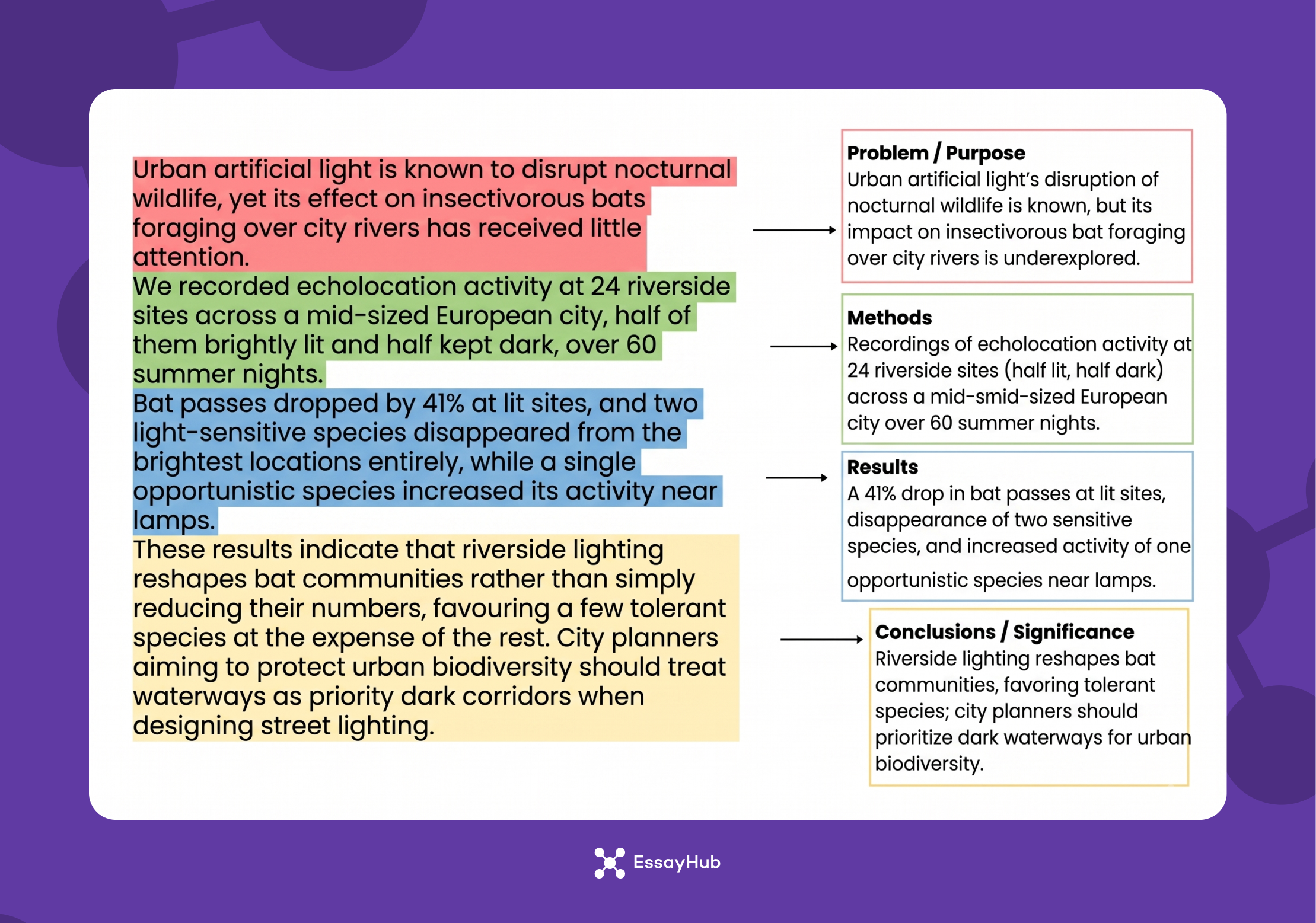
Urban artificial light is known to disrupt nocturnal wildlife, yet its effect on insectivorous bats foraging over city rivers has received little attention. We recorded echolocation activity at 24 riverside sites across a mid-sized European city, half of them brightly lit and half kept dark, over 60 summer nights. Bat passes dropped by 41% at lit sites, and two light-sensitive species disappeared from the brightest locations entirely, while a single opportunistic species increased its activity near lamps. These results indicate that riverside lighting reshapes bat communities rather than simply reducing their numbers, favouring a few tolerant species at the expense of the rest. City planners aiming to protect urban biodiversity should treat waterways as priority dark corridors when designing street lighting.
Example 2
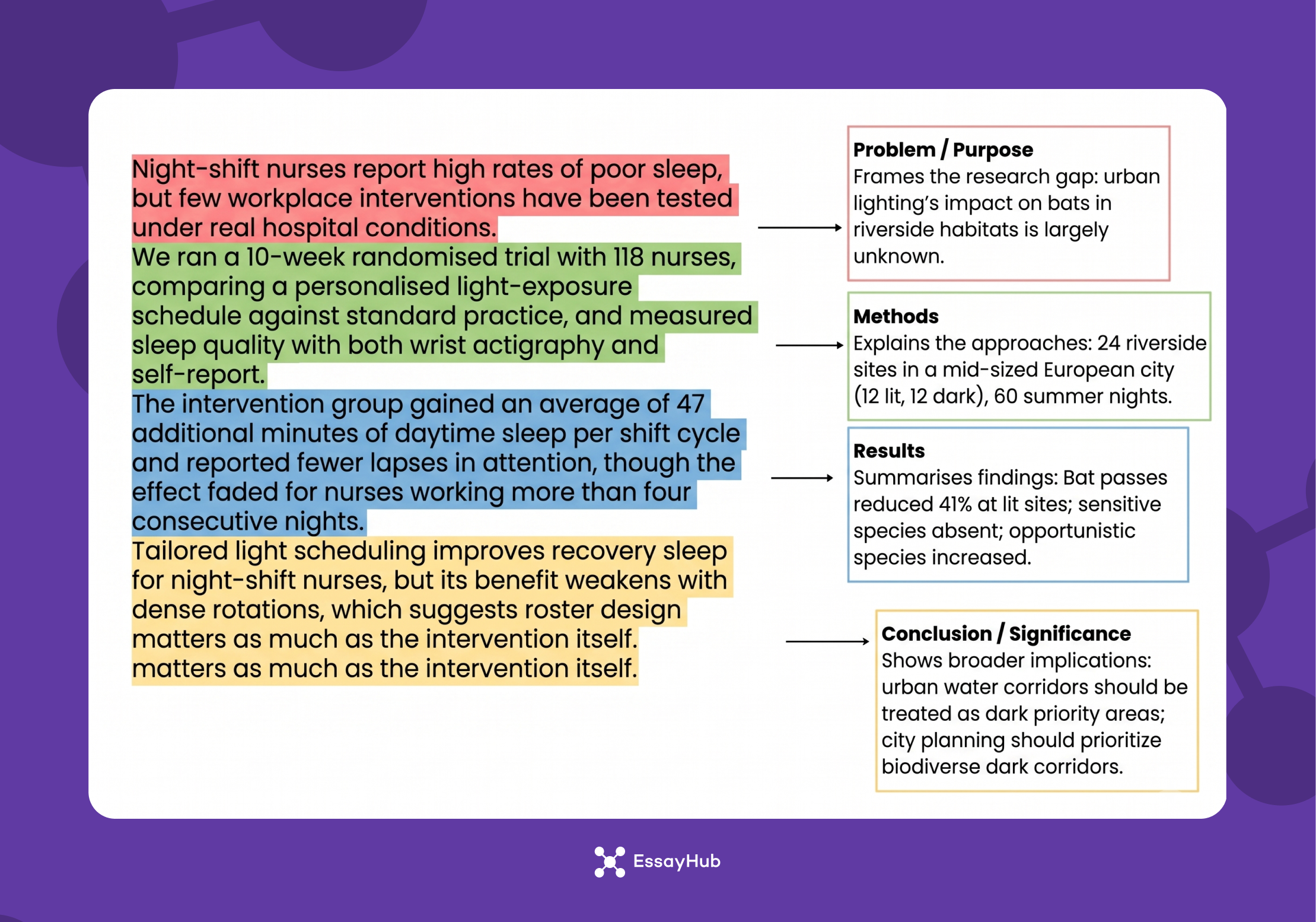
Night-shift nurses report high rates of poor sleep, but few workplace interventions have been tested under real hospital conditions. We ran a 10-week randomised trial with 118 nurses, comparing a personalised light-exposure schedule against standard practice, and measured sleep quality with both wrist actigraphy and self-report. The intervention group gained an average of 47 additional minutes of daytime sleep per shift cycle and reported fewer lapses in attention, though the effect faded for nurses working more than four consecutive nights. Tailored light scheduling improves recovery sleep for night-shift nurses, but its benefit weakens with dense rotations, which suggests roster design matters as much as the intervention itself.
Example 3
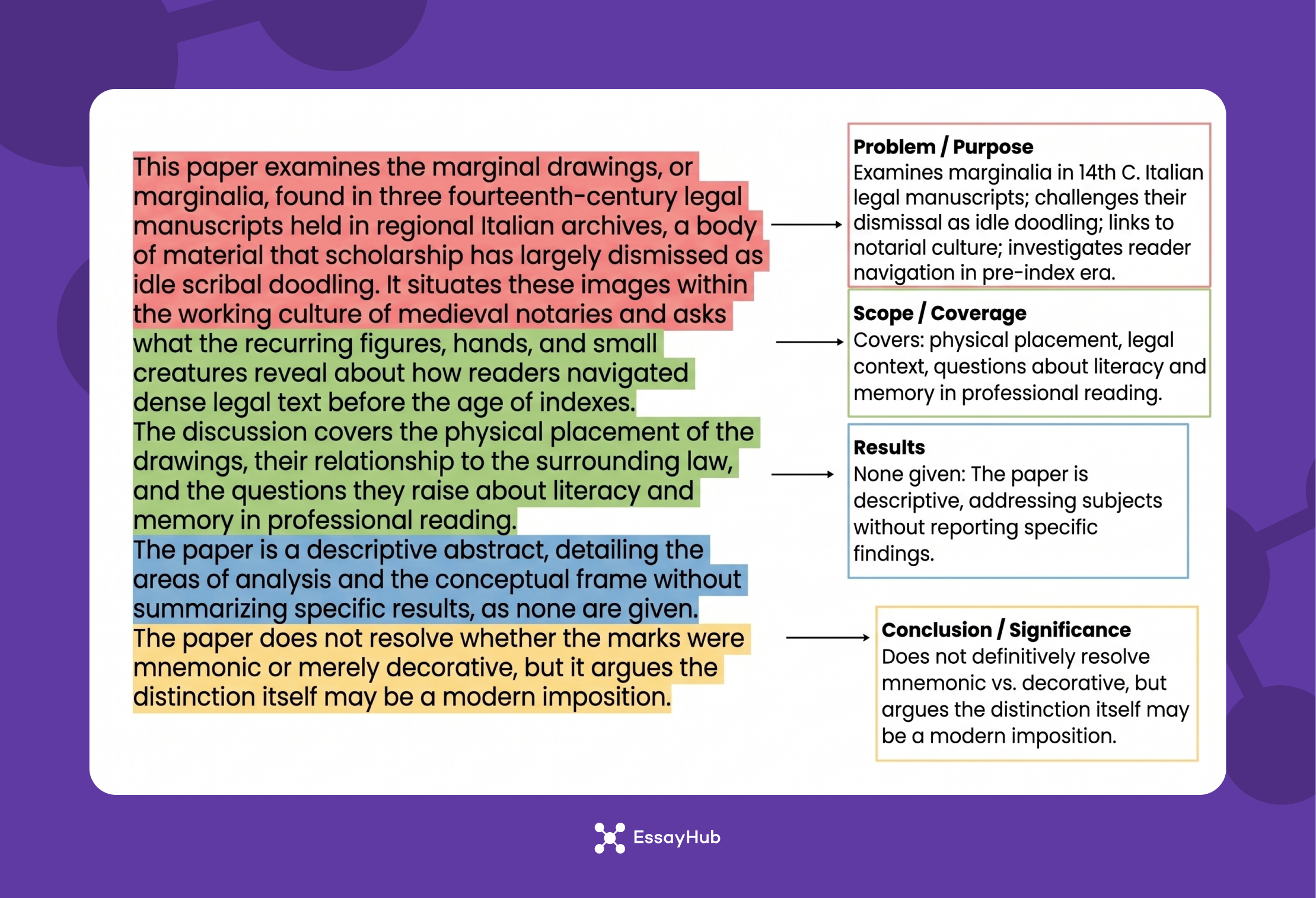
This paper examines the marginal drawings, or marginalia, found in three fourteenth-century legal manuscripts held in regional Italian archives, a body of material that scholarship has largely dismissed as idle scribal doodling. It situates these images within the working culture of medieval notaries and asks what the recurring figures, hands, and small creatures reveal about how readers navigated dense legal text before the age of indexes. The discussion covers the physical placement of the drawings, their relationship to the surrounding law, and the questions they raise about literacy and memory in professional reading. The paper does not resolve whether the marks were mnemonic or merely decorative, but it argues the distinction itself may be a modern imposition.
How to Write an Abstract When You Don't Have Results Yet?
There are times when the abstract submission deadline comes a good few months before the actual data does. You still have to submit it, though, so what should you do? What you write in that case is a promissory abstract, where you’re honest about how far along you are while still handing reviewers a solid summary.
So instead of findings, you write your expected outcomes and the contribution you think the work will make once it's done. Tell them where you are, plainly, whether that's still collecting data or partway into the analysis, so nobody comes away with the wrong impression. Reviewers see these constantly and know exactly how to read them.
Don't promise results you have no real shot at delivering by the presentation date. Claim a significant effect, then stand up on the day with data that went nowhere, and you instantly lose credibility. Instead, describe the direction your work is heading with confidence, but never manufacture a conclusion you haven't actually earned.
Pay to write research paper and all its parts if you’re running low on energy.
Mistakes to Avoid When Writing an Abstract for Research Paper
Most weak abstracts go wrong for the same small set of reasons, and once you can spot them, they're honestly easy to avoid. Here's what I run into most when a student hands me a draft to look over:
- Writing it first. You wind up summarising a paper that doesn't exist yet, and believe me, it shows.
- Blowing past the word limit. Editors clock it instantly, and a few will desk-reject you over nothing else.
- Vague results. "Performance improved" tells a reader precisely nothing. Give them the number.
- Citations and references. Those have a place in the paper. They have no business in an abstract.
- Undefined abbreviations. Make someone guess what your acronym stands for, and you've already lost them.
- Recycling sentences from your introduction. The abstract needs its own tight wording, not lines pasted over from elsewhere.
- Forgetting the keywords. Leave them out, and your paper gets that much harder to surface in a database.
- No significance. Stop at the results without answering "so what?" and you've left the reader hanging.
Final Thoughts
A strong abstract comes down to a few things within your control. Keep the four-part backbone in mind: problem, methods, results, significance. Write it last, once the paper exists. Fit the length to your venue, and let a stated limit beat any rule of thumb. Then read it cold before submitting.
FAQs
Should You Write the Abstract First or Last?
How to Write a Good Abstract for a Research Paper?
What Is Included in the Abstract of a Research Paper?
Where Is the Abstract in a Research Paper?

Samuel Gorbold, a seasoned professor with over 30 years of experience, guides students across disciplines such as English, psychology, political science, and many more. Together with EssayHub, he is dedicated to enhancing student understanding and success through comprehensive academic support.
