Close reading means studying a short passage with enough patience to notice the words, pauses, order, and tone that create meaning. A close reading guide should make the process less mysterious, because good analysis usually starts with small, exact observations.
How it works:
- Read the section first at a literal level, then again at a figurative level.
- Identify and note everything that stands out: repeated, strange, tense, or unusual words or phrases.
- Read through a dictionary and make sure you understand all the possible meanings for all words.
- Based on your notes, create a claim that highlights the overall theme of the section.
In addition to instructing you on the close reading strategies, this article will teach you sample moves and more small reading decisions for a deeper reading experience.


What Is Close Reading?
Close reading is a focused, evidence-based way of reading a small part of a text. You stay with the passage longer than feels natural at first, and you examine diction, syntax, punctuation, tone, imagery, repetition, and the order in which information appears. The close reading method also requires restraint. A claim should be tied to something the reader can point at on the page. Fully understanding the methods and techniques used for this type of reading will be useful to you at any point in your life, including the reading section on your ACT exam (if you need to pass it).
A broad reading of the text can help you identify the general content, characters, arguments and locations. Close reading, on the other hand, is an assessment that allows you to address specific questions about why each verb is in its current position, what the purpose of the break is, how many times the same word is repeated, and/or why the formality of the passage shifts from informal to formal.
See also: what are blue books. If you ever have to pass a test in this format, you’ll know exactly what you’ll be dealing with.
Why Is Close Reading Necessary?
The purpose of close reading is to create a more accurate interpretation of the text and back it up with specific evidence from it. After the first full reading, you can restate the basic message of the text, but the argument will be too vague unless it is supported by the analysis, which happens after close reading.
The benefits of close reading become evident once you start writing. You choose specific quotes and determine their tone through language, sentence structure, or pacing. One of the important academic reading strategies is also to assess the emotional connection. But of course, you avoid the common "this shows emotion" and use a specific word to describe that specific emotion, along with where in the text it’s located and how the writer creates that effect. It will take longer than you expect, but it will be worth it later.
The Close Reading Checklist: What to Look For
Use this checklist after the first read, once the basic situation is clear. I’d keep it next to the passage, not as a rigid school ritual, but as a way to stop yourself before you highlight half the page.
- Word choice: Mark the verbs that reveal attitude, such as a character's claiming, admitting, insisting.' They contain clues about their level of guilt/control/fear/pride/distance.
- Repetition: Do not stop at “this word repeats.” Look for context when determining if the same word has a neutral tone in the beginning, becomes defensive later in the text, and bitter by the end.
- Tone shifts: Find the exact point where the tone changes (short sentence/sudden formal language/fail of joke/pause felt as unnatural).
- Sentence structure: Use the way the thought moves to follow the writer's reasoning; long sentences may be due to over-explaining, while short fragments may indicate shock/embarrassment/refusal/finality.
- Avoided subjects: Identify places in the passage where it circles around an issue. Unresolved questions convey information just as effectively as the answered ones.
- Quote usefulness: Determine its meaning first, then analyze the language. Consider a different quote if the language doesn’t give you much to analyze.
How to Do Close Reading?
With close reading, unless you get the literal meaning down, you won’t be able to analyze anything. If you need to know how to do a close reading by the book, the guide is right in front of you. Yes, I mean the text itself.
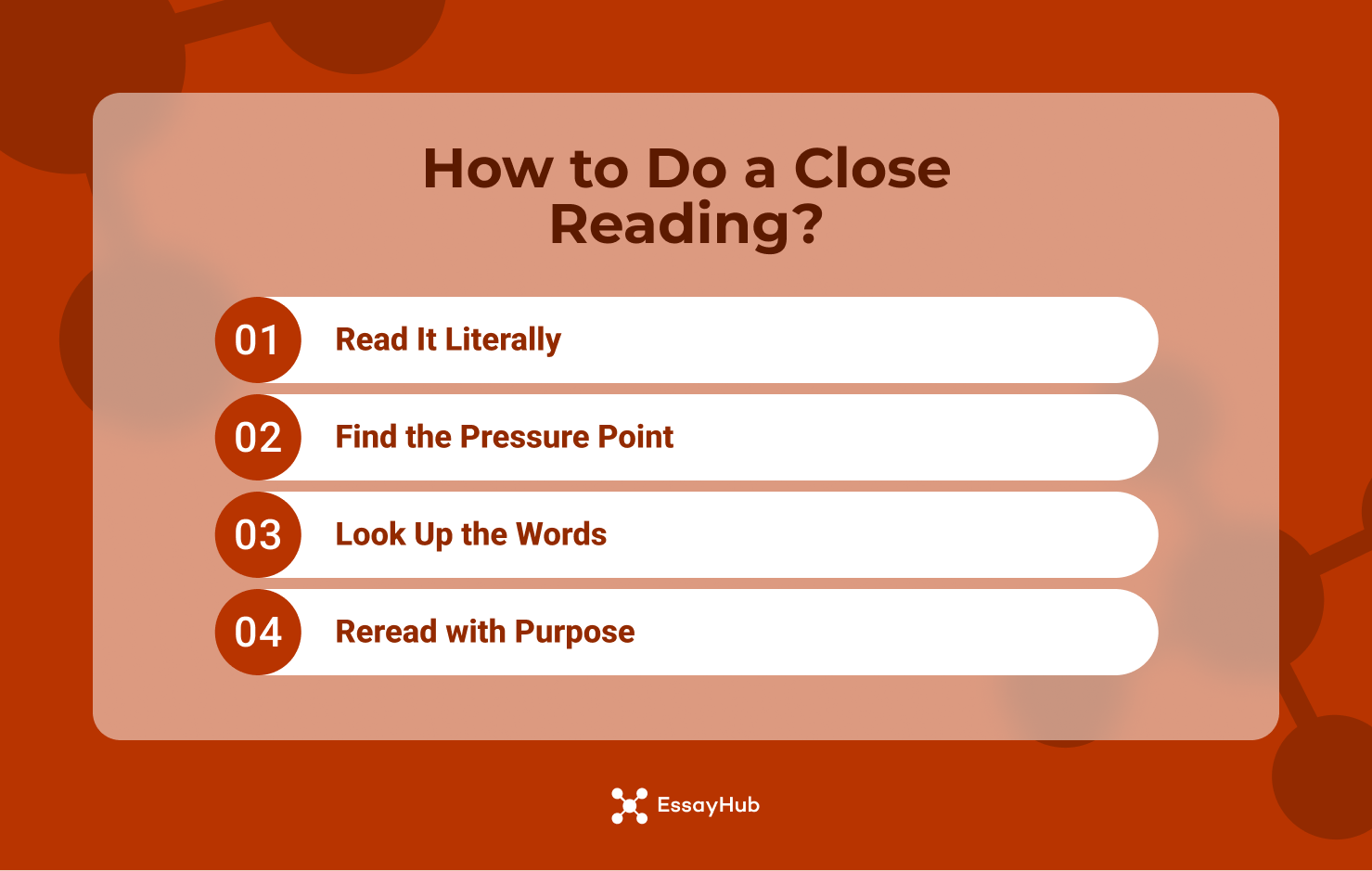
Step 1. Read It Literally
First one in the close reading steps is just understanding the text literally. A blunt paraphrase should only name:
- Who is speaking
- What is happening
- What is being claimed
- What is the surface emotion
Keep interpretation out for a minute because the surface-level paraphrase is the base for it and it will follow later.
Step 2. Find the Pressure Point
As soon as you understand what is happening (according to the previous section), identify anything that stands out to you. Write a note about each unusual detail: an abrupt sentence with no transitional phrase, an oddly rigid sounding adjective, etc.
Step 3. Look Up the Words
Use a dictionary because it can be the best resource. Which words are you familiar with? Have you come across terms that have a second meaning more significant to the text than the first one? By completing this step, you now have easy evidence available to back up your claims.
Step 4. Reread with Purpose
Read again and again, once for each task you have. One reading to track the tone, the second one to spot repetition, the third for syntax. Once you do this, build a solid claim that you will defend.
Annotation Strategies for Close Reading
You need a pen, pencil, or digital highlighting tool for close reading because the useful details are small enough that you might not remember them accurately. Annotations allow you to locate, reason, and limit each claim that you've made. Here are a few more visually helpful close reading techniques:
- Question marks: Mark lines that confuse you, sound unnatural, or otherwise feel out of place with question marks.
- Pattern circles: Circle repeated words, images, first and last names, sounds, and phrases with a recurring word. Look to see what has changed around each return.
- Structure boxes: Draw boxes around fragments, long clauses, lists, interruptions, dashes, semicolons, and unexpected breaks.
- Image underlines: Record symbols and figurative language only when they affect the meaning of the passage.
- Margin notes: Write real claims, not labels (use "speaker avoided blame" rather than "tone").
How to Turn Close Reading Notes Into an Essay?
The final move is translation. Your outline should turn close reading notes into an essay plan, not a storage place for every underline. The close reading process works best when you decide which detail can survive pressure: can it support a claim, connect to another passage, and give you language to analyze? Here are a few more tips from our professional essay services:
- Strongest note: Choose the observation with the clearest payoff. A repeated word is useful only if its context changes, sharpens, or exposes a pattern the reader might miss.
- Mechanism thesis: Write a thesis that names both meaning and method. Instead of “the passage shows fear,” try “the speaker’s clipped verbs make fear sound controlled, almost rehearsed.”
- Evidence blocks: Group notes by function, not page order. Put diction with diction, silence with silence, syntax with syntax. Each paragraph should prove one movement in the argument, then explain why that movement matters.
Close Reading Examples
These close reading examples use real passages, because invented one-line samples make the method look easier than it is. A useful example gives you enough wording to notice repetition, syntax, pacing, and small shifts in control.
Close Reading Example 1: Literature/Poetry
Text: Emily Dickinson, “Because I could not stop for Death”
Passage:
“Because I could not stop for Death —
He kindly stopped for me —
The Carriage held but just Ourselves —
And Immortality.
We slowly drove — He knew no haste
And I had put away
My labor and my leisure too,
For His Civility —
We passed the School, where Children strove
At Recess — in the Ring —
We passed the Fields of Gazing Grain —
We passed the Setting Sun —”
- “Because I could not stop for Death” starts with a dependent clause, so the speaker’s lack of action comes before Death’s action. The syntax makes her delay the first fact that she did not choose the meeting.
- “He kindly stopped for me” deserves close attention because “kindly” modifies the verb that gives Death control. The politeness makes the power sound “socially acceptable”.
- Death gets grammar before he gets description. The capital letter and pronoun “He” turn an abstract condition into a character with agency.
- “The Carriage held but just Ourselves / And Immortality” uses “but just” to make the space feel limited. Then “Immortality” enters like a third passenger, which changes the ride from social visit to afterlife journey.
- “My labor and my leisure too” pairs duty with pleasure. She has left behind the full structure of living, not only work.
- “We passed” repeats three times. That repetition makes life stages feel sequential and already out of reach: school, grain, sun.
- The dashes interrupt closure. Each image pauses before the next one arrives, so the poem advances slowly while still refusing full explanation.
Our book review writing service can help you make better sense of any text your professor has given you to close-read and review.
Close Reading Example 2: Historical Speech
Text: Abraham Lincoln, Gettysburg Address
Passage:
“Now we are engaged in a great civil war, testing whether that nation, or any nation so conceived and so dedicated, can long endure. We are met on a great battle-field of that war. We have come to dedicate a portion of that field, as a final resting place for those who here gave their lives that that nation might live. It is altogether fitting and proper that we should do this.
But, in a larger sense, we can not dedicate, we can not consecrate, we can not hallow this ground.”
- “We” does a lot of grammatical work. Lincoln uses it before the audience can separate itself from the war, the burial, or the unfinished duty. The pronoun is not a decorative unity language; it makes responsibility collective.
- “That nation” is colder than “our nation.” That distance matters. Lincoln briefly treats the country as an experiment being examined under pressure, which fits the phrase “testing whether.” The nation is not assumed to be permanent; its survival has to be proven.
- The repetition of “so conceived and so dedicated” turns founding ideals into conditions. Liberty and equality are not background values here. They become the standard by which the war and the audience will be judged.
- “Gave their lives” and “that nation might live” compress the exchange. Lincoln places individual death and national survival almost side by side, so the sentence itself performs the cost of preservation.
- “Fitting and proper” sounds like the expected cemetery language. Then “But” breaks that public script. The speech stops praising the ceremony and starts questioning what the ceremony can actually accomplish.
- “Dedicate,” “consecrate,” and “hallow” are not synonyms thrown together. Each verb raises the spiritual weight, then “can not” cancels the speaker’s power three times. Lincoln makes his own speech smaller on purpose.
Close Reading Example 3: Scientific/Academic Text Paragraph
Text: Charles Darwin, On the Origin of Species
Passage:
“When on board H.M.S. ‘Beagle,’ as naturalist, I was much struck with certain facts in the distribution of the inhabitants of South America, and in the geological relations of the present to the past inhabitants of that continent. These facts seemed to me to throw some light on the origin of species—that mystery of mysteries, as it has been called by one of our greatest philosophers. On my return home, it occurred to me, in 1837, that something might perhaps be made out on this question by patiently accumulating and reflecting on all sorts of facts which could possibly have any bearing on it.”
- Darwin opens with a travel record, not a theory. “When on board H.M.S. Beagle” gives the idea a physical origin: ship, route, fieldwork, collected observation. He wants the reader to see the claim as something that grew out of evidence, not speculation.
- “As naturalist” is doing credential work. He names his role before naming his conclusion, so the authority comes from trained observation. That is useful to mark because academic prose often builds trust before it builds an argument.
- “Certain facts” is deliberately narrow. Darwin does not begin with “the truth” or “the law.” He starts with selected facts, which makes the reasoning feel cautious and cumulative.
- Look closely at “distribution” and “geological relations.” One term concerns where organisms are found; the other concerns time, layers, and earlier life. The sentence already joins geography with history.
- “Present” and “past inhabitants” create the real hinge. Darwin is not only comparing species. He is comparing life across time, which lets the paragraph move toward origin rather than description.
- “Seemed,” “some light,” “might perhaps” slow the claim down. That hesitation is not weakness. It is scientific control: he refuses to sound more certain than the evidence allows.
- “Mystery of mysteries” changes the register for a moment. The phrase is dramatic, but Darwin attributes it to someone else, which lets him borrow its weight without making his own prose suddenly theatrical.
- The method arrives at the end: “accumulating and reflecting.” First, gather many facts, then think across them. That order matters because the paragraph defines research as patience before interpretation.
Final Thoughts
Close reading techniques help you move past summary and into evidence-based interpretation. The strongest close reading starts with basic meaning, then examines diction, structure, repetition, tone, punctuation, and patterns that change across the passage. Good notes matter too. They give your essay something exact to argue, not just a general reaction to the text.
FAQs
What Is an Example of a Close Reading?
What Are the 5 Steps of Close Reading?
Why Is Close Reading Important?
What Does It Mean to Do Close Reading?

Mark Bradford, a passionate and talented artist, utilizes his innovative spirit to support academic pursuits. In partnering with EssayHub, he leverages his artistic insights to assist students as a professional essay writer, helping them navigate and complete their academic assignments at every level of difficulty.
- Lab, P. W. (n.d.). Close Reading // Purdue Writing Lab. Purdue Writing Lab. https://owl.purdue.edu/owl/subject_specific_writing/writing_in_literature/writing_about_fiction/index.html
- Baki, Y. (2024). The Impact of Close Reading Strategies on Individual Innovativeness and Life Skills: Preservice Teachers. Behavioral Sciences, 14(9), 816. https://www.mdpi.com/2076-328X/14/9/816
- Close reading - Department of English and Related Literature, University of York. (n.d.). https://www.york.ac.uk/english/about/writing-at-york/writing-resources/close-reading/