Technology and education have been closely bound for decades. According to UNESCO, technology is featured in six out of the ten targets in Sustainable Development Goal 4 on education. Simply put, technology is one of the core elements of the development of the educational sector.
While different kinds of technology matter, innovative solutions that appear every year are the primary drivers of development. In this article, we'll look at the most recent technological trends in teaching and learning and tell you how they will impact education in 2026 and beyond.

What Is Educational Technology?
Educational technology, also known as edtech, is a generalized term used to define technology used in the educational sector. This term covers different types of gadgets, software, and other tech solutions that improve school operations, teaching, and learning. The primary goals of edtech are to reduce workloads, save time, improve student outcomes, optimize budgets, and otherwise improve the field of education.
How Is Educational Technology Used in College?
Educational technology implies purposeful integration of various tools, hardware, and software across all sectors of education. In colleges, its primary uses can be divided into three subcategories:
- College management: Technology provides solutions critical for optimizing and automating daily administrative school tasks, such as communication, resource sharing, staff training, student data management, etc.
- Teaching and learning improvement: Educational technology provides tools for teachers’ work optimization, lesson planning, establishing virtual learning environments, and supporting students with interactive learning resources and materials, including those meant for learners with special needs.
- Pastoral support: With the growing tendency toward work/study-life balance, today’s colleges also integrate technology to create a holistic pastoral (care) system that would support the physical, mental, and emotional well-being of everyone involved.
Recent Trends in Educational Technology
Some educational technology, such as Learning Management Systems (LMSs), has been steady for years. However, the world of technology is constantly evolving, offering new solutions. In the blocks below, we’ll delve into the top trends in educational technology that are currently gaining momentum.
Artificial Intelligence and Machine Learning
Artificial intelligence (AI) and related areas, such as generative AI, machine learning, and others, have been trending in all spheres lately, including education. Powerful algorithms provide unprecedented automation opportunities that have the potential to enhance teaching and learning.
How AI and ML are used in education:
- Teacher’s workflow automation: AI and ML algorithms turn time-consuming manual tasks into simple automated routines. With these technologies, educators can speed up grading and deliver real-time feedback to students with less effort.
- Learning personalization: Algorithms can process huge data volumes in minutes. They can easily detect knowledge gaps and weaknesses of individual students and provide personalized recommendations and learning plans that streamline progress.
- Virtual assistants: Together, AI and ML provide teachers and students with powerful chatbot assistants that help summarize materials, help find answers, and otherwise guide student work at any time.
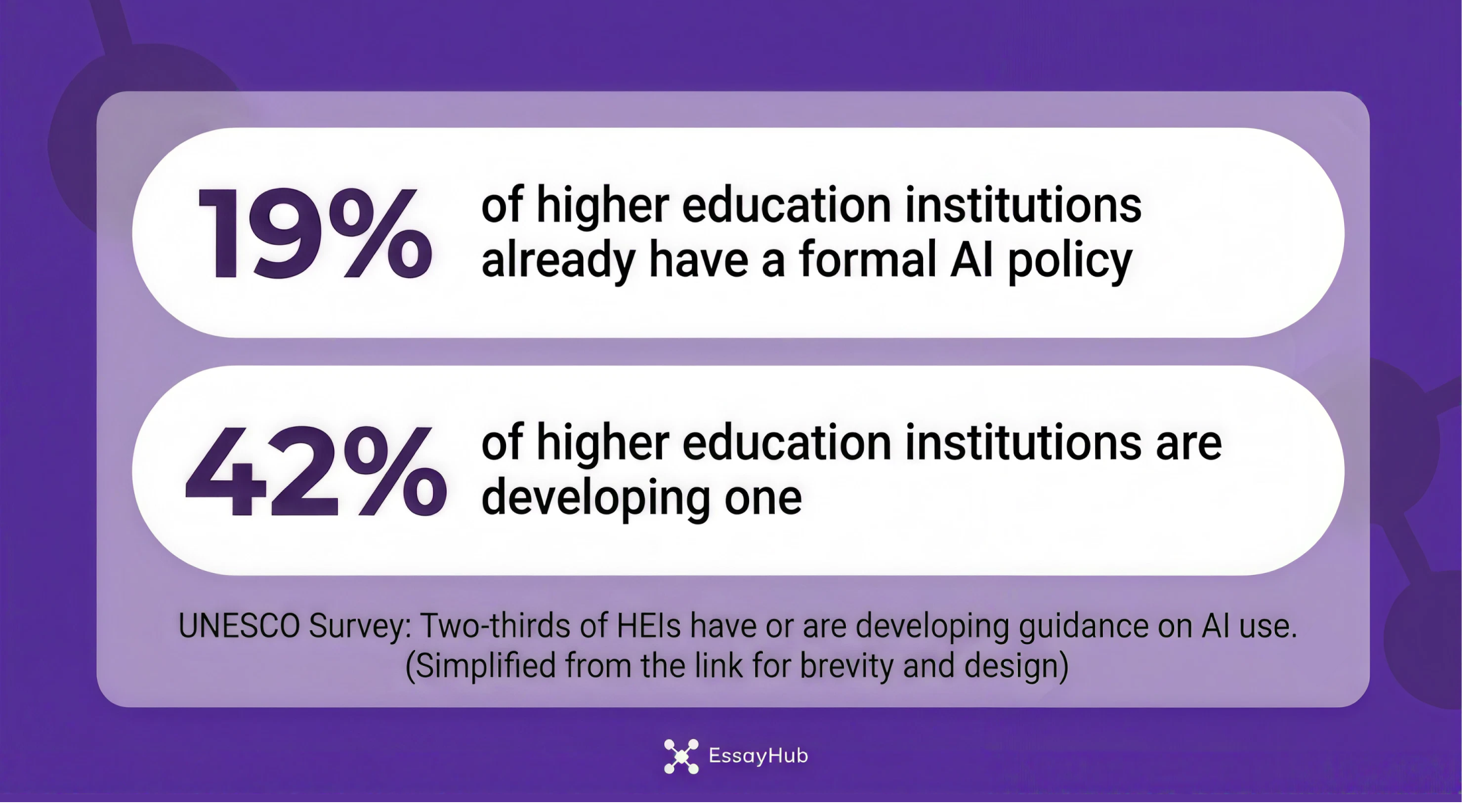
Important: Despite the potential benefits, AI also poses certain risks to education, such as the unethical use of AI in student work. For this reason, 19% of higher education institutions already have a formal AI policy, and 42% are developing one.
Adaptive Learning Technology
Adaptive learning solutions are another big trend. These are educational software/web systems that combine real-time data analytics and AI algorithms to deliver fully custom, dynamic learning experiences.
Here’s how it works:
- The system performs an initial assessment of the learner’s knowledge and skills at sign-up to establish a baseline.
- As the learner interacts with the system (i.e., completes lessons, quizzes, etc.), it records their interaction patterns, errors, and progress.
- AI and ML algorithms analyze historical data to predict how the learner will behave and dynamically adapt materials to their needs. For example, if the system records repeated errors within the same topic, it can provide additional hints and tasks for progressive practice.
As a result, learners receive fully custom experiences, stay more engaged, and progress faster.
Immersive Learning With AR and VR
Augmented reality (AR) integrates digital elements into a real-world environment. Virtual reality (VR) creates a fully digital environment that users can immerse themselves in. Both AR and VR help implement Experiential Learning Theory – a theory that implies that individuals can learn and retain knowledge better through direct experience. These technologies enable students to simulate medical procedures, visit historical places and events, and otherwise learn by doing.
School Management Automation
While many schools and higher education facilities have been using some teaching and learning technologies for years, many administrative school tasks have been done in the old way, manually. Today, we observe a growing trend toward automation in daily operations.
Education facilities leverage technology to:
- Streamline staff recruitment, onboarding, training, and other HR processes.
- Prepare and centralize documentation.
- Back up valuable data.
- Create and distribute reports.
- Track the attendance of students and teachers.
By automating these and other routine tasks, schools can significantly reduce workloads and let their staff members focus on tasks that actually require human oversight.
Digital Learning Platforms and Content Creation Tools
Digital or hybrid learning benefits both students (by improving learning accessibility) and schools (by reducing operational costs). After the COVID-19 pandemic, the popularity of digital learning platforms continues to rise with more schools implementing mixed and remote study days, fully remote programs, and hybrid programs. Digital learning platforms help turn this into reality, and content creation tools support educators by helping them create diverse, engaging, and interactive content for digital courses without technical knowledge.
Communications Platforms
Although communication technology is not entirely new, in 2026, we see how educational facilities use it in new ways, primarily to strengthen and simplify parent-teacher relationships. Parent engagement platforms enable teachers to connect with parents via a single dashboard and complete a variety of tasks, such as:
- Gathering student information.
- Sending updates.
- Sending invoices and accepting payments (for example, for school field trips).
- Managing school lunch payments.
- Scheduling parent meetings.
- Hosting digital meetings.
- Providing parents with access to a child’s calendar and progress information, etc.
Cybersecurity and Digital Literacy
As schools use more technology in the classroom and more learning activities happen online, growing concerns arise in terms of data and user safety. Given this, the last major edtech trend is a focus on cybersecurity. Schools and colleges build comprehensive security systems to prevent data breaches and other digital threats. Furthermore, more and more schools take active steps to teach students digital literacy and ensure they use technology safely and responsibly.
Conclusion
AI, ML, adaptive learning, and other emerging trends in educational technology might not all be unseen innovations. Many of the technologies we discussed here have been around for some time. However, today, they are being actively integrated into schools and classrooms to improve the quality of learning and teaching. At the same time, security remains one of the main things that we must give top priority to. More technology means more risks, which is why protecting data and users and spreading digital literacy knowledge among students is the number one task.