
Financial insecurity has long become an integral part of student life. The latest surveys find that 71% of students experience financial struggles while in school.
Beyond having to pay tuition and fees, modern students experience pressure from many additional expenses, such as housing, groceries, healthcare, and others. To complicate matters, more and more students feel worried about their future financial stability. They fear economic uncertainty, AI's impact on careers, and a lack of jobs. Together, all these factors create significant stress that tends to increase year by year.
In this article, we’ll look into the biggest financial struggles impacting Gen Z students and explore the possible management options.
Why Financial Problems Are Growing Among Gen Z College Students
Although financial instability has always been a common issue among college students, modern generations tend to feel it more intensely. Gen Z college students are living in a world with rising costs and inflation. Price pressures are growing progressively around the world due to adverse energy shocks from geopolitical conflicts, surging commodity prices, resilient goods demand, and lagged impacts of trade tariffs. As a result, students now have to deal with:
- Higher everyday costs (e.g., groceries)
- Higher transportation costs
- Higher housing costs
- Higher costs of services (e.g., healthcare)
- Higher tuition and fees
Now, it’s worth noting that Gen Zers tend to earn more (adjusted for inflation) than previous generations at the same age. Still, the affordability of housing, transportation, and other essential goods has grown so much that wealth-building generally feels more complicated for them. Hence, many modern students are also facing delayed financial independence.
The Main Financial Challenges for College Students Today
When we talk about the main expenses of college students, tuition is one of the first things we think about. Indeed, it makes up a big share. According to the Education Data Initiative, the average cost of tuition has increased by 36.8% since 2010, or by 0.92% adjusted for inflation. Yet, it’s not the only expense that students must cover.
On top of school fees, most students have to pay for:
- Groceries and basic personal needs
- Housing (whether in a dorm or rented)
- Transportation and parking
- Technology and software subscriptions
- Campus and lab fees
- Healthcare and insurance
- Textbooks
- Social life
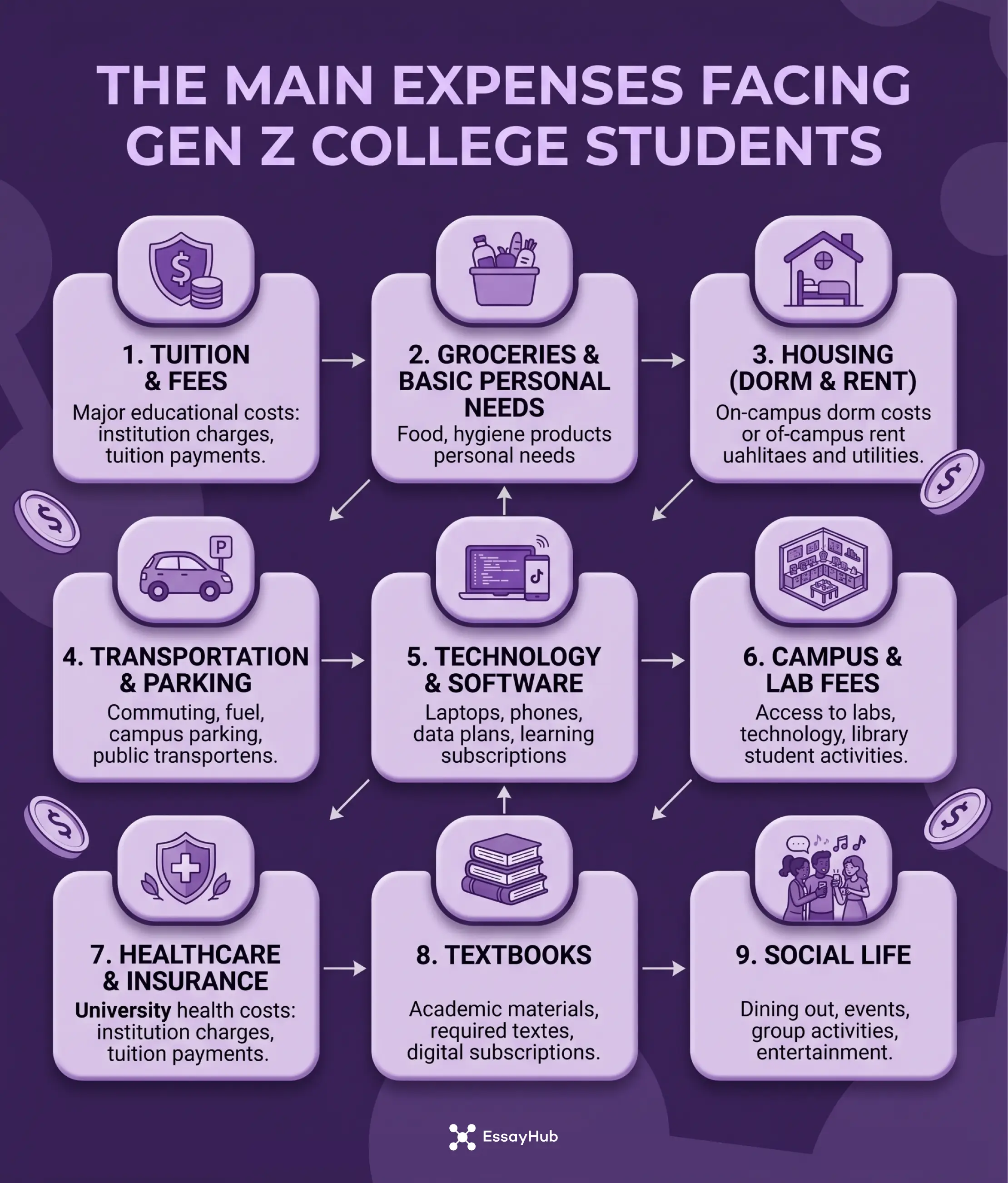
Each of these expense items can add hundreds of dollars a year. So when families experience the so-called sticker shock when looking at tuition prices, the truth is that a big part of the total college cost is actually hidden beyond it.
How AI Is Changing the Job Outlook for Gen Z College Students
Apart from the growing expenses of education and daily living, artificial intelligence is another massive stressor for Gen Z students. This technology has been evolving rapidly over the past few years and has already made it into the majority of industries.
According to surveys, 82% of executives admit that AI is already devaluing human roles. It replaces many repetitive routine tasks that previously were assigned to entry-level professionals. This fact creates significant employment insecurity among college students. They feel uncertainty about whether they can secure jobs after graduation, face increased competition in the labor market, and feel pressured to develop AI skills alongside their basic career skills.

While AI cannot fully replace human roles, its presence affects students’ financial confidence. It creates additional background stress that can exacerbate how students already feel.
Why College Student Money Problems Are Changing Students’ Career Plans
The increasing financial pressure doesn’t only affect students’ mental health. It also affects their academic and career decisions.
First of all, more and more Gen Zers focus on future earning potential over passion when choosing their majors. Although 83% of young people admit it’s important to love what you do, 68% of them choose “realistic” majors to ensure future financial stability.
For the same reason, more students now choose paid internships over valuable but unpaid experience just to cover their daily expenses. As for recent graduates, many of them now consider jobs outside their major to pursue stability. The Burning Glass Institute reports 52% of recent graduates are underemployed, taking jobs that either don’t use their full potential or that don’t require a degree at all.
How Gen Z College Students Are Managing Financial Struggles
As costs keep rising, Gen Z students are responding to this with practical survival strategies rather than accepting their financial hardships. Many students choose one or several of the following tactics to overcome their struggles:
- Choosing a community college first can save students up to $30,000 or more of the total attendance cost.
- Applying for more scholarships can provide extra funds for paying tuition and living expenses.
- Working or freelancing while studying can offer an additional source of income to increase students’ budgets.
- Sharing an apartment with roommates can help reduce high housing costs.
- Buying used textbooks, using student benefits, and other saving tips can help reduce daily costs and save some money.
- Solid financial literacy and budgeting skills can help planning your budget ahead and prevent overspending.
- Looking for emergency grants can help overcome significant hardships and cover essential costs.
How Gen Z College Students Can Improve Their Financial Situation
While surveys and research show that Gen Zers don’t accept their struggle and seem to be looking for possible management options, their financial insecurity is still high. Here are a few steps students can take to address their stress and improve the situation:
Taking Financial Literacy Training
Financial literacy is what gives us practical money skills. It teaches budgeting, saving, avoiding heavy debt, and making smarter money decisions. Despite its importance, the majority of students still lack basic literacy when it comes to handling their money. Taking specialized classes can help you gain essential financial skills and minimize the impact of economic uncertainty.
Gradually Building a Safety Net
As much as young people hate hearing this from their families, building a financial safety net is a must for withstanding emergencies and economic instability. It’s a step-by-step process. You can start with small goals (e.g., saving a few hundred dollars) and turn saving into a strong habit. When you do, you will gradually build a safety net that will help you cover essential expenses even when you’re in a tough financial situation.
Developing AI and Digital Skills
Even though we say that AI and technology cannot fully replace humans, let’s face it – we are already living in a highly technological world. Digital skills are now essential to nearly all jobs. AI skills are also catching up, with over one-third of entry-level positions requiring them. To secure a job post-graduation, you should start acquiring these skills while still in school.
Avoiding Unnecessary Debt
When you find it hard to carve out a few hundred for daily living, this can feel frustrating. Many students choose to borrow money to handle such hardships. Yet, the truth is that growing your debt can significantly limit your financial freedom, increase stress, and drain your future income. Hence, it’s recommended to avoid unnecessary debt.
Budgeting
Although student expenses increase, covering them remains possible with wise budgeting. When you draw up a monthly budget, you can clearly see all the expenses you need to cover, prioritize them, and allocate funds for each spending category. Doing so gives you full control over your money, prevents overspending, and helps save for your financial safety net.
Conclusion
Financial stress in college students has significantly increased over the past few years. Compared to previous generations, Gen Z college students may make more money. Still, they have to deal with rapidly increasing costs of education and daily living. Multiple hidden costs can make college attendance more expensive and stressful than ever. Yet, learning financial literacy and basic budgeting can help you overcome current struggles and prepare for graduating into economic uncertainty.