Education is rapidly digitalizing. More and more schools now switch to cloud services, integrate learning management systems, and start using various technologies on a daily basis. This means that more student and staff data becomes centralized and digitized, making it a vulnerable target for cybercrime.
The growing scope of tech solutions used in the educational sector makes old, simplified security solutions like antivirus software insufficient. Instead, educational institutions have to implement more comprehensive school cybersecurity strategies that would protect them from attacks and data breaches.
What Is Cybersecurity in Schools?
Cybersecurity in schools is the practice of protecting servers, systems, devices, and data used in educational institutions from digital threats, such as unauthorized access, cyber attacks, and data theft or damage. It’s not a single specific policy or solution. It’s a comprehensive strategy that combines a set of technologies, practices, and policies geared toward security. This strategy aims to protect different items, including LMSs, internal correspondence, student records, financial information, and the overall school’s IT infrastructure.
In practice, school cybersecurity has three pillars:
- Technical safeguards: security software, encryption, firewalls, and multi-factor authentication that protect systems and data on the technical level.
- Organizational safeguards: Clearly defined roles (for access authorization), policies, and incident response plans that build proper governance practices.
- Human behavior safeguards: Increasing student/staff awareness, providing staff training, and helping staff and students acquire secure habits that would make them less vulnerable to threats.
When all three pillars are strong, they create an efficient cybersecurity system. If even one of them is weak, this undermines the whole system and can lead to safety incidents.
Why Schools Are Becoming Prime Targets for Cybercriminals
The frequency of cybercrime and the amount of losses caused by it are steadily growing across all sectors. In 2025, the FBI reported internet-crime-related losses to exceed $16 billion, which is a 33% increase from 2023.
%20%20.webp)
Today, education is becoming one of the primary targets, too. This happens because of:
- Limited IT budgets in schools;
- Implementation of large repositories with personal data;
- The growing number of devices used in classrooms and the thousands of users present within one network;
- Weak financial systems, etc.
These reasons make schools a good target for cybercriminals. A UK-based research firm found that educational facilities actually accounted for the majority (74%) of all attacks in 2025. Among the most common attack types are ransomware, phishing, and credential theft.
What Are the Top Cybersecurity Threats for Schools?
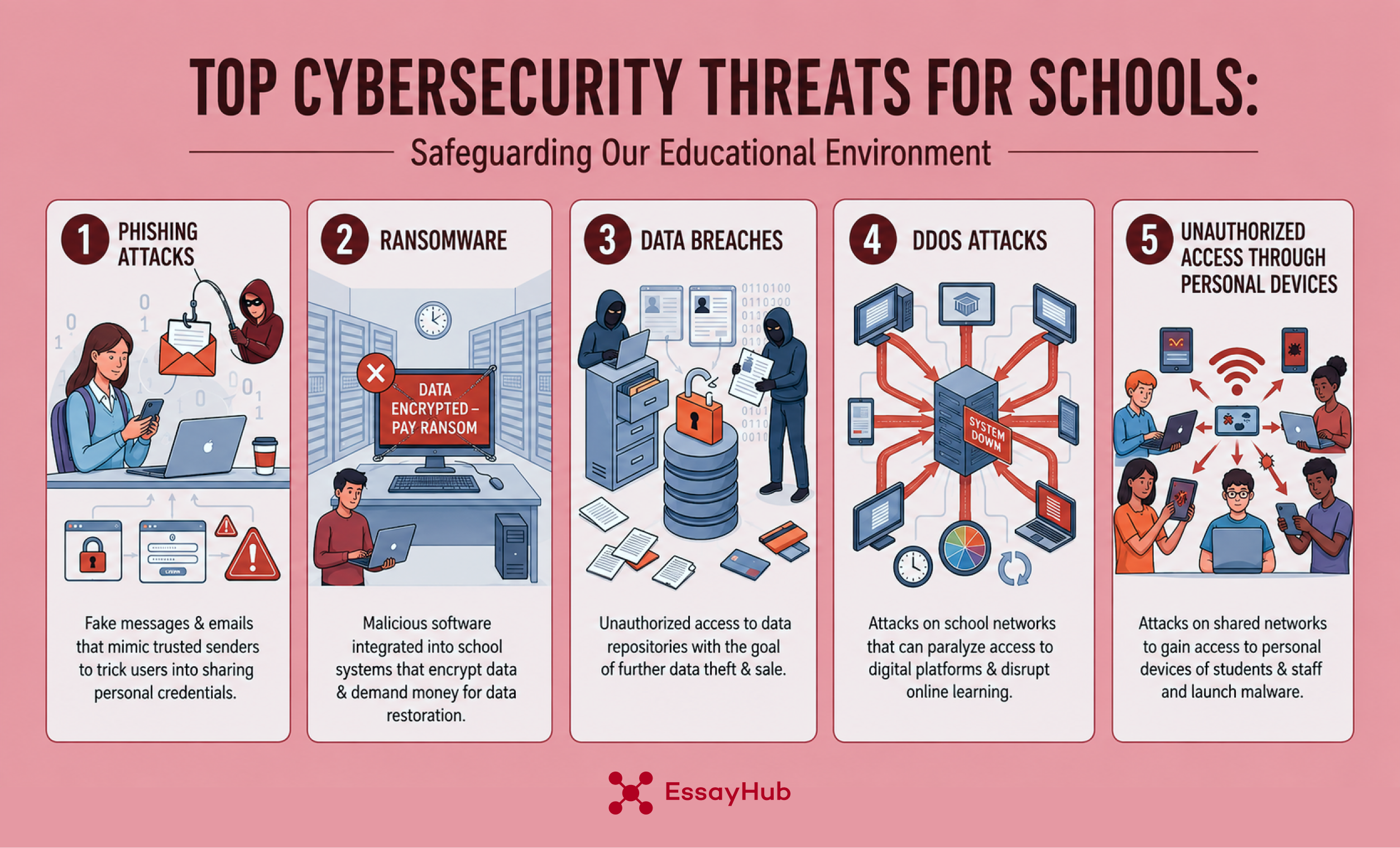
Now that schools have become one of the prime targets for cybercriminals, it’s important that we understand the possible threats to be able to protect our systems and data better. Of course, the diversity of possible attack types is very broad. However, according to Erasmus, the following five categories of threats seem to be the most common:
- Phishing attacks – Fake messages and emails that mimic trusted senders to trick users into sharing personal credentials.
- Ransomware – Malicious software integrated into school systems that encrypts data to give criminals an opportunity to blackmail and demand money for data restoration.
- Data breaches – Unauthorized access to data repositories with the goal of further data theft and sale.
- DDoS (Distributed Denial-of-Service) attacks – Attacks on school networks that can paralyze access to digital platforms and disrupt online learning.
- Unauthorized access through personal devices – Attacks on shared networks to gain access to personal devices of students and staff and launch malware.
How AI Is Changing Cybersecurity in Schools
Being one of the most thriving technologies today, AI obviously plays a role in cybersecurity.
As more schools use AI in their systems (e.g., for learning personalization purposes) and more students and teachers use AI bots in their daily tasks, this technology can offer additional threats. With AI, cybercriminals can create deepfakes and more sophisticated phishing messages. On top of that, AI also allows criminals to automate their attacks and, respectively, cause more damage. Not to mention the possibility of stealing data directly from users’ chatbots. According to IBM, as many as 300,000 AI chatbot credentials were found on sale in 2026.
On the other hand, AI in cybersecurity can also mean greater protection. Integrating this technology into your defense system can allow:
- Real-time monitoring of threats
- Instant anomaly detection
- Complex threat analysis
- Automatic triggering of security protocols in response to detected threats
What Is the Most Common Cyber Incident in Schools?
Criminals can use different attack types to create a breach in a school’s defense system. Yet, phishing remains one of the most common incidents of all.
After finding their target, cybercriminals impersonate trusted senders, such as well-known platforms, school administration, ministry officials, and others, and send a bulk of fraudulent emails convincing teachers and students to share their credentials or download files infected with malicious software.
The main problem with this type of attack is the scope of damage. A single email that reaches the goal can compromise the full system. Let’s say one staff member shares their LMS login credentials – after this, attackers can access thousands of student and staff records from one place or amplify their attacks by using a legitimate sender address of the compromised account.
Cybersecurity Best Practices for Schools
Given the huge number of possible threats, it becomes clear that every school needs a sophisticated cybersecurity strategy that would reduce its vulnerability and help protect valuable systems and data.
Here are some of the best practices to implement in the first place for stronger security:
- Educate staff and students and encourage the use of strong, unique passwords for all school accounts.
- Implement multi-factor authentication (MFA) to minimize the risks of unauthorized access.
- Regularly update school software, devices, and apps.
- Encourage staff and students to access school systems only from private Wi-Fi points or via a trusted VPN.
- Implement automatic backups for valuable files and data and use several data storage options (e.g., cloud and physical) to simplify restoration.
- Encourage teachers and students to lock devices when leaving the classroom.
- Train everyone to verify sources and senders before opening attachments or clicking links in emails, and communicate the importance of data sharing only to authorized platforms.
- Build a collective habit to report any suspicious activity to the DPO or IT coordinator.
Conclusion
Now, when education is being rapidly digitalized, strong cybersecurity for schools becomes a necessity rather than an option. Shared school systems typically contain loads of sensitive data from students and staff members, so when there is a breach, the loss can be massive.
After reading this guide, you should have a better idea of why cybersecurity matters for schools in 2026. Use this knowledge to be informed about the possible threats and implement positive cybersecurity practices to build a strong defense.