
Key Takeaways
- A letter of continued interest should feel purposeful, not rushed or emotional
- Focus on meaningful academic experiences since your original application
- Reaffirm interest in the program without repeating your personal statement
- Send it at the appropriate time and follow the school’s submission instructions
- Careful wording and proofreading help maintain credibility during review
A letter of continued interest is a short, formal letter sent to a college to reaffirm your strong interest after being deferred or waitlisted. To write a letter of continued interest, begin by expressing gratitude for the ongoing review process, then restate clear interest in the institution. Relevant updates should be selected carefully. Connections to the program or campus are also expected, ending with a short closing that confirms intent to attend if admitted.
For students who need extra support before submitting, EssayHub’s college essay writer service can help refine a letter to make it sound clear, natural, and purposeful.
What Is a Letter of Continued Interest?
A letter of continued interest is a brief, formal update sent to a college after a deferral or waitlist decision that confirms a student’s continued interest in enrolling and shares new, relevant information beyond the original application.
Its role is defined by timing and purpose, since it functions as a professional signal of commitment within the admissions process rather than a second-chance essay.
Many applicants mistakenly treat the letter as an emotional appeal, expanding on personal stories or repeating points from their personal statement. That approach often weakens the message. Admissions offices generally view the letter as a factual update, where clarity matters more than tone.
What to Include in a Letter of Continued Interest?
A strong letter of continued interest focuses on clarity, relevance, and restraint. Each component should serve a clear purpose, demonstrating ongoing engagement with the college while keeping the admissions team informed about significant developments since the initial application.
Key components of a letter of continued interest format include:
- Clear statement of interest: Early in the letter, reaffirm that the college remains a top choice and that you would accept an offer if admitted. This sets context and intent immediately.
- Brief expression of gratitude: Appreciation for continued consideration should be stated simply. One sentence is enough to acknowledge the time and review given by the admissions office.
- Relevant academic updates: Improved grades, updated GPA, new coursework, or stronger performance in a challenging class should be shared when they strengthen your profile.
- Recent accomplishments: New awards, leadership roles, research projects, or measurable achievements add substance and show forward momentum.
- A connection to the specific program or campus: Fit matters. Mentioning a course, professor, or academic focus shows that interest is informed rather than generic.
- Concise, professional closing: End by restating interest and confirming availability to provide further information. Keep the tone formal and the length controlled.
To keep your letter sounding intentional rather than generic, read our guide on types of tone.


How to Write a Letter of Continued Interest?
A strong letter of continued interest is direct and focused. It opens with clear intent, briefly expresses gratitude, reaffirms interest, and highlights only meaningful updates tied to the program. Keeping the letter concise and ending with a confident closing helps it read as thoughtful and professional.
In the following sections, we will give you a step-by-step guide on writing a letter of continued interest.
Start With a Direct, Purpose-Driven Opening
Open the letter by stating why you are writing and where your application stands. A deferred or waitlisted decision should be acknowledged in a steady, professional way, without frustration or apology. Admissions readers should understand your intent within the first few lines, since the letter is reviewed quickly and alongside many others.
Express Gratitude Without Overexplaining
Gratitude belongs near the top, but it should remain brief. One or two sentences are enough to thank the admissions office for continued consideration. Excessive praise or flattery distracts from the update itself and can feel performative rather than professional.
Reaffirm Your Interest With Precision
Interest should be stated clearly and unambiguously. If the school remains your top choice, that commitment should be expressed directly. Vague language weakens credibility. Specific phrasing helps admissions officers gauge intent, especially when managing a competitive waitlist process or deferred pool.
Present Meaningful Updates Since the Initial Application
Updates form the core of the letter. Recent grades, academic improvements, leadership roles, research work, or new responsibilities should be shared only when they strengthen your profile. Details matter here. Concrete outcomes carry more weight than general claims of growth or motivation.
Connect Updates to the Program or Institution
Fit must be demonstrated, not assumed. New achievements should be tied back to the program, department, or academic direction you plan to pursue. When alignment is shown naturally, the letter reinforces why the institution remains the right place for your goals.
Keep the Letter Focused and Controlled
Length signals judgment. A strong letter stays concise, fits on one page, and avoids repetition from the original application. Every paragraph should add value. Anything that feels emotional, defensive, or redundant should be removed.
Close With Professional Confidence
End the letter by restating interest and confirming willingness to provide further information if needed. A calm, confident closing reinforces maturity. Before submitting, careful proofreading is essential, since grammatical errors undermine an otherwise strong message.
To bring these steps to life, check out our letter of continued interest example list separately.
Letter of Continued Interest Template
This template follows a clean, traditional letter format that admissions offices expect. Contact details appear at the top, followed by a short subject or reference line, a formal greeting, and a structured body with clear spacing.
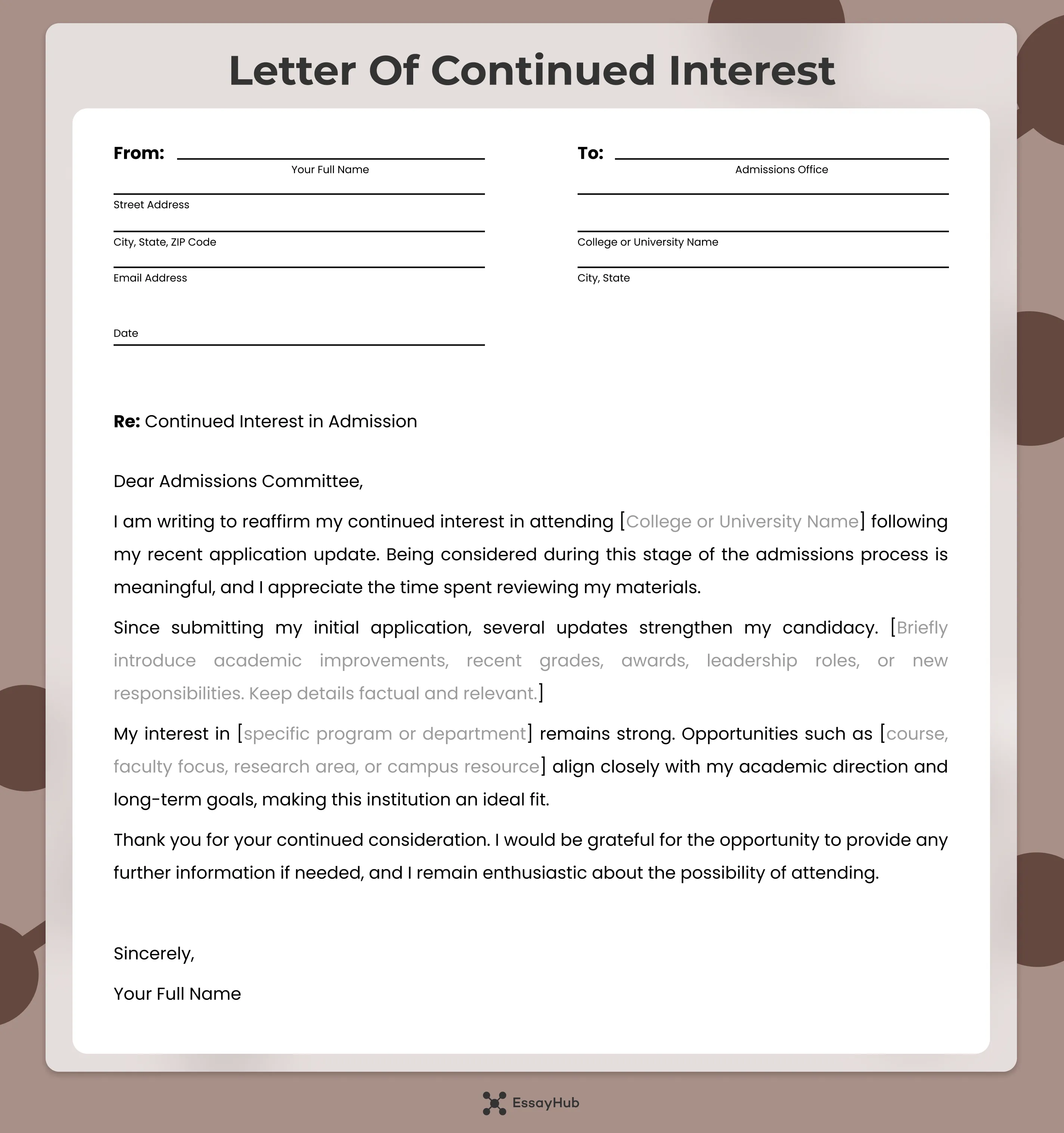
You can also take a look at the PDF format:

EssayHub can write your college essay, so that your supplemental essays and continued interest letters all convey a cohesive voice.
What Not to Include in a Letter of Continued Interest?
A letter of continued interest works when it stays narrow and thoughtful. Adding too much detail, or the wrong kind of detail, can blur the message you’re trying to send. The point is to share a clear update and restate your interest, not to reargue your application or push for a decision.
Avoid including the following:
- Repetition from your original application: Rewriting your personal statement or listing activities already reviewed adds no new value and signals a lack of judgment.
- Emotional appeals or pressure language: Statements meant to create guilt or urgency can feel uncomfortable to admissions readers and work against you.
- Excessive praise for the institution: Flattery without substance reads as generic and distracts from your actual qualifications.
- Negative comparisons to other schools: Mentioning other institutions, especially in a dismissive way, raises unnecessary questions about motivation.
- Unverified or minor updates: Small changes that do not strengthen your profile can clutter the letter and dilute its impact.
- Complaints about the decision or process: Frustration, disappointment, or criticism should never appear in a continued interest letter.
- Overly long explanations: A letter that runs long suggests difficulty prioritizing information and respecting the reader’s time.
For applicants in creative fields, EssayHub offers guidance on crafting an artist statement that explains your work and aligns with the rest of your application.
The Bottom Line
A strong letter of continued interest reads as deliberate and well judged. Growth since the original application should be clear, along with a sense that the program still aligns with your academic goals. Intent is best stated plainly, without pressure or unnecessary detail. When handled carefully, the letter keeps your application visible and credible during ongoing review. For students who want help refining their message or polishing their language, EssayHub offers comprehensive assistance while preserving a professional tone, including support for tasks like ‘write my personal statement’ when applicants need broader guidance beyond a single letter.
FAQs
How to Write a Good Letter of Continued Interest?
How to Format a Letter of Continued Interest?
Where to Send a Letter of Continued Interest?
When to Send a Letter of Continued Interest?
How Long Should a Letter of Continued Interest Be?

Mark Bradford, a passionate and talented artist, utilizes his innovative spirit to support academic pursuits. In partnering with EssayHub, he leverages his artistic insights to assist students as a professional essay writer, helping them navigate and complete their academic assignments at every level of difficulty.
- Georgia Institute of Technology. (n.d.). Deferred admission. https://admission.gatech.edu/first-year/defer
- Emory University. (n.d.). Deferred applicants https://apply.emory.edu/apply/deferred.html
- Harvard Law School. (n.d.). The waitlist. https://hls.harvard.edu/jdadmissions/apply-to-harvard-law-school/jdapplicants/application-toolkit/the-waitlist/