.webp)
Key Takeaways
- Tone shows the writer’s attitude and shapes how a reader interprets the message.
- Each tone creates a specific emotional effect, so choosing the right one influences clarity and impact.
- Selecting tone depends on purpose, audience, and the level of formality the task requires.
- Paying attention to word choice, pacing, and sentence structure makes it easier to control tone with intention.
Tones fall into broad categories built around formality, mood, and the stance a writer takes. Some voices sound formal or informal, while others lean toward optimism, pessimism, seriousness, humor, joy, or sadness. Certain approaches push toward persuasion or sarcasm, and some carry sympathy or authority. Each choice signals how the writer feels about the subject before the full meaning unfolds.
This article aims to help students understand the types of tone in academic writing. You will learn how to shape the tone with careful word choice and pacing. If you need deeper guidance, you can turn to essay writer service EssayHub.
What Is Tone in Writing?
Tone in writing is the attitude or stance an author communicates through word choice, phrasing, and level of formality. It shapes how the message sounds and how the reader understands the intention behind it. Tone clarifies whether a piece feels neutral, skeptical, supportive, confident, or any other emotional position. In academic work, tone must stay consistent and aligned with the purpose of the assignment. In creative writing, tone may shift to match the scene or perspective. Every sentence contributes to tone, making it a defining element of how the text is interpreted.
Most Common Types of Tone
The different tones in writing include formal, informal, optimistic, pessimistic, serious, and humorous. Other widely used tones are persuasive, sarcastic, and joyful. You can determine which one among these you need once you fully understand the task and audience.
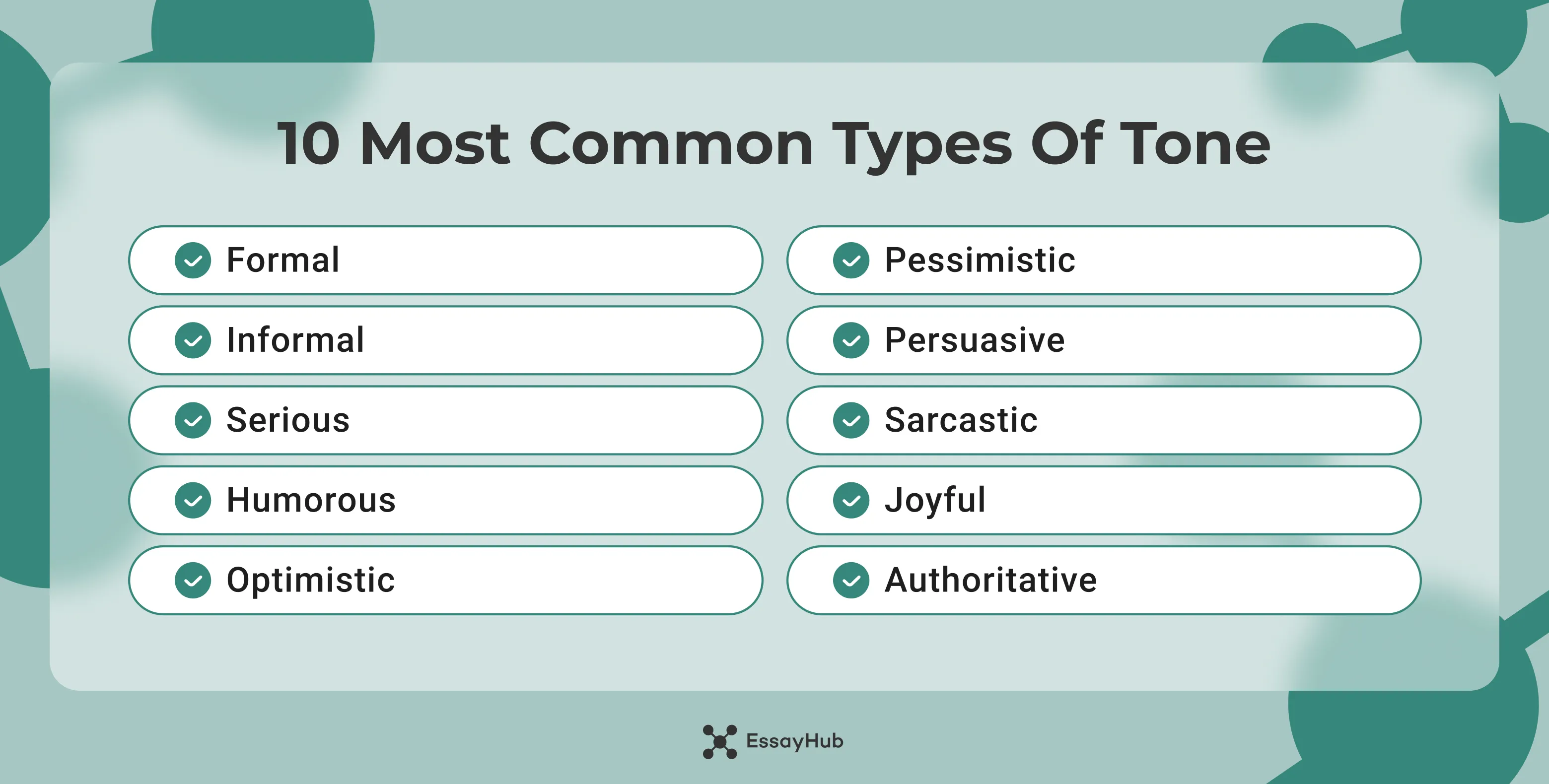
An extended essay service can help you set the right tone for your papers whenever you feel confused.
Formal Tone
A formal tone keeps the language clean and deliberate. It creates distance that helps the message feel organized and steady. Writers use it when the situation calls for careful phrasing and a clear sense of structure.
Examples:
- A written notice arrived this morning that outlined the updated building rules with careful wording.
- The museum requested that all guests follow the posted guidelines during the evening program.
Informal Tone
An informal tone mirrors the flow of everyday conversation. It feels like someone speaking freely, without stiffness or ceremony. Readers settle into it easily because the voice sounds familiar and open.
Examples:
- My roommate wandered in with a half-finished smoothie and asked if I had seen her shoes again.
- I tried that bakery down the street and ended up walking home with a box I definitely didn’t plan to buy.
Serious Tone
A serious tone places weight on the message. It slows the moment and signals that attention is required. People use it when the subject needs steadiness instead of flair.
Examples:
- The paramedic spoke in a level tone that made the entire hallway fall silent.
- The neighborhood parents gathered in the park after hearing about the recent accident near the crosswalk.
Humorous Tone
A humorous tone highlights the funny or unusual parts of a situation. It uses playful wording that makes ordinary moments feel amusing or slightly exaggerated.
Examples:
- My cat knocked over the plant, stared at me like I caused the mess, and then sat in the soil like a tiny gremlin.
- The GPS proudly led me into a parking lot and announced that I had reached my destination.
Optimistic Tone
An optimistic tone leans toward possibility. It reminds the reader that a situation can open up rather than close in. Hope sits at the center of it.
Examples:
- The first rehearsal felt rough, yet the spark in everyone’s eyes hinted at a strong final show.
- The bakery owner opened the shutters early because the sunrise looked too hopeful to waste.
Pessimistic Tone
A pessimistic tone shows concern about how things might turn out. It hints that problems may grow instead of improving, and the wording often feels heavy because the writer expects setbacks.
Examples:
- The bus stop crowd stretched around the corner, which made the morning feel heavier than usual.
- The half-finished project sat on the table, and every piece suggested another long night.
Persuasive Tone
A persuasive tone tries to change the reader’s mind. It uses confident wording that pushes an idea forward and encourages the reader to support a specific action or viewpoint.
Examples:
- The neighborhood should support the weekend cleanup because the park thrives when people invest in it with steady care.
- The school board needs a clear vote on the new program since families have already prepared for the shift.
Sarcastic Tone
A sarcastic tone uses dry humor that carries a bite. It draws attention to the oddness or exaggeration in a situation through sharp phrasing.
Examples:
- The apartment heater worked brilliantly, assuming the goal involved producing a faint suggestion of warmth.
- The group chat solved the problem instantly once everyone repeated the same idea in slightly different words.
Joyful Tone
A joyful tone shows excitement or genuine happiness in the moment being described. It sounds upbeat, and it usually highlights small details that make the scene feel lively or celebratory.
Examples:
- The street filled with music as the bakery opened, and the smell of fresh dough rolled into the morning air.
- My cousin burst into the kitchen, waving her college acceptance email like a sparkler.
Authoritative Tone
An authoritative tone comes from certainty. It signals that the writer knows the subject deeply and can guide the reader without hesitation.
Examples:
- The trail requires sturdy footwear, steady pacing, and attention to the posted markers at each ridge.
- The appliance must rest for a full hour after installation because the internal pressure stabilizes only under controlled conditions.
An extended essay writing service can help you set the right tone for your papers.


Examples of 50 More Types of Tone
Writers reach for far more than “serious” or “funny” when they want a specific emotional effect. Real life needs sharper tools. You might want a tone that sounds jaded, or one that feels gently supportive, or something that makes a boring scene look completely unhinged. The more of these shades you know, the easier it becomes to choose the exact voice your paragraph needs.
Below are fifty extra types and examples of tone in writing.
1. Cautionary Tone
A cautionary tone warns the reader about a real or likely risk. It points out what could go wrong and signals that the situation deserves attention before moving forward.
Examples:
- Double-check the contract before signing anything.
- Save your work now because this software crashes without warning.
2. Ambivalent Tone
An ambivalent tone shows mixed or competing feelings. It reflects hesitation, uncertainty, or a lack of clear direction, even when the writer acknowledges that the decision matters.
Examples:
- I might go to the event, but nothing about it excites me.
- The project matters, yet I still don’t know how invested I feel.
3. Acerbic Tone
An acerbic tone delivers criticism sharply and without restraint. It cuts straight to the flaw or problem and makes no attempt to soften the reaction or protect the reader’s feelings.
Examples:
- This plan collapses the moment anyone looks at the details.
- If this is your final draft, I’d hate to see the earlier ones.
4. Chatty Tone
A chatty tone is perhaps one of the most common types of tones in writing because it sounds like natural conversation. It’s relaxed, informal, and often includes small personal observations that make the writing feel like friendly one-on-one talk.
Examples:
- I walked into the meeting late again, and everyone pretended not to notice.
- You should’ve seen the line at the bookstore; it wrapped around the entire block.
5. Benevolent Tone
A benevolent tone is used to express goodwill and supportive intent. It shows a desire to help, reassure, or uplift the person being addressed, even when pointing out a difficulty.
Examples:
- You worked hard on this, and it shows in every section.
- Let me help you organize the notes so the next step feels easier.
6. Accusatory Tone
An accusatory tone assigns blame directly. It focuses on the other person’s actions and presents them as the clear cause of a problem or negative outcome.
Examples:
- You ignored every guideline I sent.
- This problem started because you refused to check the numbers.
7. Celebratory Tone
A celebratory tone highlights success or meaningful progress. It recognizes achievement and gives the moment the sense of importance or joy it deserves.
Examples:
- We reached our fundraising goal in half the expected time.
- Your team closed the quarter stronger than anyone predicted.
8. Aggrieved Tone
An aggrieved tone expresses resentment or the belief that someone has been treated unfairly. It often comes from feeling overlooked, dismissed, or burdened by someone else’s actions.
Examples:
- I handled most of the work, yet my name barely appeared in the report.
- You promised support, and I ended up dealing with the fallout alone.
9. Complex Tone
A complex tone communicates layered thoughts or mixed interpretations. It acknowledges that the situation cannot be reduced to a simple claim, and it reflects how multiple factors shape the writer’s view.
Examples:
- The policy helps some groups, complicates things for others, and shifts budgeting in ways we’re still mapping out.
- I appreciate the opportunity, even though the workload and timing raise several concerns.
10. Defensive Tone
A defensive tone pushes back at criticism or perceived blame. It tries to justify actions, correct assumptions, or protect the writer from judgment that feels unfair or inaccurate.
Examples:
- I followed every instruction you gave, so the mistake isn’t on me.
- You’re misunderstanding what I said, and I need you to hear it correctly.
11. Friendly Tone
A friendly tone sounds warm, approachable, and easy to trust. It creates a sense of closeness and makes the reader feel welcomed rather than judged or instructed.
Examples:
- Let me know when you need help, and I’ll jump in right away.
- I saved you a seat because I knew you’d want the better view.
12. Tense Tone
A tense tone carries pressure or unease. It signals that something important is at stake and that the situation feels tight, strained, or close to breaking.
Examples:
- We need an answer now because the window for change is closing fast.
- Nobody spoke during the meeting, and the silence kept tightening.
13. Apologetic Tone
An apologetic tone expresses regret or responsibility for something that went wrong. It acknowledges fault directly and aims to repair trust or soften the impact of a mistake.
Examples:
- I should have updated you sooner, and I’m sorry you had to wait.
- I misunderstood the instructions, and that set everything back.
14. Irreverent Tone
An irreverent tone treats serious subjects with a casual or playful attitude. It challenges formality and often pushes against expectations, sometimes for humor and sometimes for boldness.
Examples:
- The “mandatory” meeting could’ve been a three-sentence email, but here we are.
- They called it a historic announcement, yet half the room fell asleep before slide two.
15. Depressing Tone
A depressing tone highlights emotional heaviness. The writer acknowledges a situation that feels draining or bleak, and the wording gives the reader a sense of weight or sorrow without exaggeration.
Examples:
- The house feels quieter every night, and I’m starting to dread walking through the door.
- I keep replaying the conversation, hoping it would hurt less the next time around.
16. Detached Tone
A detached tone creates distance between the writer and the event. It sounds observational rather than emotional, as if the writer is describing something from the outside rather than living it.
Examples:
- She packed her things, and I watched without feeling much at all.
- The meeting ended, and everyone left quickly, which seemed expected.
17. Disappointed Tone
A disappointed tone appears when expectations fall short. The writer acknowledges that something could have turned out better and focuses on that gap.
Examples:
- I hoped the news would be different, but it wasn’t.
- The turnout was smaller than we planned, and it stung a little.
18. Disheartening Tone
A disheartening tone conveys discouragement. The writer recognizes setbacks that feel bigger than expected and shows how they drain motivation.
Examples:
- I tried applying again, but the rejection letter arrived just as quickly as the last one.
- The project collapsed before we even reached the first milestone.
19. Dispassionate Tone
A dispassionate tone remains neutral and controlled. The writer sticks to facts and avoids revealing any personal stake in the situation.
Examples:
- The report will be finished once the final numbers are verified.
- She left before the ceremony, and no further explanation was given.
20. Docile Tone
A docile tone sounds gentle and agreeable. It signals that the writer accepts what’s happening without pushback, even if the situation isn’t ideal.
Examples:
- If that’s the plan, I’m fine with going along.
- I don’t mind adjusting the schedule again if it helps.
21. Earnest Tone
An earnest tone is sincere and steady. It shows that the writer cares deeply and wants their words to be taken seriously.
Examples:
- I really need you to understand why this matters to me.
- I meant every word I said about supporting your move.
22. Egotistical Tone
An egotistical tone centers on the writer’s importance. It often reads as confident to the point of self-inflation.
Examples:
- They should’ve asked me first; I always make the best calls.
- Honestly, I was the reason the whole event worked.
23. Encouraging Tone
An encouraging tone pushes the reader forward. It offers reassurance in a practical way, focusing on effort and possibility rather than clichés.
Examples:
- You’ve already solved tougher problems than this; keep going.
- The first draft doesn’t need to be perfect, just written.
24. Evasive Tone
An evasive tone dodges clarity. The writer avoids direct answers or shifts the conversation to avoid being pinned down.
Examples:
- Well, there are a lot of factors, so it’s hard to say.
- I’m sure we’ll talk about it later, once things settle.
25. Facetious Tone
A facetious tone uses playful exaggeration or light sarcasm. It pokes fun without aiming to wound.
Examples:
- Sure, because staying up until 3 a.m. is obviously the healthiest choice.
- I’d love to help, assuming my superpowers kick in today.
26. Forceful Tone
A forceful tone gives commands or pushes urgency. It sounds firm, direct, and uncompromising.
Examples:
- Send the files now so we can finish today.
- Move your bags off the walkway; people can’t get through.
27. Frustrated Tone
A frustrated tone reflects irritation that’s been building. The writer acknowledges obstacles that feel repetitive or unnecessary.
Examples:
- I’ve explained this twice, and we’re still in the same spot.
- Every fix creates another issue, and I’m running out of patience.
28. Grim Tone
A grim tone underscores a sense of dread or seriousness. It hints that the circumstances may get worse before they improve.
Examples:
- The forecast says the storm could swallow half the coast by morning.
- His silence told me the outcome wouldn’t be good.
29. Humorous Tone
A humorous tone makes space for amusement. It points out odd or ridiculous details to lighten the moment.
Examples:
- I tried baking bread, and the loaf came out shaped like a deflated football.
- My cat keeps scheduling meetings by walking across the keyboard.
30. Hypocritical Tone
A hypocritical tone contradicts itself. The writer pretends to uphold a standard while clearly breaking it.
Examples:
- I told her to stop procrastinating, right after ignoring my own deadline.
- Don’t overspend this month, I said, clicking “checkout” again.
31. Imploring Tone
An imploring tone asks for help or understanding with clear emotions. It shows vulnerability and a need for response.
Examples:
- Please hear me out before deciding.
- I need you to stay for a moment; I can’t handle this alone.
32. Incensed Tone
An incensed tone carries sharp anger. The writer reacts strongly to a perceived insult or wrongdoing.
Examples:
- I can’t believe you shared that without asking me.
- That comment was out of line, and you know it.
33. Incredulous Tone
An incredulous tone expresses disbelief. The writer can’t accept what they’re hearing or seeing.
Examples:
- You’re telling me this all happened overnight?
- That explanation doesn’t make sense to me at all.
34. Indignant Tone
An indignant tone shows outrage rooted in feeling wronged. The reaction is emotional but grounded in a sense of fairness.
Examples:
- You blamed me when you knew I wasn’t even there.
- I won’t stay quiet about this; it crosses a line.
35. Macabre Tone
A macabre tone leans into fear, death, or unsettling imagery. It pushes the reader toward the darker edges of a situation and doesn’t hide the discomfort that comes with it.
Examples:
- I kept hearing footsteps in the hallway long after everyone was supposed to be gone.
- The room looked untouched, yet the silence carried a strange warning.
36. Naïve Tone
A naïve tone shows innocence or a limited understanding of a situation. It sounds open and curious, sometimes missing implications that others would notice immediately.
Examples:
- I thought the store would stay open if I showed up late and smiled.
- She told me everyone keeps their promises, so I didn’t bother to double-check.
37. Mocking Tone
A mocking tone imitates someone in a way that belittles them. It uses sharp phrasing that pokes fun at behavior, choices, or beliefs.
Examples:
- Wow, what a brilliant plan, truly flawless.
- Look at you acting surprised again, as if this wasn’t predictable.
38. Laudatory Tone
A laudatory tone expresses admiration or approval. It highlights strengths and achievements with clear respect.
Examples:
- Your dedication shows in every detail you finished today.
- She carried the entire project with a level of focus most people never reach.
39. Mischievous Tone
A mischievous tone plays with boundaries in a light, sometimes sneaky way. It hints at trouble without fully committing to it.
Examples:
- I told him the cookies disappeared on their own, which was technically true.
- Let’s try it once and pretend we planned it all along.
40. Narcissistic Tone
A narcissistic tone centers the speaker above everyone else. It carries self-importance and a belief that their actions or abilities outweigh those around them.
Examples:
- I wouldn’t expect you to get it, but I always do things flawlessly.
- If they had listened to me sooner, none of this would have fallen apart.
41. Nostalgic Tone
A nostalgic tone looks backward with longing or affection. It pulls emotion from memories and frames the past as vivid and meaningful.
Examples:
- The streetlights felt warmer back then, even on cold nights.
- I still remember how the house smelled after the first snowfall.
42. Outspoken Tone
An outspoken tone states opinions directly, even when they may cause discomfort. It values honesty over restraint.
Examples:
- These are clear writing myths, and pretending they’re real solves nothing.
- He crossed a line, and everyone in the room knows it.
43. Malicious Tone
A malicious tone speaks with intent to hurt. It uses sharp language designed to unsettle, provoke, or emotionally harm.
Examples:
- You always fall short, and today just proves it again.
- Tell them the truth about what you did, if you can stand hearing it out loud.
44. Pragmatic Tone
A pragmatic tone strips emotion away to focus on results. It prioritizes what can be done now and what will actually work.
Examples:
- Call them first, fix the mistake second, and settle the rest tomorrow.
- We don’t need theories, just a step that moves us forward.
45. Mourning Tone
A mourning tone expresses grief and the weight of loss. It leaves space for sorrow and reflects on what can’t return.
Examples:
- Her laugh still echoes in my head, even though the room is quiet now.
- I keep reaching for my phone to text him, then remembering why I can’t.
46. Judgmental Tone
A judgmental tone is harsh. It highlights flaws and shortcomings with little patience or generosity.
Examples:
- You didn’t even try, and it shows in every part of this.
- He talks big, but his actions are always small.
47. Obsequious Tone
An obsequious tone tries too hard to please. It bends toward flattery in a way that feels eager or overly deferential.
Examples:
- Your idea is brilliant, truly brilliant, and I’d love to follow your lead.
- If you approve it, I’ll support it fully, no questions asked.
48. Pensive Tone
A pensive tone slows down and reflects. It suggests quiet thinking and a mind turning something over carefully.
Examples:
- I’ve been wondering why this moment feels heavier than it should.
- Some decisions echo for years, even when they start small.
49. Jaded Tone
A jaded tone shows weariness or emotional exhaustion. It hints at past disappointments that shape how the speaker now sees things.
Examples:
- I’ve heard promises like that before, and they never last.
- Nothing surprises me anymore, not even the bad news.
50. Mean-Spirited Tone
A mean-spirited tone delivers cruelty with intention. It doesn’t soften the blow and aims to make someone feel small.
Examples:
- You’ll never get it right, so stop pretending you can.
- They only tolerate you because they feel sorry for you.
A Detailed PDF List of Types of Tone
If you want a quick guide you can keep on hand, the tone examples list in the PDF offers a clean, easy-to-scan format. It’s simple to reference while drafting and helps you pick the right tone without scrolling back through the full article.

How Do I Choose the Right Tone in Writing?
Choosing a tone is a small step that quietly influences everything else in your writing. A reader senses mood before processing your argument, so the right tone in a sentence becomes crucial. Here are a few ways to pick a tone that actually fits what you’re trying to say:
- Think about the reader first and ask what kind of voice they’ll accept without resistance.
- Match the tone to the goal of the piece; some assignments want clarity, some need persuasion, and a few want you to sound like you’re simply thinking out loud.
- Read your writing aloud and listen for any stiffness or sharp edges sneaking in.
- Keep a small collection of writing you admire and study how those writers shape tone by changing one word at a time.
- Look back at the requirements before you submit; tone slips easily when you’re tired.
Check out our guide on capitalization rules if you want your writing to read even sharper.
Bringing Everything Together
Tone shapes how writing sounds and how readers interpret the message. It’s the attitude carried through word choice, structure, and formality. Strong writing depends on choosing a tone that fits the purpose, matches the audience, and stays consistent from start to finish. Different tones create different effects, and small shifts in phrasing can change how a sentence reads.
If you feel stuck choosing the right tone for your papers, you can rely on help from EssayHub's professionals.
FAQs
How to Use Tone in Writing?
Why Is Tone Important in Writing?
How to Identify Tone in Writing?
What Are the Different Types of Tone?
What Is Tone in Writing?

Mark Bradford, a passionate and talented artist, utilizes his innovative spirit to support academic pursuits. In partnering with EssayHub, he leverages his artistic insights to assist students as a professional essay writer, helping them navigate and complete their academic assignments at every level of difficulty.
- BBC Bitesize. (2024, February 14). Types of tone - Analysing tone in Critical Reading - National 5 English Revision - BBC Bitesize. BBC Bitesize. https://www.bbc.co.uk/bitesize/guides/zdybkhv/revision/2
- Wheaton College. (2009). Style, Diction, Tone, and Voice. Wheaton College. https://www.wheaton.edu/academics/services/writing-center/writing-resources/style-diction-tone-and-voice/