
Key Takeaways
- Signal phrases identify the author, frame the idea, and connect source material to your analysis
- Verb choice shapes meaning, showing agreement, caution, or contrast
- Placement affects flow, emphasis, and readability within a sentence
- Proper punctuation protects academic integrity and prevents misquotation
- Varying signal phrases improves clarity and strengthens credibility
A signal phrase introduces source material by naming the author and framing the evidence within the writer’s analysis. It creates smooth transitions between original interpretation and supporting evidence. For instance, in psychology, Steven Pinker explains language development by referencing research and evidence.
This article defines signal phrases and explains their examples, placement, citation styles, and common mistakes.
Why Use a Signal Phrase?
Signal phrases play a central role in academic writing because they shape how sources enter your argument. They guide readers, clarify ownership of ideas, and strengthen the overall flow of analysis. Used consistently, signal phrases help with:
- Preventing plagiarism by giving credit and clearly connecting ideas to their original authors, reducing the risk of plagiarism.
- Establishing authority by showing awareness of who produced the source and why it matters.
- Positioning arguments by framing evidence in a way that reinforces the writer’s analytical direction.
How to Use a Signal Phrase?
Using signal phrases effectively depends on three core elements that work together inside a sentence:
- Author name: Identifies who produced the idea and anchors it to a credible source
- Attributive tag: A reporting verb, such as states, argues, or explains that frames the author’s stance
- Source material: The quoted or paraphrased idea being introduced
Writers can strengthen credibility by adding titles or credentials when relevant. Phrases like historian John Smith or cognitive psychologist Steven Pinker help readers assess the authority of a source before engaging with the evidence.
Verb choice is important because it shapes meaning. Saying an author argues signals a firm position, while concedes suggests limitation or partial agreement. Misusing these verbs can misrepresent the author’s ideas and weaken the analysis.
Signal phrases also support contrast between sources. Transition words allow writers to place scholars in dialogue with one another:
- Smith argues that media exposure shapes behavior; however, Johnson suggests environmental factors play a stronger role.
- Although early studies supported this view, later research challenges its conclusions.
For a broader breakdown of linking words for essays and how they support flow, this guide explains common patterns.
How to Vary a Signal Phrase Placement?
You can place signal phrases at the beginning, middle, or end of a sentence to control rhythm and keep academic flow from sounding mechanical. Where you place them changes what readers notice first and how smoothly ideas connect.
- A lead-in placement introduces the source before the evidence. This approach works well when readers need context. A comma usually follows the attributive tag here.
- An interrupted placement sits inside the quotation itself. This is a more advanced move. It lets writers spotlight a specific word or idea without stopping the sentence cold.
- A follow-up placement delivers the idea first and credits the source afterward. Writers typically use a period or attribution phrase that removes the need for a comma and keeps the sentence moving.
Sentence transformation:
- Lead-in: Smith argues, 'Digital tools reshape attention.'
- Interrupted: 'Digital tools,' Smith argues, 'reshape attention.'
- Follow-up: 'Digital tools reshape attention.' Smith argues.


Signal Phrases Examples
The signal words you choose reveal how an author positions an idea and how you, as the writer, relate to that source material.
Below are the main functions signal phrases perform with examples.
- Presenting an author’s central claim: This function introduces a main idea without judgment. It keeps the focus on the author’s position. (Common words: argues, explains, states, notes)
Example: Smith argues that early exposure to language affects long-term cognitive development.
- Showing agreement or alignment: These signal phrases indicate that the writer supports or builds on the source’s ideas. (Common words: supports, agrees, affirms, reinforces)
Example: Jones supports this view, suggesting that consistent feedback improves learning outcomes.
- Marking limitation or qualification: Here, signal words show that the author acknowledges boundaries, exceptions, or uncertainty. (Common words: concedes, acknowledges, admits, qualifies)
Example: Lee concedes that the study’s sample size limits its broader application.
- Expressing contrast or disagreement: This function places sources in tension and helps structure debate. (Common words: challenges, disputes, counters, questions)
Example: Garcia challenges this assumption, arguing that cultural factors play a larger role.
- Summarizing or synthesizing ideas: These signal phrases condense complex arguments into a manageable form. (Common words: summarizes, outlines, reviews, synthesizes)
Example: In a broad review, Patel summarizes prior research on attention and memory.
- Evaluating credibility or emphasis: This function subtly comments on the strength or significance of the source. (Common words: emphasizes, highlights, stresses, underscores)
Example: Chen emphasizes the long-term implications of these findings for policy decisions.
Understanding how signal phrases guide readers also supports broader teaching strategies. See our article to learn more.
Signal Phrase Examples Across Different Citation Styles
Signal phrase examples change depending on citation styles because each system handles tense, attribution, and placement differently.
Signal Phrases in APA
APA style prioritizes research currency. Writers usually use the present tense for established findings and the past tense for specific studies. Author names appear with the publication year, and signal phrases often introduce paraphrased ideas rather than long quotations.
Signal Phrases in MLA
MLA style emphasizes the text itself. Signal phrases typically use the present tense when discussing an author’s ideas, even for older works. Page numbers follow quotations, and attributive verbs focus on what the author says within the source.
Signal Phrases in Chicago
Chicago style allows more flexibility. Writers may choose the past or present tense based on context and discipline. Signal phrases often include fuller references to the author or publication, especially in historical or humanities-based writing.
Choosing Signal Phrases by Tone
Tone shapes how sources enter academic writing. A signal phrase tells readers how strongly a claim is made, how much distance the writer keeps, and how ideas relate to one another. When tone matches intent, arguments stay accurate and credible. When it doesn’t, sources get distorted.
Below is a signal phrase bank organized by writer intent:
Tone choice should always match context. A literature review often relies on neutral and summarizing verbs to map existing research. An argumentative section may lean on stronger verbs to advance a claim. When comparing scholars, contrast verbs help clarify disagreement without overstating it.
Choosing the right signal phrase is part of making deliberate language choices in writing, and this guide explains how word selection shapes tone.
Signal Phrase Mistakes to Watch For
Signal phrases help clarify sources, but small missteps can undercut their purpose. Most mistakes come from rushing or relying on habit instead of intent. When signal phrases feel repetitive, inaccurate, or incomplete, readers lose trust in how sources are handled. Catching these issues early keeps writing clear, precise, and academically sound.
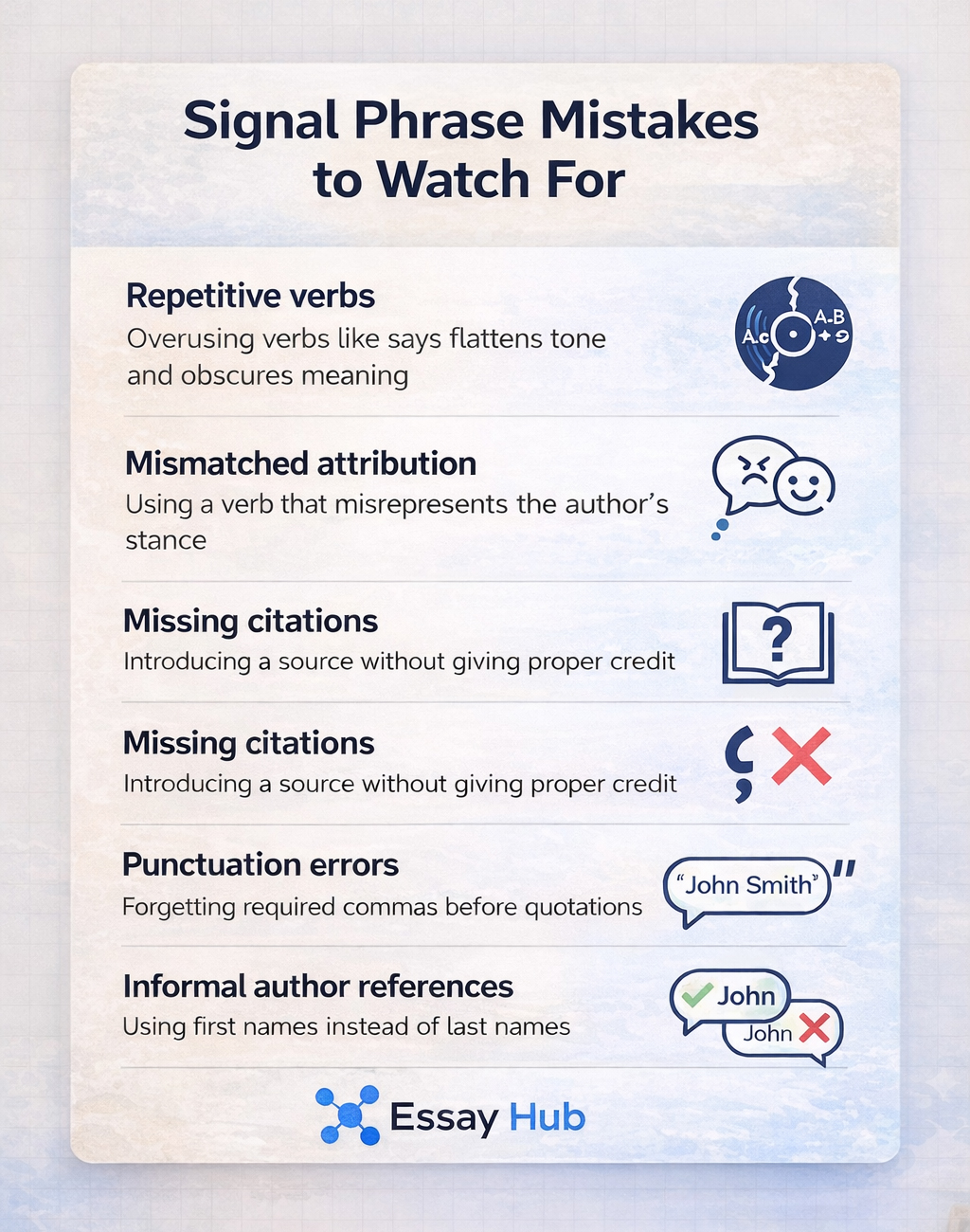
- Falling back on the same verb every time, especially says, which drains tone and hides meaning
- Picking a verb that doesn’t fit the author’s actual position, making a careful claim sound forceful, or a strong claim sound hesitant
- Introducing a source clearly, then forgetting to include the citation that gives it proper credit
- Slipping up on punctuation, especially missing the comma before a quotation in a lead-in signal phrase
- Referring to authors by first name only, which weakens formality and makes the writing sound casual
Final Thoughts
Signal phrases shape how sources enter your writing. They clarify who is speaking, frame ideas accurately, and help arguments flow without sounding stitched together. When chosen with intention, signal phrases strengthen credibility, prevent confusion, and keep readers oriented as ideas move between your analysis and supporting evidence.
If you need help beyond examples and rules, remember, EssayHub can write an essay from scratch.
FAQs
How to Use Signal Phrases?
What Is a Signal Phrase Example?
How to Write a Signal Phrase?
What Is the Purpose of a Signal Phrase?
What Are Signal Phrases?

Ryan Acton is an essay-writing expert with a Ph.D. in Sociology, specializing in sociological research and historical analysis. By partnering with EssayHub, he provides comprehensive support to students, helping them craft well-informed essays across a variety of topics.
- Madonna University Writing Center. (n.d.). Signal phrases. https://www.madonna.edu/pdf/OWLSignalPhrases.pdf
- University of Wisconsin–Madison Libraries. (n.d.). Signal phrases. https://researchguides.library.wisc.edu/c.php?g=1148483&p=8387380