.webp)
An explanatory essay is a type of assignment that does not take sides. It covers a subject honestly, breaks it down in a way that actually makes sense, and leaves the reader understanding it by the last line.
Pulling one together means a few things have to line up. You pick a topic narrow enough to handle properly, go through the material with some care, sort what you find into an order that flows, and write it out in language that does not waste the reader's time.
Here, we cover what the purpose of an explanatory essay is, how to outline it, the steps involved in drafting it, the mistakes we see students make most often, and some examples worth looking at before you try writing an explanatory essay on your own.
What Is an Explanatory Essay?
An explanatory essay is a type of writing that takes something that would otherwise be difficult to grasp and brings it down to a level the reader can actually work with. It does not argue a point or try to pull anyone toward a particular conclusion, and that distinction matters more than it might seem at first.
As the writer, your job is to stay neutral from the first sentence to the last, and that is honestly harder than most students expect it to be. The purpose of an explanatory essay is actually to have accuracy, a clear line of thought, and an order that lets the reader follow along without losing the thread somewhere in the middle.


Explanatory Essay Outline
Before writing anything, having a clear explanatory essay outline in place makes the whole process considerably more manageable, and we cannot stress that enough. Here is what that looks like when it is laid out.
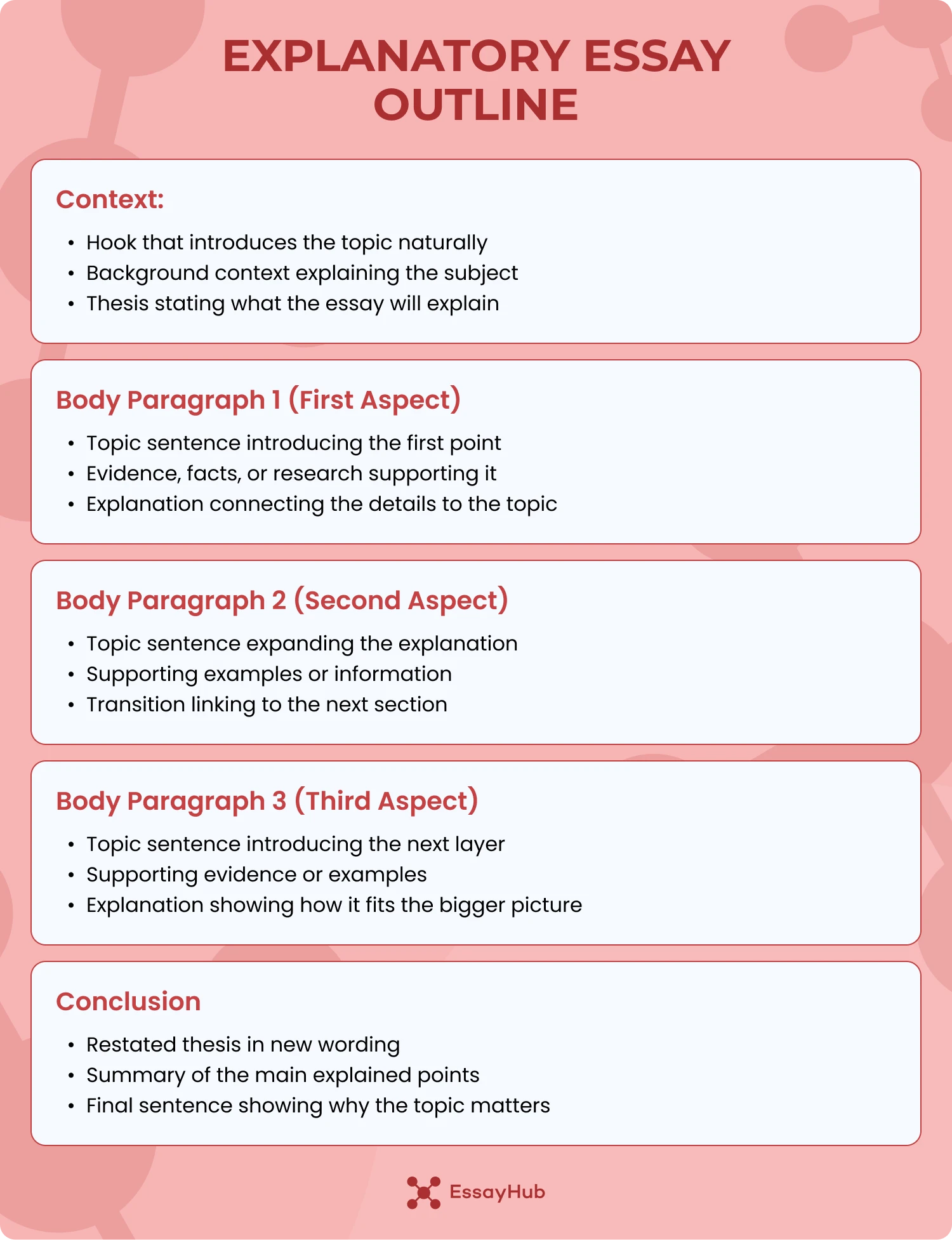
Explanatory Essay Introduction
- Hook: an opening line or two that pulls the reader into the topic without overpromising what the essay delivers
- Background: enough context that the reader understands what is actually being explained before the thesis lands
- Thesis: a clear, grounded statement of what the essay will explain and roughly how it intends to do that
Body Paragraph 1: First Aspect of the Topic
- A topic sentence that tells the reader exactly what this section is going to cover
- Evidence, facts, or research that supports the explanation and gives it something concrete to stand on
- A clear line connecting that information back to the overall topic
Body Paragraph 2: Second Aspect of the Topic
- A topic sentence that moves the explanation forward from where the first paragraph left off
- Supporting information and examples that fill out this particular aspect of the topic
- A brief transition that stitches this section to whatever is coming next
Body Paragraph 3: Third Aspect of the Topic
- A topic sentence that brings in the next layer of the explanation
- Supporting evidence or examples that hold the argument up
- A sentence or two explaining how this piece fits into the broader picture
Explanatory Essay Conclusion
- Restate the thesis in different words, not a copy-paste of what was already said.
- A brief run through the main points covered, just enough to remind the reader of the ground covered
- A closing sentence that leaves the reader with some sense of why understanding this topic is worth their time
How to Create an Explanatory Essay Outline?
Building a strong explanatory essay structure before you start writing saves more time than most students expect it to, and forces you to check whether the explanation actually holds together in a logical order.
- Choose and narrow the topic. Starting broad is one of the more common traps students fall into, so the goal here is to come in specific enough that the explanation has a clear focus.
- Gather the main points. Once the topic is set, identify two or three key aspects of it that are genuinely worth explaining.
- Find supporting information. For each of those points, note down what evidence, examples, or facts will actually back it up.
- Order the points logically. Arrange them in a sequence that builds understanding gradually rather than jumping between ideas.
- Draft the thesis. Write a sentence, just one to start with, that tells the reader what the essay explains and gives them a rough sense of how it is organized.
If you are struggling with structure or clarity, our experts can help write your essay and organize your ideas effectively.
Explanatory Essay Structure Example
To make the outline more concrete, here is what one looks like applied to a specific topic. We chose something that comes up in real academic contexts but does not get covered as often as it probably should.
Topic: How Algorithmic Content Recommendation Shapes What People Read and Believe
Introduction
- Hook: Most people assume they choose what they read online. In practice, a significant part of that choice is made for them before they open a single article.
- Background: How recommendation algorithms work in basic terms and where they are used
- Thesis: Algorithmic content recommendation influences reading habits, narrows exposure to diverse perspectives, and gradually shapes what people accept as normal or true
Body Paragraph 1: How Recommendation Algorithms Actually Work
- Topic sentence: Before examining the effects, it helps to understand the mechanism
- Explanation of how platforms track behavior and use it to predict what a user will engage with next
- Key point: The system optimizes for engagement, not accuracy or diversity
Body Paragraph 2: How Algorithms Narrow What People Are Exposed To
- Topic sentence: Over time, recommendation systems tend to pull users toward a narrower range of content
- Evidence from research on filter bubbles and echo chambers
- Explanation of how this happens gradually and why most users do not notice it
Body Paragraph 3: How Repeated Exposure Affects Belief
- Topic sentence: Seeing the same types of claims and perspectives repeatedly has a measurable effect on what people consider credible
- Reference to research on familiarity and perceived truth
- Explanation of why this matters beyond individual reading habits
Conclusion
- Restate thesis: Algorithms shape not just what people read but how they come to think about the world around them
- Summarise the three main points briefly.
- Closing sentence: Understanding how this works is the first step toward engaging with online information more deliberately
Explanatory essays often explore modern issues and technology. Our article on how accurate is AI examines the reliability of AI-generated information.
Explanatory Essay Examples
A good explanatory essay stays neutral throughout and builds understanding gradually rather than dumping information all at once. Each section connects to the next, the evidence is specific rather than vague, and the reader finishes with a clearer picture of the topic than they started with. Here is what writing explanatory essays looks like in practice.
Example #1: How Sleep Debt Accumulates and What It Does to the Brain
[Hook] Most people think they can catch up on lost sleep over a weekend. The research suggests that it is not quite how it works.
[Background] Sleep debt is the gap between how much sleep the body needs and how much it actually gets. It builds gradually, often without the person noticing, because the brain adapts to reduced sleep in ways that mask how impaired it has become.
[Thesis] Understanding how sleep debt accumulates, how it affects cognitive function, and why recovery is slower than most people assume helps explain why chronic tiredness has become such a widespread problem.
[Body: How It Builds] Sleep debt does not require dramatic deprivation to develop. Losing an hour a night across five days produces the same cognitive deficit as pulling an all-nighter, according to research from the University of Pennsylvania. The difficulty is that the brain stops accurately registering how tired it actually is after a few days of reduced sleep, which makes the problem self-concealing.
[Body: What It Does] The effects show up in concentration, memory consolidation, reaction time, and decision-making. What is less commonly known is that emotional regulation is also affected. People running on sleep debt tend to react more strongly to negative experiences and recover from them more slowly, which has implications beyond just feeling tired at work.
[Body: Why Recovery Takes Longer] A single night of good sleep does not clear accumulated debt. Research suggests full cognitive recovery after a period of sleep restriction can take several days of adequate sleep, not one. The brain prioritizes certain types of recovery over others, which means some functions return to normal before others do.
[Conclusion] Sleep debt is not a minor inconvenience that a weekend fixes. It is a physiological deficit with measurable consequences that builds quietly and recovers slowly. Knowing that changes how the problem is worth thinking about.
What Makes This Work:
The essay stays objective throughout and never tells the reader what to do or what to think about the information. Each body section adds a new layer rather than repeating the same point in different words. The thesis signals clearly what the three body paragraphs will cover, and they follow through on that in the same order. That kind of internal consistency is what separates an explanatory essay that reads cleanly from one that feels like scattered information.
If you want to compare different writing styles, reviewing narrative essay examples can help you see how structure changes across essay types.
Example #2: How Misinformation Spreads Faster Than Corrections Online
[Hook] A false story travels faster than the correction that follows it. That is not an impression. It is what the data shows.
[Background] Misinformation online is not a new problem, but the speed at which it moves has changed significantly with social media. Understanding why it spreads the way it does requires looking at the mechanics behind it rather than just the content itself.
[Thesis] Misinformation spreads faster than accurate information online because of how platforms are designed, how people process emotionally charged content, and why corrections rarely reach the same audience as the original claim.
[Body: Platform Design] Social media platforms are built to maximize engagement. Content that provokes a strong reaction, whether outrage, fear, or surprise, tends to get shared more than content that is accurate but less emotionally charged. The algorithm does not distinguish between the two. It responds to engagement signals regardless of whether the content is true.
[Body: How People Process It] False stories tend to be simpler and more emotionally direct than accurate ones. When something feels intuitively true or confirms what a person already believes, the brain is less likely to pause and question it. Research from MIT found that false news stories on Twitter were 70 percent more likely to be retweeted than true ones, partly because novelty drives sharing and false stories tend to contain more surprising claims.
[Body: Why Corrections Fall Short] By the time a correction appears, the original claim has already reached a much larger audience. People who saw the false story rarely encounter the correction because they have already moved on in their feeds. There is also a psychological dimension. Corrections sometimes trigger a backfire effect where people double down on the original belief rather than revising it, particularly when the false claim aligns with existing views.
[Conclusion] Misinformation spreads the way it does because the conditions online are genuinely well-suited to it. The platforms reward engagement, the content plays to how the brain processes new information, and corrections arrive too late for most of the people who need them. Understanding that sequence makes the problem easier to think about clearly.
What Makes This Work:
Each body paragraph covers a distinct cause without overlapping with the others. The MIT research is specific enough to carry real weight without turning the essay into a literature review. The conclusion does not moralize or tell the reader what to do with the information. It simply closes the explanation at the point where it has covered what the thesis promised.
Example #3: Why Certain Cities Become Creative Hubs, and Others Do Not
[Hook] Some cities produce a disproportionate share of the world's artists, designers, musicians, and writers. That is not random, and it is not purely about money.
[Background] The concentration of creative output in specific cities has been studied across economics, urban planning, and sociology. What emerges is a picture that is more specific than most people expect when they think about why creativity clusters geographically.
[Thesis] Certain cities become creative hubs because of a combination of affordable entry conditions, dense informal networks, and a cultural tolerance for experimentation that takes years to build and is difficult to manufacture deliberately.
[Body: Affordable Entry Conditions] Creative industries tend to take root in places where the cost of failure is low enough that people can afford to try things. Cities with cheap rents in certain neighborhoods, accessible studio or rehearsal space, and a baseline of part-time work that pays enough to survive attract people willing to take risks on creative work. Once that initial concentration exists, it tends to attract more of the same.
[Body: Dense Informal Networks] What sustains creative output in a city is not just the presence of individuals but the density of connections between them. Ideas move quickly when people from different disciplines are regularly in the same physical spaces, sharing venues, coffee shops and community events. Research on creative clusters consistently points to informal contact rather than formal institutions as the primary driver of innovation and output.
[Body: Cultural Tolerance for Experimentation] Cities that become known for creative work tend to have a history of tolerating unconventional behavior and ideas rather than pushing toward conformity. That tolerance is not always comfortable or easy to describe, but it shows up consistently in the histories of cities like Berlin, New York in the seventies, or Lagos today. It attracts people who feel out of place elsewhere and creates conditions where experimental work gets made and seen.
[Conclusion] Creative hubs are not built by policy alone or by money alone. They develop over time through a specific set of conditions that are easier to lose than to create. Understanding what those conditions actually are matters for anyone trying to think seriously about why creativity concentrates where it does.
What Makes This Work:
The thesis makes three specific claims, and the body paragraphs deliver on each one in the same order. None of the sections drifts into opinion or recommendation. The examples used, Berlin, New York and Lagos, are specific enough to ground the explanation without turning into case studies that take over the essay. The conclusion closes the explanation without reaching further than the evidence supports.
If you're dealing with larger academic projects, use our bachelor thesis writing service for professional support.
How to Write an Explanatory Essay?
Writing good explanatory essays is more manageable when it is broken into clear stages rather than approached as one large task. Our process comes down to six steps, each one building on the previous.
Step 1: Choose and Narrow the Topic
Starting too broad is probably the most common mistake at this stage. A topic like climate change covers too much ground for one essay to handle properly. Something like how carbon pricing works as a policy mechanism gives the essay a clear focus and a specific explanation to build around. Our advice is to keep narrowing until the topic fits inside one clear question.
Step 2: Research Before Writing Anything
Before the outline, before the thesis, gather the information first. Look for reliable sources that actually explain the topic rather than just referencing it in passing. Note specific facts, figures, and examples as you go. Having that material in front of you before writing starts makes the whole process considerably less frustrating.
For example, if the topic is how sleep debt accumulates, collecting research on sleep restriction studies before drafting means the body paragraphs have real substance to work from rather than vague general claims.
Step 3: Write the Thesis
An explanatory thesis does not argue a position. It signals what the essay is going to explain and roughly how. That distinction matters. Students who are used to argumentative writing sometimes drift into making a claim rather than stating an explanatory direction, and the essay then pulls in the wrong direction from the start.
Example thesis: "This essay explains how recommendation algorithms work, how they shape what users see over time, and why their effects are harder to notice than most people assume."
Pro Tip:
Our approach is to write the thesis before anything else and check that every body paragraph is actually delivering on what it promises.
Step 4: Build the Outline
Our approach here is simple. Take the two or three main aspects of the explanation and assign each one a body paragraph. Check that they follow a logical order, one that builds understanding rather than jumping between unrelated points. If the connection between sections is not obvious at the outline stage, it will not become obvious once full paragraphs are written around them.
Step 5: Write the Draft
Work through the explanatory essay format section by section. Each body paragraph needs a topic sentence that states what it covers, specific evidence or information that supports the explanation, and a few sentences connecting that information back to the overall topic. Neutral language throughout. No opinions, no recommendations, no language that signals a preference.
Transition example between paragraphs: "Beyond how the algorithm functions, it is worth looking at what repeated exposure to a narrowed range of content actually does to reading habits over time."
Step 6: Revise for Clarity
Read the draft back and ask one question at each paragraph: Does this actually explain what it says it is going to explain? Clarity is the main thing to check for in an explanatory essay, not argument strength or persuasiveness. If a sentence could be misread or if a section assumes knowledge the reader probably does not have, that is where revision is needed most.
Pro Tip:
Do not mix explanation with argument. Slipping between the two, explaining something in one paragraph and then arguing for a particular conclusion in the next, pulls the essay in two directions at once and tends to do neither well.
Common Mistakes to Avoid in Explanatory Essays
Most of the mistakes we see in explanatory essays come down to a handful of things that are worth knowing before you start, rather than after.
- Taking a side without realizing it. Opinion has a way of creeping into the writing even when students are actively trying to keep it out, so it is worth checking for that before you submit anything.
- Keeping sources vague. Saying "studies show" or "experts suggest" without naming anything specific does real damage to the explanation, more than most students expect it to.
- Poor ordering. An explanation that jumps between ideas without a clear thread loses the reader faster than almost anything else.
- A weak or missing thesis. A good explanatory essay won’t leave the reader with no sense of where the essay is going, which makes everything that follows harder to follow than it needs to be.
For broader academic support, our custom coursework writing service can help you manage essays, reports, and research assignments.
The Final Words
Explanatory writing is one of the more underrated academic skills. It looks straightforward until you are actually doing it, and doing it well requires more discipline than most students expect going in. Staying neutral, building a logical structure, and explaining rather than arguing are habits that take practice to develop properly.
Our experience working with students on this is that the ones who struggle most are usually the ones who skip the outline and jump straight to writing. Do the groundwork first. The essay tends to take care of itself from there.
FAQs
How Do You Write an Explanatory Essay?
What Is the Structure of an Explanatory Essay?
How Do You Start an Explanatory Essay?
How Many Paragraphs in an Explanatory Essay?
What Is the Purpose of an Explanatory Essay?

Mark Bradford, a passionate and talented artist, utilizes his innovative spirit to support academic pursuits. In partnering with EssayHub, he leverages his artistic insights to assist students as a professional essay writer, helping them navigate and complete their academic assignments at every level of difficulty.
- Learning Experience Team Define and use concepts in your writing. (n.d.). https://www.scu.edu.au/media/scu-dep/current-students/learning-zone/quick-guides/define_and_use_concepts_in_your_writing.pdf
- Flores-Ferres, M., Liselore van Ockenburg, Aimee, Lieke Holdinga, & Weijen, V. (2023, June 18). Writing to Understand and Being Understood: Basic Design Principles for Writing Instruction. https://www.researchgate.net/publication/371672726_Writing_to_Understand_and_Being_Understood_Basic_Design_Principles_for_Writing_Instruction
- Stringer, L. (2024, September 16). Subject Guides: Academic writing: a practical guide: Structure & cohesion. Subjectguides.york.ac.uk. https://subjectguides.york.ac.uk/academic-writing/structure
