Key Takeaways
- About 50% of students worry about false AI accusations, even when their work is original.
- AI detection accuracy can drop from 39.5% to 17.4% after minor edits, increasing false positives.
- Over 90% of students now use AI, but many hide it due to shaming.
- Fear and stigma hinder academic progress, transparency, and innovation.
AI shaming refers to the growing social and institutional pressure that treats using AI as suspicious by default, even when no rules are broken. In academic settings, it shows up through fear-driven enforcement that frames AI use as cheating rather than a tool. As a result, students afraid to use AI often limit or hide their legitim ate use of support tools, not because it is prohibited, but because it feels risky. Recent surveys show that around 50% of students fear false accusations related to AI use.
This climate of AI shaming in education shifts focus away from learning and toward self-protection. EssayHub’s extended essay writers step into that gap by helping students navigate expectations responsibly, offering human guidance where policy and practice still lag behind reality.
What Is AI Shaming?
AI shaming is a social, academic, or institutional backlash against people for using AI tools. In practice, this backlash pushes many students and researchers to hide their gen AI usage, treating it as something shameful rather than as a legitimate aid.
This pattern is familiar. New tools that reduce friction in thinking or production have always attracted stigma. Calculators were once accused of destroying mathematical ability. Spellcheckers were framed as shortcuts that weakened language skills. Each time, critics warned that “real” ability was being replaced by automation. Unlike earlier tools, generative AI can participate in core cognitive tasks such as drafting, structuring, or summarizing ideas, which intensifies the fear that human-only efforts are being displaced rather than supported.
AI Shaming Is Now a Widespread Academic Issue
Between 2024 and 2025, attitudes toward AI in education shifted fast:
- Surveys show that 92% of UK students now use AI in some form, up from 66% in 2024.
- Use of generative AI for assessments increased even more dramatically, rising from 53% in 2024 to 88% in 2025.
- Over half of students now report concrete worries: 53% fear being accused of cheating, while 51% are concerned about false positives or hallucinated outputs.
- Students became more aware of real risks - misinformation, deepfakes, bias, data privacy, and intellectual property concerns.
With growing anxiety about skills loss and the sheer pace of AI development, we are facing a climate where using AI feels both necessary and risky. That mix of reliance, uncertainty, and surveillance accelerated AI shaming, quickly turning a tool into a social fault line.
Fear of False Accusations for Using AI
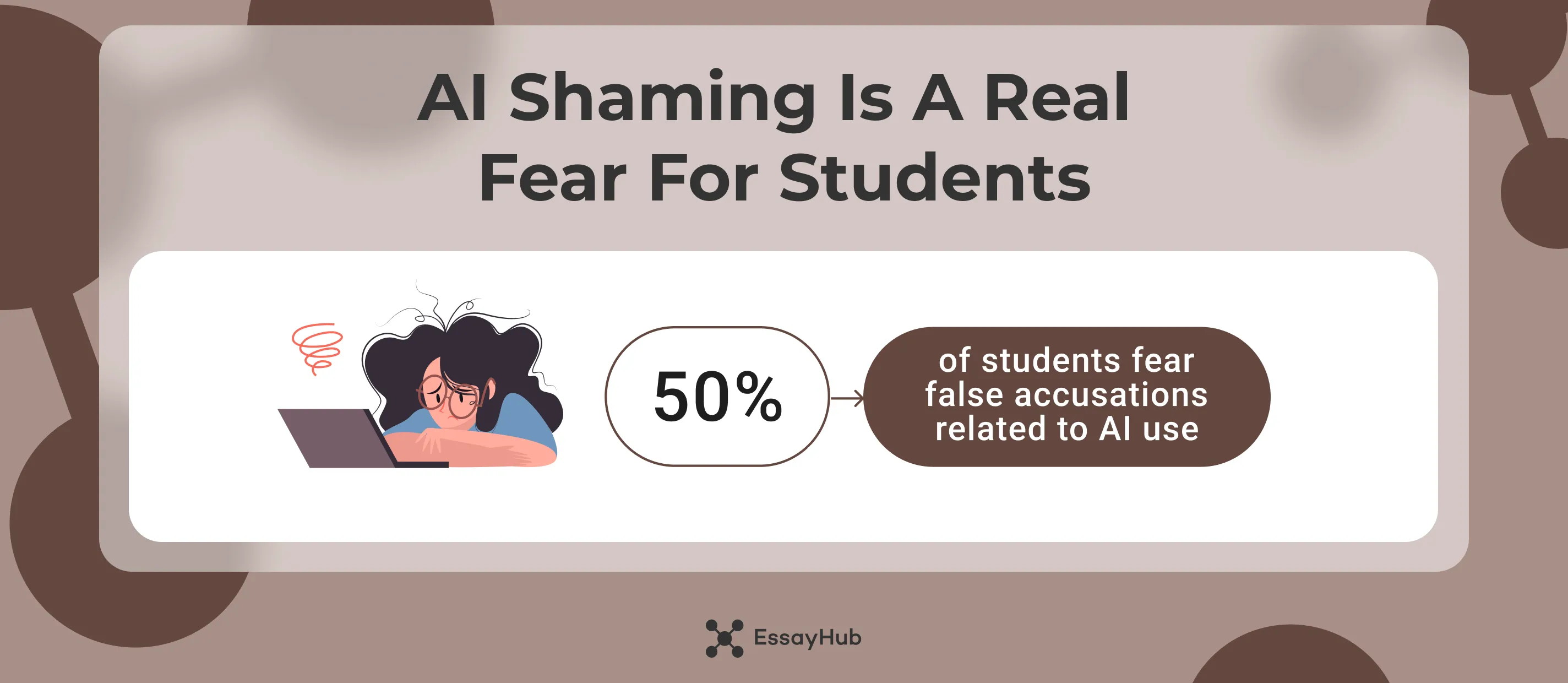
The fear of AI accusations has become students’ biggest concern because it combines uncertainty, high stakes, and limited control. When half of the students report worrying about being falsely accused of using AI to cheat, they are responding to an environment where rules shift quickly, and enforcement tools are opaque.
Students understand that AI use is widespread, yet expectations vary by instructor, department, or university. That inconsistency makes even cautious, responsible use feel risky. A draft written independently can still trigger suspicion, and once an accusation surfaces, students often feel they must defend themselves against a system that assumes wrongdoing before context.
This fear is reinforced by parallel concerns about skills and credibility. Students and parents worry that heavy AI use could erode critical thinking over time, while detection tools may misinterpret polished writing as misconduct.
Why Students Feel Guilt When Using AI for Legitimate Work
Many students internalize a sense of wrongdoing around AI use even when their gen AI usage is legitimate, a phenomenon best described as internalized “cheating guilt.” This reaction is less about actual rule-breaking and more about absorbing a cultural signal that AI assistance undermines effort or authenticity. As warnings about AI cheating accusations grow louder, students begin to doubt their own judgment. Even permitted uses start to feel risky.
This emotional response mirrors broader patterns of pressure and self-doubt documented outside education. KPMG 2024 paper argues that emotional strain, imposter syndrome, and chronic self-questioning have become widespread in modern high-pressure environments. The report links these feelings to overlapping crises, unclear expectations, and constant performance scrutiny. Students operate under similar conditions. When AI tools are framed as morally suspect, they don’t just worry about policy violations, but about their credibility. That psychological weight explains why many students avoid helpful tools or hide their use, even when rules allow it, out of fear that any AI involvement could trigger accusations and lasting doubt about their academic integrity.


How AI Detection Tools Intensify AI Shaming
AI detection tools were introduced to protect academic integrity, yet their limitations have quietly created new problems. Most AI detectors estimate likelihood, not authorship. That design leaves room for errors, especially AI detection false positives.
- Under some testing conditions, detection accuracy hovers around 39.5%, and research shows it can drop to 17.4% after relatively minor content edits.
- A single “suspicious” label can trigger immediate doubt. Context, drafting history, and intent are often ignored while students or researchers are pushed to defend themselves against an unprovable claim.
- Writers begin to avoid useful tools or soften strong academic writing out of fear that clarity, polish, or confidence will be mistaken for artificial authorship.
For context on how fast new technologies become normal, read this overview of how many Americans use TikTok.
Who Faces the Greatest Impact From AI Shaming
AI shaming does not land evenly. Its impact is heavier on students who already face structural disadvantages:
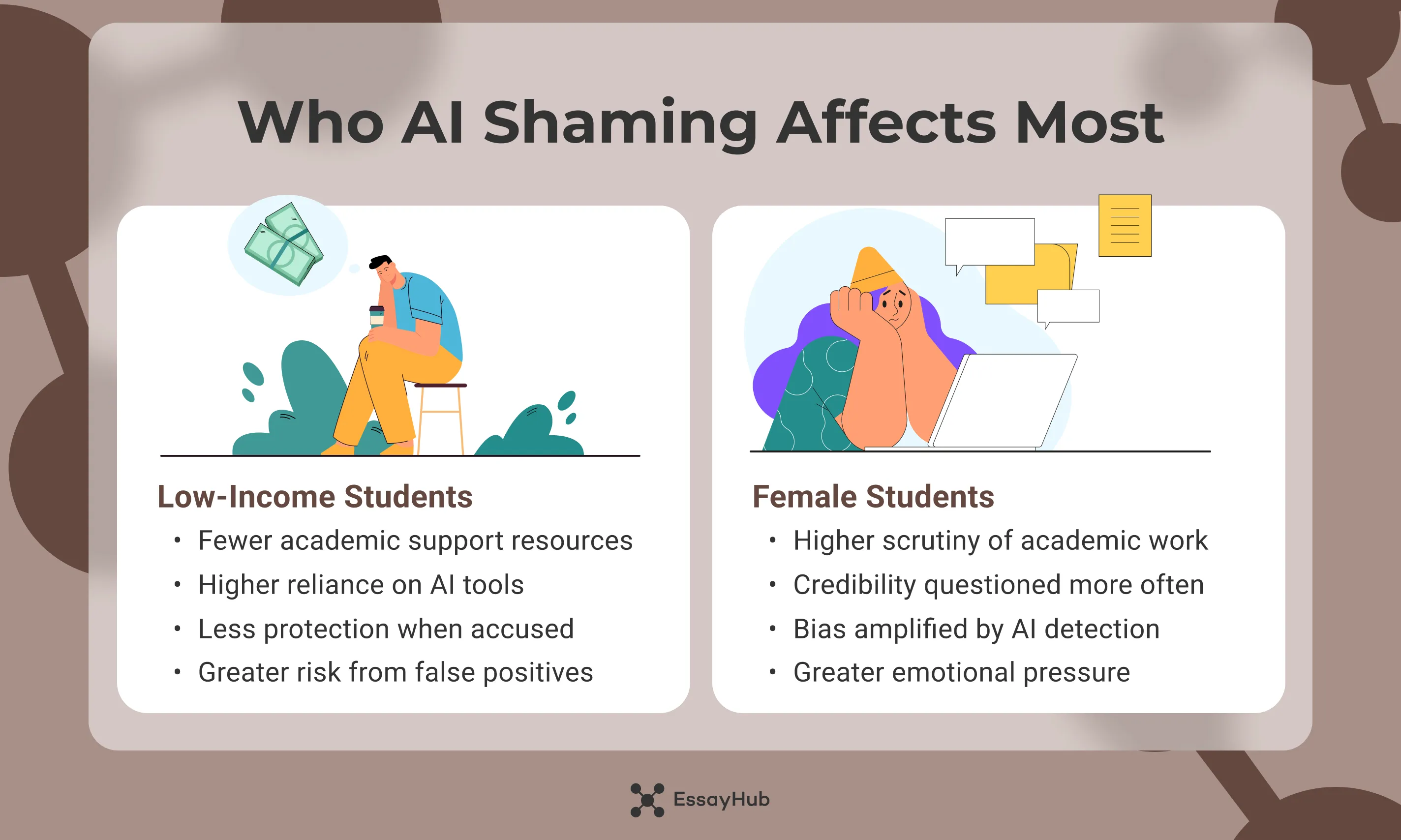
- Low-income students are often more vulnerable because they rely on AI tools to bridge gaps in time, access, or academic support. When those tools are treated with suspicion, these students carry a higher risk despite having fewer alternatives. Limited access to guidance or advocacy makes it harder for them to challenge accusations or explain how AI was used responsibly.
- Female students may be disproportionately affected, as existing research on academic bias shows higher scrutiny and credibility challenges. Studies on algorithmic bias and academic evaluation show that women are more likely to face credibility doubts, heightened scrutiny, and assumptions about legitimacy.
How AI Shaming Undermines Learning and Innovation
AI shaming hurts learning because it turns a useful tool into a psychological threat. When students fear false AI accusations in education, they avoid these tools altogether. Many students worry they’ll be accused of cheating simply for using AI to brainstorm or clarify concepts, so they hide their use of generative AI rather than explore how it can augment human capabilities. In this climate, anxiety over reputation replaces curiosity about improvement, and students lose opportunities to strengthen critical thinking or writing. Without clear guidance, fear of judgment or accusation suppresses open engagement with generative tools, stifling both individual development and broader innovation in how learning adapts to new technology.
For additional guidance on habits that support learning and wellbeing, check out this summary of recommended sleep for teenagers.
How Students Can Defend Themselves Against False AI Accusations
Drafts are more than leftovers from the writing process. They are proof. Keeping outlines, early versions, and saved edits shows how your thinking actually unfolded. When a paper raises questions, that trail matters. A final submission can look sudden or polished. A folder full of drafts shows effort, revision, and decision-making over time.
In cases of false accusations, version history turns a vague defense into something concrete. You are no longer explaining how you worked. You are showing it. In academic settings where suspicion around AI use is growing, having that record can mean the difference between being doubted and being believed.
Summing It Up
AI shaming thrives in uncertainty. Fear of false accusations, unreliable detection tools, and unclear rules has created an academic climate where students hesitate to use helpful technology, even responsibly. The cost shows up in stress, secrecy, and missed chances to learn more effectively. Moving forward means shifting focus from punishment to process, transparency, and fair evaluation. When students can show how their work was developed, trust starts to return.
For those who need structured support, EssayHub works with experienced academic writers who understand how to build original, well-documented work from the ground up. If you are looking for an expert essay writer who respects academic standards while navigating today’s AI-shaped landscape, EssayHub provides guidance that keeps both integrity and learning intact.
FAQs
Which Groups Are Most Impacted by AI Shaming?
How Do AI Detection Tools Contribute to AI Shaming?
How Many Students Worry About False AI Accusations?
Why Do Students Hesitate to Use AI Tools in College?
What Does AI Shaming Look Like in Academic Settings?

Samuel Gorbold, a seasoned professor with over 30 years of experience, guides students across disciplines such as English, psychology, political science, and many more. Together with EssayHub, he is dedicated to enhancing student understanding and success through comprehensive academic support.
- Doss, C. J., Hines, M., Stahl, N., & Klein, A. (2025). Artificial intelligence detection tools in education: What educators need to know about the use and impacts of detection tools. RAND Corporation. https://www.rand.org/pubs/research_reports/RRA4180-1.html
- Freeman, J. (2025). Student generative AI survey 2025. Higher Education Policy Institute. https://www.hepi.ac.uk/reports/student-generative-ai-survey-2025/
- Freeman, J. (2024). Provide or punish? Students’ views on generative AI in higher education (HEPI Policy Note 51). Higher Education Policy Institute. https://www.hepi.ac.uk/reports/provide-or-punish-students-views-on-generative-ai-in-higher-education/
- Jisc National Centre for AI. (2025, May 21). Student perceptions of AI 2025. https://nationalcentreforai.jiscinvolve.org/wp/2025/05/21/student-perceptions-of-ai-2025/
- Stephenson, R. (2024, June 25). From knee-jerk reactions to saving the sector to opening the knowledge estate - discussions on generative AI. Higher Education Policy Institute. https://www.hepi.ac.uk/2024/06/25/from-knee-jerk-reactions-to-saving-the-sector-to-opening-the-knowledge-estate-discussions-on-generative-ai/
- Tech Times. (2024, June 11). Turkish student arrested for using AI to cheat at university entrance exam. https://www.techtimes.com/articles/305573/20240611/turkish-student-arrested-using-ai-cheat-university-entrance-exam.htm
- Turan, A., & Aydin, A. (2024). AI shaming: The silent stigma among academic writers and researchers. ResearchGate. https://www.researchgate.net/publication/382083712_AI_Shaming_The_Silent_Stigma_among_Academic_Writers_and_Researchers
- Weichert, J., & Dimobi, C. (2024). DUPE: Detection undermining via prompt engineering for deepfake text. arXiv. https://arxiv.org/abs/2404.11408
- Perkins, M., Roe, J., Vu, B. H., Postma, D., Hickerson, D., McGaughran, J., & Khuat, H. Q. (2024). GenAI detection tools, adversarial techniques and implications for inclusivity in higher education. arXiv. https://arxiv.org/abs/2403.19148