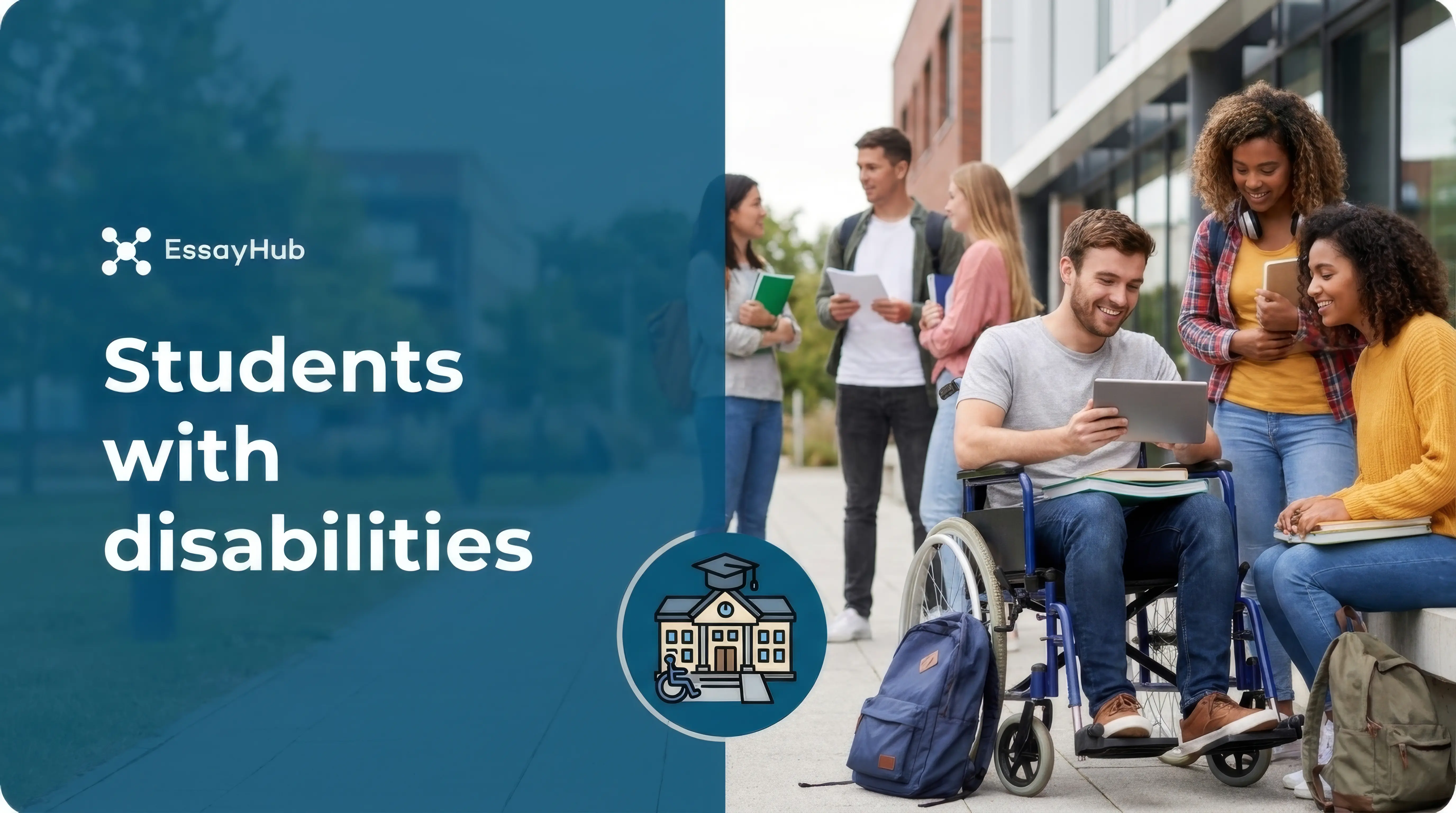
1.3 billion people have a disability. This is about 1 in 6 of the globe's population. And students make a big share of them.
.webp)
Different types of disabilities affect students’ daily lives and relationships. And, for the most part, they affect their academic aspirations and success. Here’s what we know about disabled students:
- The Disabilities Education Act (IDEA) serves 7.5 million students.
- The national average of disabled students among all public students in the U.S. was 15%.
- Only 24% of disabled college students graduate.
In this article, we’ll explore more stats, look at the main problems facing students with disabilities, and explore the solutions that are there.
Students With Disabilities Statistics
In 2022-23, 7.5 million young people aged 3-21 were served under IDEA. This is an increase from 6.4 million in 2012-13. And it continues growing.
The largest share of disabled students has specific learning disabilities (32%). Other major disability categories also included:
- Speech or language impairments - 19%
- Other health impairments - 15%
- Autism - 13%
Disability types that accounted for smaller shares of students included:
- Developmental delays - 7%
- Intellectual disabilities - 6%
- Emotional disturbances - 4%
The total share of disabled students in the student body in different states ranges from 12% to 21%. Pennsylvania, New York, and Maine show the highest share of 21%. Idaho and Hawaii reported the lowest share of 12%.
The numbers also differed significantly depending on race and ethnicity. The highest share (19%) was reported for American Indian/Alaska Native students. Black students made another major category with 17%. The least disabilities were found among Pacific Islanders (12%) and Asians (8%).
What Are the Different Types of Disabilities?
There are many different disabilities. Each has its own set of symptoms and peculiarities. They can be inborn or acquired. Also, they may be visible or not. And including such learners in the classroom requires a deep understanding of different impairment types and implementing a tailored approach.
The most common student disabilities include:
- Intellectual disabilities. This type of disability implies a reduced ability to understand new information and/or acquire new skills. It may go beyond academics. People with such conditions also often have limited social skills.
- Learning disabilities. These include conditions that affect a person’s ability to learn. Individuals who have them often have limited language, reasoning, academic, writing, and other skills. Common examples of learning disabilities include dyslexia, dyscalculia, and similar.
- Physical disabilities. This category includes all conditions that affect an individual’s mobility and physical functioning. These can be visible or not visible. Some impairments may be acquired and temporary. Others might be permanent.
- Hearing impairments . This kind of disability implies limited hearing functioning. It can include both partial and complete inability to hear.
- Vision impairments. This type of impairment implies partial or complete vision loss.
- Mental issues. Not all mental conditions qualify as a disability. However, some affect the behavior and emotions of a person so much that this interferes with daily life. Some examples are bipolar disorder, PTSD, ADHD, autism, and others.
- Speech/language impairments. This category spans conditions that affect a person’s speech and language. They can create significant challenges in communication for a student with special needs.
What Challenges Do Disabled Students Deal With?
Disabilities create many hurdles in learning. Because of this, only 15% of students who have them decide to enroll in college. Those who do also often struggle with keeping up. Only 24% of them actually complete their degrees.
What challenges lead to this? Reasons vary. However, most students with learning disabilities have problems with the following:
- Lack of environmental accessibility. Physical disabilities can make it hard for students to attend schools that don’t have accessible campuses. And it’s one of the biggest problems.
- Lack of accessibility in teaching. Disabled students often require specialty materials and teaching approaches to empower their success. This is something many schools lack.
- Low awareness. Many people don’t have an understanding of disabilities. This includes school staff and students themselves. And this can create a lot of stigma.
- Lack of staff training. Many schools don’t train their staff on how to work with disabled students.
- Lack of accessible housing. Impaired students typically need to live close to the school area for easy access. Yet, it’s not always possible to find suitable housing nearby.
- Lack of specialized support programs. Many colleges don’t offer personalized coaching or other support opportunities for students with disabilities.
- Lack of accessible activities. Traditional campus activities are designed for regular students. Let’s say sports. This often holds learners with impairments away from participating. This creates additional challenges for fitting in.
How to Include Students With Disabilities in the Classroom: Practical Steps
In order to include learners with special needs in regular classrooms, schools need to implement a number of steps. This includes building awareness and rethinking the program design. And there are many other things included.
Let’s look at the five crucial elements of accessibility that should be embraced in modern schools:
1. Environment Accessibility
The overall accessibility of venues matters most. This involves the ease of access to all campus areas, from classrooms to dorms. There are many features that improve access. School buildings must have the following:
- Wide aisles
- Ramps
- Level thresholds
- Grab bars
- Close-proximity parking, etc.
It’s also important to make buildings sensory-friendly, with specialized equipment and quiet spaces.
2. Universal Design for Learning
The Universal Design for Learning (UDL) is a set of guidelines for inclusive learning. It aims for diversity in learning programs. The goal is to meet diverse student needs. One of the primary UDL concepts is a combination of all learning formats for inclusivity. This includes auditory, visual, and hands-on principles.
3. Personalized Programs
Impairments make keeping up harder. Students who have them may read, write, and comprehend information more slowly. And this can cause a lot of insecurities. Adjusting classroom activities for different levels helps. Teachers can do a few things to do this:
- Break down complex tasks into manageable steps.
- Offer students a choice of assignment types.
- Diversify learning materials to prevent domination of a certain format, etc.
4. Peer Support & Collaboration
Impaired students often feel left out. This happens because their peers often lack understanding of disabilities and have certain stigmas. To help such students fit in and communicate more, it’s important to create engaging collaboration opportunities. Teachers can pair disabled students with non-disabled learners for collaborative projects to stimulate peer support.
5. Inclusive Atmosphere
Last but not least, it’s important that schools create positive attitudes inside classrooms. Teachers and other staff members should openly address disability in a respectful way to grow awareness. This will help reduce stigma and build understanding. It’s also important to encourage everyone to use inclusive language to create a friendly atmosphere.
Top Colleges for Students With Disabilities
Special needs students depend on accessibility and inclusivity. And though their number grows, many schools still lack these features. This is the primary reason why many disabled students avoid continuing their education. But not all schools are like that.
Many colleges actively work on inclusivity. They build strong support systems. And they make their environments accessible.
Here are the top 10 options worth considering:
Federal Support for Students With Disabilities: Section 504
Students with special needs are challenged every day. And many of their challenges are related to education. The dropping enrollment and graduation rates clearly indicate the need for a strong support system. And now you know that some schools do provide it. Yet, this isn’t the only support disabled students receive in the US.
Students with disabilities are also protected through federal law. The Office for Civil Rights (OCR) takes care of their needs through multiple efforts. It fosters a partnership between parents and school districts in its programs.
In terms of law, disabled students are protected through Section 504. This is a federal law aimed at education accessibility. It ensures that students with disabilities are not denied participation in and the benefits of any programs and activities funded by the U.S. Department of Education (ED). This includes public schools and higher education facilities, among others.
Unlike IDEA, Section 504 is a law aimed at eliminating discrimination. It ensures that all qualified students receive free appropriate public education (FAPE).
Conclusion
The number of special education students has been steadily growing over the last decade. As you now know, 7.5 million students are already under IDEA. This law serves learners with special needs, helping them receive FAPE. And their interests are also protected through Section 504.
Despite federal efforts, enrollment and graduation rates among impaired students keep dropping. This means the need for stronger support systems. In particular, schools need to make more effort to ensure inclusivity.
Luckily, many schools across the country already implement accessibility and inclusivity programs. They offer special counseling, accessible venues, tailored housing, and personalized study programs to help disabled students succeed.
https://web.archive.org/web/20050206190838/https://www.ed.gov/about/offices/list/ocr/504faq.html
https://udlguidelines.cast.org/
https://esu-online.org/disabilities-students-higher-education/
https://nds.org.au/disability-types-and-description
https://nces.ed.gov/programs/coe/indicator/cgg/students-with-disabilities
https://www.who.int/news-room/fact-sheets/detail/disability-and-health