
Key Takeaways
- Academic writing relies on precise vocabulary rather than conversational wording.
- Strong verbs and concise sentences make arguments clearer and easier to assess.
- Formal, objective wording keeps the focus on evidence instead of personal opinion.
- Transitions and sentence variety help readers follow complex reasoning.
- Thoughtful word choice helps academic writing sound deliberate and trustworthy.
English language choices in writing shape how ideas are understood, evaluated, and taken seriously. They favor formal, objective, and precise expression, steering clear of slang, contractions, and vague wording that weakens meaning. Strong verbs, clear sentence structure, and careful connectors support logical flow, while tentative language such as ‘might’ or ‘could’ allows room for nuance. The focus stays on clarity rather than decorative complexity.
In this article, you’ll understand why these linguistic choices matter across academic contexts and how to apply them consistently. For students who need extra support, EssayHub, a legit essay writing service, offers assistance aligned with these standards.
What Language Choice Means in Academic Writing
Language choices in academic writing refer to the deliberate selection of words, tone, and structure to match academic expectations and purpose. Appropriate language signals care, discipline, and respect for scholarly norms, which makes ideas more persuasive to the academic community. Different forms of academic writing call for subtle shifts:
- Descriptive work leans on clarity and accuracy.
- Analytical and critical writing demand precision and restraint.
- Persuasive arguments rely on measured emphasis.
In every case, language use is powerful, and it shapes how seriously the work is received. These expectations reflect broader language attitudes within academic communities.
11 Core Rules of Word Choice in Academic Writing
The importance of words in academic writing lies in how they shape meaning before an argument is fully formed. The rules of language choices in academic writing examples show how careful word selection strengthens meaning, improves structure, and supports clear academic communication.
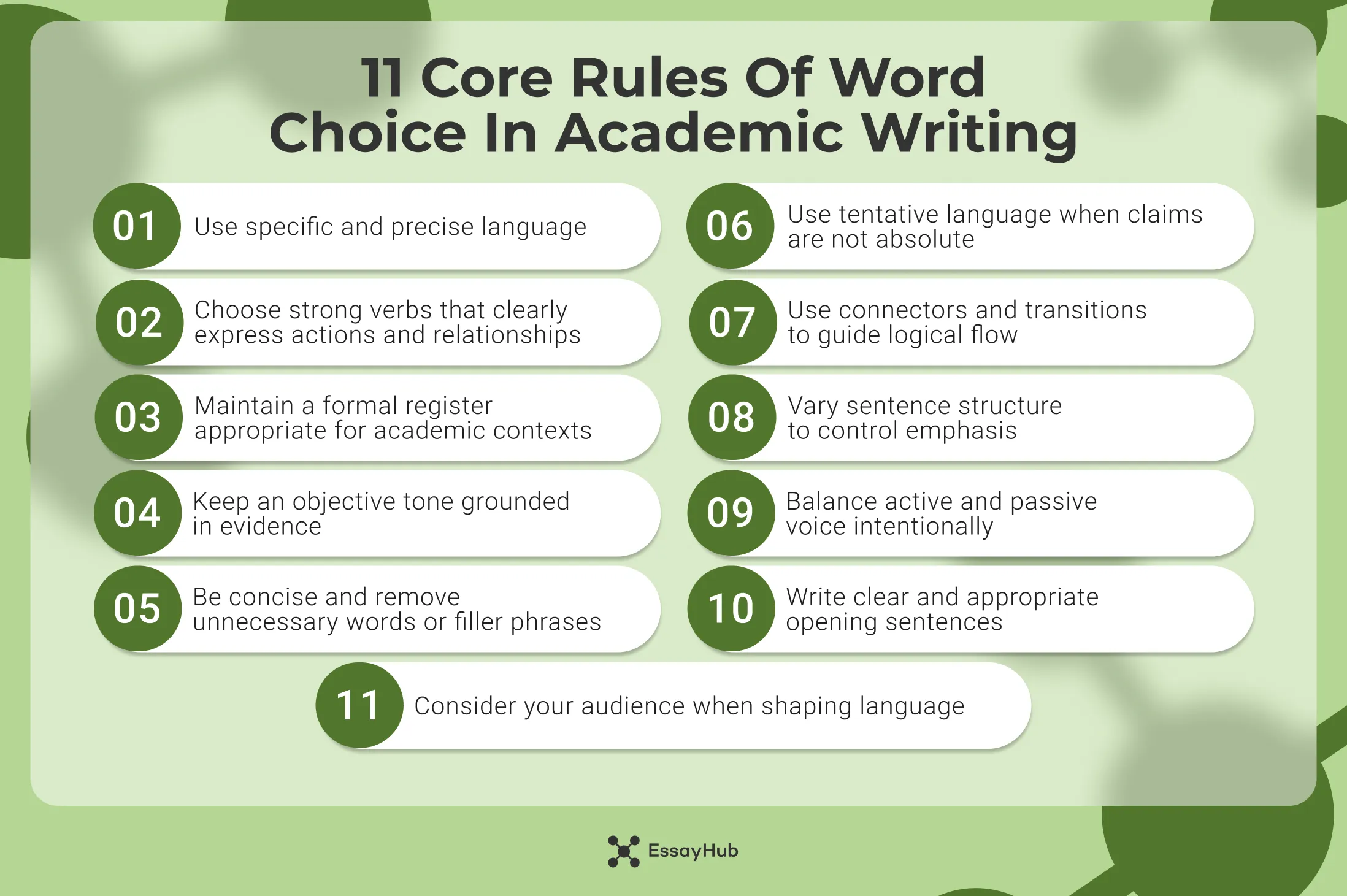
To better interpret and apply these conventions, see the guide on academic reading strategies.
1. Prioritize Specific and Precise Language
Precision is central to academic language. Using long words does not improve clarity unless they add meaning. Clear, specific language keeps arguments transparent, evidence easy to follow, and claims open to evaluation without added explanation.
The use of words such as “things,” “stuff,” “interesting,” “nice,” “big,” or “a lot” should be avoided because they contribute little to meaning. Academic style benefits from terms that name ideas directly. Use “establish” instead of “set up,” “factors” instead of “things,” and “significant” instead of “interesting.” Precise language reduces ambiguity and reflects careful, deliberate reasoning. Precision matters more than using sophisticated language through complexity.
2. Choose Strong Verbs
Strong verbs give academic sentences clarity and direction. They state actions and relationships directly, without relying on informal phrasing or extra modifiers. Weak verbs often blur meaning and force the sentence to carry unnecessary explanation.
In examples of language choices in academic writing, effective verbs make a clear difference. Prefer “demonstrate” instead of “show,” “establish” instead of “set up,” “produce” instead of “churn out,” “tolerate” instead of “put up with,” and “assemble” instead of “put together.” Avoid vague verbs like “do,” “make,” or “get,” which hide the nature of the action. Strong verbs sharpen claims, tighten sentences, and signal analytical control.
3. Maintain a Formal Register
Academic writing generally operates within shared expectations and language policy about tone. Formal language signals that a claim is meant to be examined, not reacted to. When informal speech patterns appear, they shift attention away from analysis and toward the wording itself, which weakens focus.
Slang, contractions such as “it’s” or “don’t,” and conversational fillers like “stuff,” “kinda,” or “a bunch of” belong to spoken interaction, not academic argument. Casual phrasing, such as “people think” or “it’s pretty obvious,” also reduces precision. In formal writing, “researchers argue” or “the evidence suggests” keeps the emphasis on ideas rather than voice. Similar expectations appear in legal papers, where wording carries formal weight
4. Maintain an Objective Tone
Using language choices in academic writing means keeping attention on evidence rather than personal response. When sentences rely on opinion or emotional emphasis, the argument begins to sound subjective and less grounded in analysis.
Expressions such as “I think,” “I feel,” or “I strongly believe” shift focus toward the writer instead of the research. Emotive terms like “obviously,” “clearly,” or “surprisingly” can also overstate conclusions. Academic writing is stronger when claims are framed through evidence. Writing “the data suggest” or “the findings indicate” allows readers to evaluate the argument based on information, not personal stance.
5. Be Concise
Concision keeps academic writing focused. When sentences stretch beyond what they need to say, the main idea becomes harder to locate. Direct language helps readers follow an argument without working through unnecessary wording. This reflects the principles of plain language in academic contexts.
Phrases like “due to the fact that,” “in order to,” or “it is important to note that” add length without adding substance. Academic writing is clearer when these are reduced to “because,” “to,” or removed entirely. Writing “The study explains the results” communicates the point more effectively than “It is important to note that the study explains the results.”
6. Use Tentative Language Where Appropriate
Academic claims are rarely absolute. Most arguments are shaped by limited data, context, or scope, and the language should reflect that uncertainty. Tentative wording allows writers to present findings carefully without overstating conclusions.
Modal verbs such as “may,” “might,” or “could” help signal that a claim is open to interpretation or further evidence. For example, “The results may indicate a correlation” is more accurate than “The results prove a correlation.” Phrases like “suggests,” “appears to,” or “is likely to” also allow writers to maintain precision while acknowledging limits.
7. Use Connectors and Transitions
Academic writing rarely moves in straight lines. Ideas build, pause, qualify, and sometimes shift direction. Readers follow this movement through small cues that explain why one sentence follows another. When those cues are missing, the argument still exists, but its shape becomes harder to trace.
Transitions provide that structure. Words like “however” signal a turn, “therefore” points to a conclusion, “for example” opens space for clarification, and “in contrast” marks difference. These connectors guide interpretation, helping readers understand how each point fits into the larger line of reasoning.
For a focused overview of effective transitions, see this resource on essay linking words.
8. Vary Sentence Structure
Sentence structure affects how ideas are paced and where emphasis falls. When sentences follow the same length or grammatical pattern, important points can lose visibility, even when the content itself is strong. Variation helps control rhythm and keeps the reader engaged. Repeating the same sentence structure reduces emphasis.
Shorter sentences can highlight key claims or conclusions. Longer ones allow space for explanation, evidence, or qualification. Shifting structure with intention makes arguments easier to follow and prevents academic writing from becoming monotonous or dense.
9. Balance Active and Passive Voice
Voice shapes what the reader notices first. Active sentences place the subject up front and move ideas forward with clarity. Passive constructions shift attention toward the action or result, which can be useful when the agent is unknown or irrelevant.
Academic writing works best when these choices are deliberate. Active voice keeps arguments direct and readable. Passive voice allows distance when describing methods, results, or processes. Relying too heavily on passive structures can blur responsibility and slow the pace, so balance matters more than preference.
10. Pay Attention to Opening Sentences
Opening sentences set the tone and direction of academic writing. They frame how a point is received before the reader reaches the main idea. Many academic style guides, including guidance from universities such as the University of Queensland, recommend avoiding sentence openings that feel informal or abrupt.
Starting sentences with digits or conjunctions such as And or But can weaken formality and disrupt flow. These openings are common in speech, but they draw unnecessary attention in academic prose.
Incorrect examples:
- And the results show a clear pattern.
- But this approach has limitations.
- 10 participants were excluded from the study.
Clear academic alternatives place the focus on the idea itself rather than the opening structure, allowing the sentence to integrate smoothly into the surrounding argument.
11. Consider Your Audience
Academic writing always assumes a reader who is informed, critical, and attentive to detail. Language choices should anticipate what the audience needs in order to follow the argument without confusion. Clear connections between ideas, complete sentences, and accurate grammar and language maintenance help readers focus on meaning rather than decoding structure.
Writers should avoid shortcuts, unexplained references, or fragmented ideas that leave gaps in interpretation. Each sentence should contribute clearly to the overall point and connect logically to what comes before and after. This principle applies across contexts, including academic and professional communication, especially in a professional setting. The same principles apply to business documents.
For practical guidance on clarity and tone in formal contexts, see this resource on writing business English.


Common Language Choice Mistakes in Academic Writing
Even strong ideas can lose impact when language choices work against clarity or tone. The mistakes below appear often and usually without intention, especially when drafts move quickly.
- Misused words, where a term sounds appropriate but does not match the intended meaning
- Words with unintended connotations, which introduce bias, emotion, or assumptions that the writer did not plan
- Unclear pronoun references, when it, this, or they appear without a clear antecedent
- Overuse of jargon or technical terms without explanation, which limits accessibility for readers outside a narrow field
- Informal tone, including conversational phrasing, casual expressions, or spoken patterns
- Lack of hedging, where claims are presented as absolute despite limited evidence
- Excessive passive voice, which can obscure agency and weaken sentence clarity
- Use of hyperbole, clichés, or regionalisms, which distract from analysis and reduce academic neutrality
Final Thoughts
Language choices shape how academic writing is read, judged, and trusted. The rules covered here show how precision, structure, tone, and voice work together to support clear reasoning and credible argumentation. Following the rules of language choices in academic writing makes it easier for writers to communicate ideas without distraction, signal awareness of academic standards, and guide readers through complex material with confidence.
For students who need support applying these principles consistently, EssayHub offers assistance aligned with formal writing expectations. Our services, including access to a college essay ghostwriter, are designed to support clarity, structure, and appropriate academic language without losing focus on the original argument.
FAQs
How Do Language Choices Shape Clarity in Academic Writing?
Why Are Language Choices Important in Academic Writing?
What Are the Effective Language Choices?
What Are Some Examples of Language Choices?
What Is Language Choice in Writing?

Mark Bradford, a passionate and talented artist, utilizes his innovative spirit to support academic pursuits. In partnering with EssayHub, he leverages his artistic insights to assist students as a professional essay writer, helping them navigate and complete their academic assignments at every level of difficulty.
- The University of Sydney. (n.d.). Writing support for students. https://www.sydney.edu.au/students/writing.html
- University of Southern California Libraries. (n.d.). Academic writing. https://libguides.usc.edu/writingguide/academicwriting
- University of Nevada, Reno – Writing & Speaking Center. (n.d.). Word choice. https://www.unr.edu/writing-speaking-center/writing-speaking-resources/word-choice