
Key Takeaways
- Strong research article summaries begin with active reading that identifies the study’s research question, methods, main findings, and conclusions before any writing starts.
- Organizing notes with the IMRaD structure (Introduction, Methods, Results, and Discussion) helps keep information in the right order and prevents important points from being overlooked.
- Writing in your own words means restating the authors’ ideas clearly without copying sentences or phrasing from the original paper, which supports accuracy and avoids plagiarism.
- Careful editing and revision ensure the summary reflects the article’s core message, removes unnecessary details, and maintains an objective academic tone.
To summarize a research article, start with active reading, paying attention to what the study is trying to accomplish, how the research was carried out, what the key results show, and how the authors interpret those results. Once the key elements are clear, sort them into the IMRaD structure: Introduction, Methods, Results, and Discussion, so each idea has a defined place. Write the summary using your own words, aiming to capture meaning instead of copying phrasing. Finish the research article summarizing by revising carefully. Tighten the language, check accuracy against the original paper, keep the tone objective, and include citations where required.
The purpose of this article is to provide clear instructions for building research article summaries. If you still need help with your work after reading our post, EssayHub's professional article summarizer can help you make sense of the original literature.
How to Summarize a Research Article Example
Take a look at how to summarize a research article sample below to see how core objectives, findings, and conclusions can be presented clearly. For easier reference while you work, the example is available as a free PDF you can review alongside your own draft.

How to Summarize a Research Article Effectively
There are several ways to summarize a research article, but effective results usually come from the same sequence of actions. You read the paper with intention, organize the key points, draft carefully, and then refine. The following steps explain that workflow, but if you still need help structuring your summary, you can ask our essay writer service for help. Here’s the brief process before we get into the details:
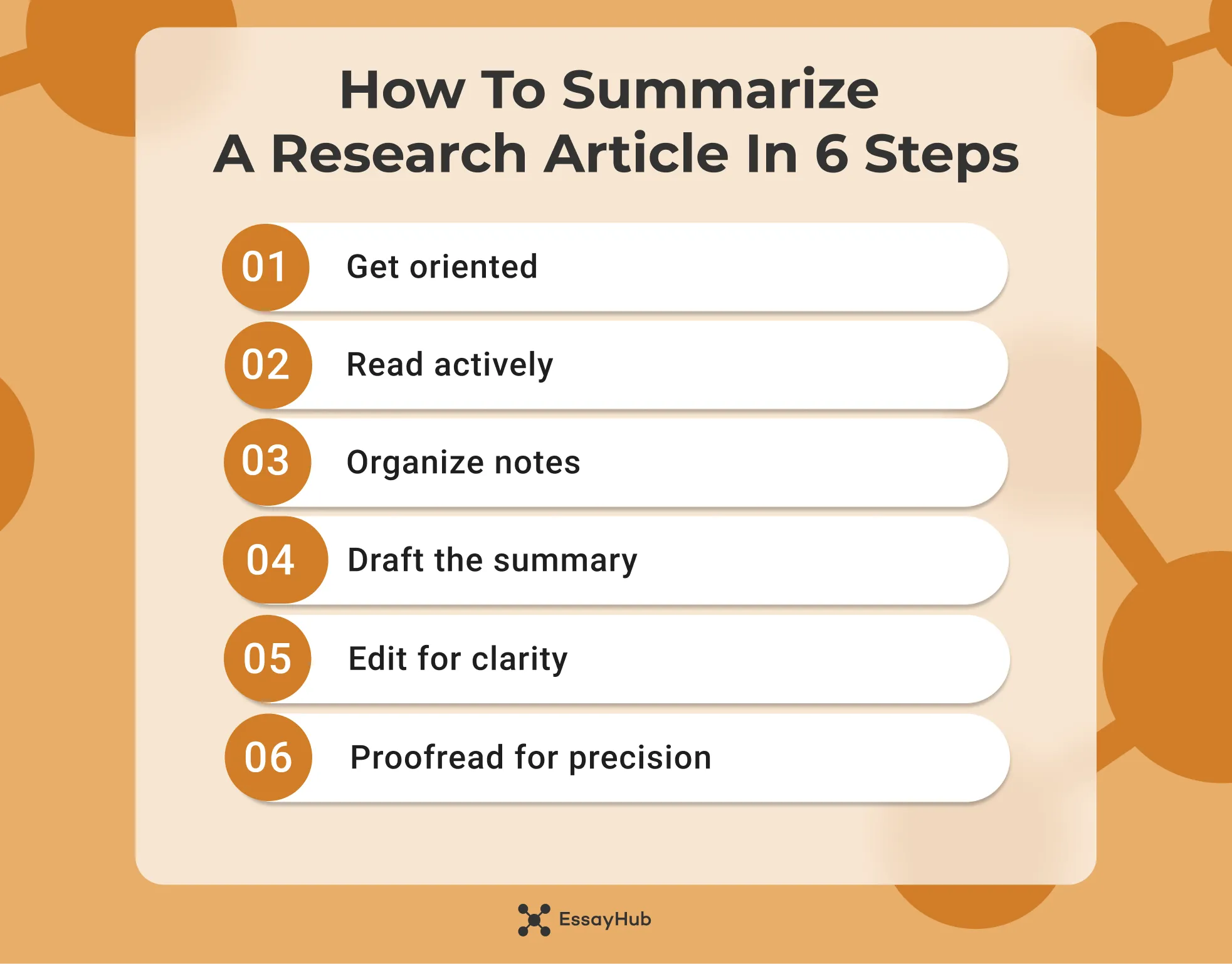
Step 1: Get Oriented First
Begin by scanning the paper to understand its overall direction. This step helps you grasp purpose and outcomes before you engage with dense sections. Once you identify the topic through the title, review the abstract to see the research question and main findings. Then, look through headings, introduction, and the conclusion, as these sections reveal what was studied and why it’s important. Notice recurring terms and themes, since they often signal the paper’s focus. At this stage, you are not judging quality or evidence. You are building context. This early orientation prevents confusion later and helps you recognize which sections deserve closer attention during detailed reading.
Questions to guide this scan:
- What issue does the study examine?
- Why is the topic important?
- What results are emphasized?
- What outcome does the paper highlight?
Step 2: Read Actively
After the initial scan, return to the paper for careful reading. Highlight research questions, central concepts, methods, and conclusions. Pay attention to how the study was designed, including variables and analytical techniques. Mark passages that explain results or discuss implications, since these are often the most important elements of the summary. Read sections in logical order, but slow down when ideas become complex. Reread difficult parts until they make sense. Take notes in brief phrases instead of copying sentences. Active reading will help you separate essential findings from background detail when writing a summary of a research article.
Here are some questions to ask yourself as you read:
- What question is the study answering?
- How was the research carried out?
- Which findings drive the conclusions?
- What meaning do the authors assign to results?
If you’re looking for some technical paper ideas, check out our organized list of technology research topics.
Step 3: Organize Your Notes
After reading, the focus shifts to organization. Notes on their own are not enough. They need structure before you can write anything coherent. This is where the IMRaD method becomes useful. Most research articles follow this format: Introduction, Methods, Results, and Discussion. Using it as a guide helps you sort information logically instead of reacting to the paper line by line.
Group your notes according to these sections. The Introduction should capture the research question or objective. The Methods section should briefly explain how the study was conducted, without technical overload. Results should highlight the main findings rather than individual data points. Finally, the Discussion or Conclusion should reflect how the authors interpret those findings.
Step 4: Draft the Research Paper Summary
With a structured outline in front of you, begin writing the first draft. At this point, all you should think about is getting ideas onto the page in a logical sequence, rather than perfect phrasing. Follow the paper’s reasoning while avoiding its exact wording. Let the outline guide the order so the summary reflects the original structure without copying it. Here are the ideas for summarizing research article that you should include in your paper:
- Introduction: State the research question or problem and explain why it matters. This information usually comes from the paper’s introduction and sets the context for the reader.
- Methods: Briefly describe how the research was conducted. Focus on the design, participants, procedures, and key variables without going into technical detail.
- Results: Present the main findings and indicate whether the hypotheses were supported. Emphasize outcomes that drive the study’s conclusions rather than raw data.
- Conclusion: Explain how the authors interpret their results and what implications they highlight, without offering critique or personal opinion.
Learn how to build APA outlines while you're at it, as it will help you create more structured and academically sound papers.
Step 5: Polish for Clarity and Academic Style
Editing is the stage where a rough draft becomes something you can confidently submit. Read the summary slowly and work through it one sentence at a time. The wording should sound like your own thinking rather than a repetition of the source. A neutral, factual tone matters here. Opinions and side comments only get in the way and should be removed. Pay attention to how sentences connect so ideas flow naturally across sections. Citations need to appear wherever the original paper requires credit. Extra words and repeated points should be trimmed because a strong summary stays brief while remaining readable. At this point, the language settles, the meaning sharpens, and the piece finally reads as a unified whole.
Key editing checks:
- Use original phrasing throughout
- Maintain an objective academic tone
- Strengthen transitions between sections
- Cite the source accurately
- Remove excess wording
Step 6: Review and Revise for Precision
The final step is careful revision. Compare the summary with the original paper and confirm that it reflects the core message accurately. Make sure no major findings are misrepresented or omitted. Remove minor details that distract from the main points. Read the summary aloud to check clarity and flow. Each sentence should contribute directly to understanding the article. Adjust wording where the meaning feels unclear or compressed. This final review strengthens research article summarization by ensuring accuracy, clarity, and concision.
Scroll through our collection of psychology research paper topics to find some inspiration for your projects.


Common Mistakes When Summarizing a Research Article
Problems usually do not come from misunderstanding the paper, but rather from poor judgment about what actually belongs in the summary. This type of writing asks for careful selection and restraint, a balance that is easy to lose unless you approach the paper with a clear plan.
- Copying sentences from the article instead of rewriting the ideas in your own words.
- Going through the paper section by section instead of focusing on the main point.
- Including small details or numbers that do not affect the overall conclusions.
- Explaining too much background while barely covering the results and conclusions.
- Adding personal opinions or assumptions that the authors did not make.
- Putting ideas in a confusing order that does not match the paper’s logic.
- Describing the conclusions inaccurately or making the findings seem more important than they are.
Final Thoughts
A good research article summary depends on disciplined reading and careful writing. You identify the study’s purpose, track how the research was carried out, isolate the key findings, and report the authors’ conclusions clearly. Structure guides that process, while careful precision keeps it accurate. The result should reflect the original work without borrowing its language or drifting into interpretation.
When writing a paper becomes difficult to manage, or deadlines start stacking up, you can pay for research paper from EssayHub and take that well-deserved break.
FAQ
Which Mistakes Derail Research Article Summaries?
Is Personal Opinion Appropriate in a Research Article Summary?
Which Sections of a Research Article Should I Include in a Summary?
How Long Should a Research Article Summary Be?
What Is the Purpose of a Research Article Summary?

Samuel Gorbold, a seasoned professor with over 30 years of experience, guides students across disciplines such as English, psychology, political science, and many more. Together with EssayHub, he is dedicated to enhancing student understanding and success through comprehensive academic support.
- How to summarize any article? | ResearchGate. (2025). ResearchGate. https://www.researchgate.net/post/How_to_summarize_any_article
- University of Wisconsin - Madison. (2017). Writing an Abstract for Your Research Paper. The Writing Center. https://writing.wisc.edu/handbook/assignments/writing-an-abstract-for-your-research-paper/
- Dwyer, J. (n.d.). LibGuides: Scholarly Articles: How do I summarize a scholarly article? https://libguides.slcc.edu/scholarlyarticles/summarize