
Key Takeaways
- A deductive conclusion is guaranteed only when the argument is valid.
- Inductive reasoning can shift as new observations appear.
- Invalid deduction happens when a conclusion reaches beyond what the premises support.
- Flight delays, classroom tech choices, and book recommendations all illustrate real reasoning patterns.
- Rules guide deduction, while patterns guide induction.
Deductive reasoning uses a general rule to reach a specific conclusion. This pattern relies on a broad idea that narrows toward a single, logical result.
Here’s a quick example:
All mammals have backbones. Humans are mammals. Therefore, humans have backbones.
Anyone who drives legally must have a valid license. Emma is driving legally today. Therefore, Emma has a valid license.
This article outlines the purpose of deduction, explains its structure, and offers deductive reasoning with examples. And if you want more arguments or stronger reasoning in your assignments, EssayHub can also provide extra support!
What Is Deductive Reasoning?
Deductive reasoning is a logical process that starts with a general statement and applies it to a specific case to reach a conclusion. The structure moves downward: a broad premise sits at the top, and the final claim follows only if each earlier step holds firm. A key detail often gets overlooked here.
Deductive reasoning is valid when the conclusion follows from the premises by structure. It becomes sound only when the premises are also true. When both conditions hold, the conclusion cannot be false. When the foundation holds, the conclusion cannot contradict it. Deduction, therefore, gives writers and researchers a reliable way to move from established facts to clear, defensible outcomes.
The Basic Structure of Deductive Reasoning
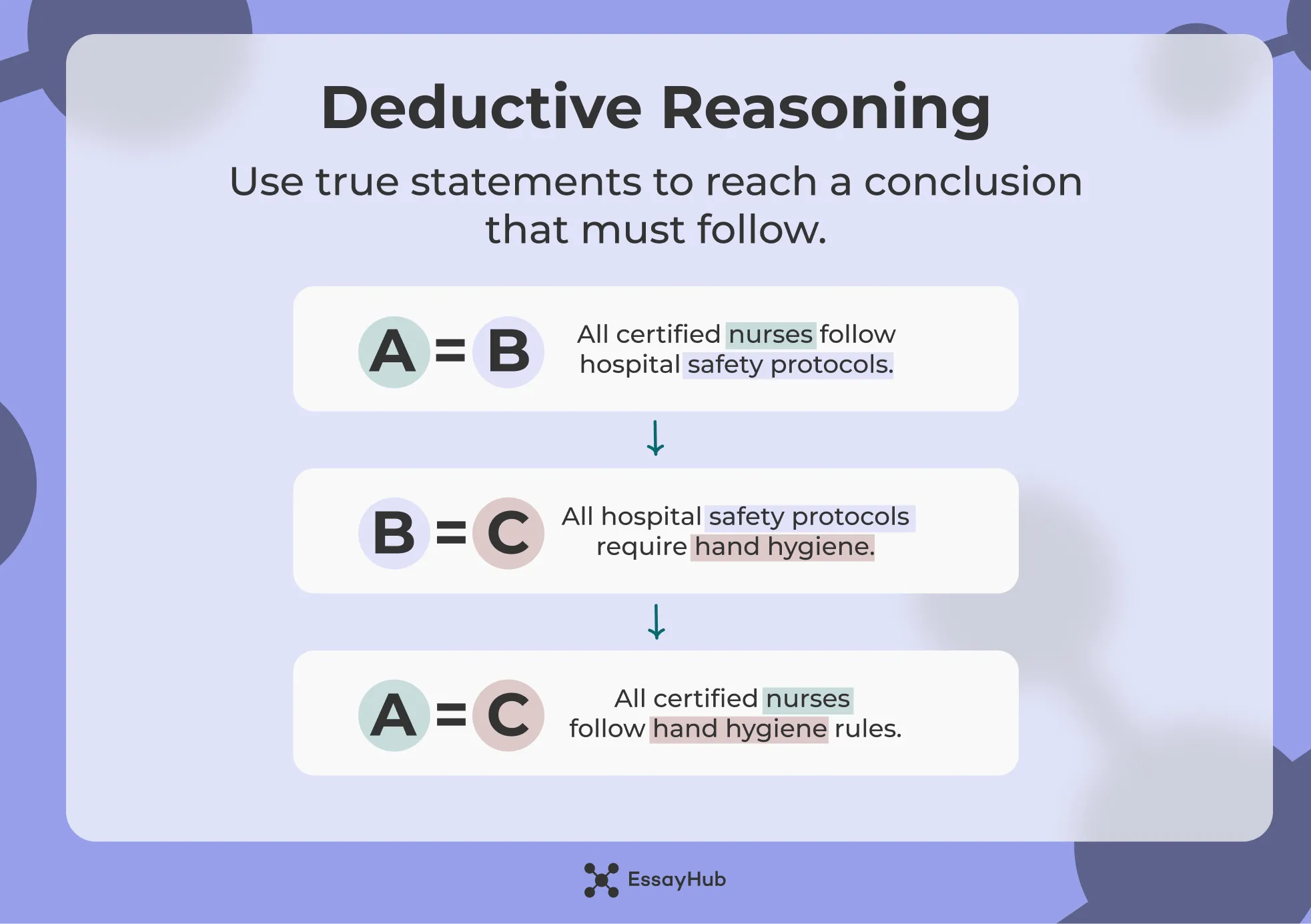
Deductive reasoning relies on a three-part structure that moves from a broad claim to a specific, certain conclusion. Writers use it to build arguments that rest on firm logic rather than intuition. The structure includes:
- Major premise (premise 1): a general rule or principle accepted as true
- Minor premise (premise 2): a specific case that fits within that rule
- Conclusion: the statement that must follow if both premises hold
The three parts form a chain where weak premises break the logic, and strong ones secure it. A sound deductive argument requires true premises and a valid structure.
Example of deductive reasoning:
- Premise 1: Every controlled experiment requires controlled variables.
- Premise 2: This study uses controlled variables.
- Conclusion: Therefore, this study meets that requirement.
Types of Deductive Reasoning
Deductive reasoning appears in several reliable forms, each offering a different path toward a logically certain conclusion. The most common types include syllogism, modus ponens, and modus tollens. Writers who understand them can build arguments with clearer structure and stronger support.
Syllogism
A syllogism connects two statements to produce a conclusion that must follow from both. The form moves cleanly from a general rule to a specific case, then completes the chain with a final claim.
Example:
All citrus fruits contain vitamin C. Lemons are citrus fruits. Therefore, lemons contain vitamin C.
Modus Ponens
Modus ponens uses a conditional statement and affirms its first part to confirm the second. The approach follows an if–then pattern that appears frequently in academic and everyday reasoning.
Example:
If a student completes every assignment, they pass the course. Maya completed every assignment. Therefore, Maya passes the course.
Modus Tollens
Modus tollens works by rejecting the result of a conditional statement, which forces the rejection of its initial condition. The structure reverses the direction of modus ponens while keeping the logic equally firm.
Example:
If a device is fully charged, the battery light stays green. The light is not green. Therefore, the device is not fully charged.
Examples of Deductive Reasoning for Different Topics
Here are some deductive reasoning examples in everyday life, class discussions, and academic writing:
- When a university requires every enrolled student to finish a final assignment, Arman’s enrollment means he has to complete it. The rule covers him fully, so the obligation is clear.
- If a product is certified organic, it must meet standards that restrict synthetic pesticides. This bag of apples is certified organic. Therefore, it must meet those standards.
- If a tablet has a dead battery, it will not power on. This tablet will not power on. Therefore, a dead battery is one possible explanation, but more checks are needed.
- In a building where only residents receive keycards, seeing Mia use one at the entrance means she is a resident.
- When a book on a reserved shelf is available only to students in a particular course, and that book sits on the shelf now, the borrowing restriction applies. Only students in that course can check it out.
- If a city bans parking on a street after midnight, any car parked there at 1 a.m. violates the rule. Lina’s car is parked on that street at 1 a.m., so it breaks the parking restriction.
- When a course requires attendance to pass, missing too many classes leads to failure. This student has exceeded the allowed absences. Passing the course is no longer possible.
- If a password must include a special character, a password without one will be rejected. This password contains only letters and numbers. Access will be denied.
- In a workplace where safety helmets are mandatory on the construction floor, anyone entering without one is out of compliance. That worker entered the floor without a helmet, so a violation occurred.
- If a library card expires after four years, cards issued in 2020 are no longer valid. This card was issued in 2020. It cannot be used now.
If you need more practice shaping clear arguments, explore good argumentative essay topics.
What Invalid Deductive Reasoning Looks Like
Invalid deduction often appears when someone stretches a rule too far or forces a conclusion that simply doesn’t follow. The premises may sound reasonable, yet the leap to the final claim doesn’t hold. These cases show how the structure can collapse even when the statements look neat on the surface:
- All roses have petals. This flower has petals. Therefore, this flower is a rose.
- All chefs wear aprons at work. Dylan is wearing an apron. Therefore, Dylan is a chef.
- All professional runners train daily. Mira trains daily. Therefore, Mira is a professional runner.
In each situation, the logic breaks because the conclusion assumes more than the premises allow. The statements look connected, but the relationship between them is manufactured rather than proven. When 'a' and 'b' are true, it doesn’t automatically make 'c' true; the final claim rests on an overgeneralization rather than a real rule.
If you want something lighter after these logic tangles, you can read EssayHub’s guide on business school ranking.


How Deductive and Inductive Reasoning Differ
Inductive reasoning creates a general idea by looking at several specific examples. The process starts with observations, and a broader conclusion forms after a pattern becomes noticeable. The result can be strong, but it is never fully guaranteed because new evidence might change the pattern.
The main difference between inductive and deductive reasoning lies in how the reasoning moves. Deductive reasoning begins with a general rule and reaches a conclusion that must be true when the premises are correct. Inductive reasoning works the opposite way. It begins with individual cases and builds a conclusion that is likely rather than certain. Both approaches help with problem-solving, though only deduction promises a definite answer.
.webp)
Inductive vs Deductive Reasoning Examples
Inductive and deductive reasoning reach conclusions in different ways, but both rely on clear logical movement. Inductive thinking grows from several observations and forms a general idea. Deductive reasoning begins with a rule and applies it to a single case. These inductive and deductive reasoning examples show how the two methods operate in practical situations.
Example 1:
Inductive Reasoning:
Maya has taken three weekend flights, and each one left late. From those experiences, she believes weekend flights often run behind schedule.
Deductive Reasoning:
All Saturday flights on this route are scheduled to depart at 9:00 a.m. Maya is booked on that Saturday flight, so her departure time is 9:00 a.m.
Example 2:
Inductive Reasoning:
Several teachers at the school use laptops during class. Riley assumes most teachers there prefer laptops based on that pattern.
Deductive Reasoning:
Teachers at this school are required to use the school-issued laptop during instruction. Riley teaches there, so Riley uses a school-issued laptop during class.
Example 3:
Inductive Reasoning:
Two of the last three books recommended by a friend were thrillers. Jordan concludes this friend tends to choose thrillers when suggesting books.
Deductive Reasoning:
This friend only recommends thrillers. Jordan received a recommendation from this friend, so the book is a thriller.
Clear Difference Between the Two
Inductive reasoning builds a broad conclusion from repeated cases. Maya’s belief about weekend flights grew from three late departures, and more flights might change that conclusion. Deductive reasoning, on the other hand, applies a fixed rule to one situation. When a rule states that all flights on a route run late, and Maya takes that route, the conclusion must follow. The first method produces a likely idea, while the second produces a conclusion that must follow as long as the rule is true and the reasoning is valid.
The Bottom Line
Deductive and inductive reasoning strengthen thinking in different ways. Deduction relies on a general rule and produces a conclusion that must follow when the rule is correct. Inductive reasoning grows from repeated observations and forms a broader idea that remains open to revision. Both methods help writers build clearer arguments and understand how evidence supports a claim.
Support is available for students who want help applying these skills in real assignments. English paper writing service EssayHub offers guidance from real experts who write and review papers without relying on automation. Our team focuses on clarity, structure, and strong reasoning. So check it out!
FAQs
Which Deductive Reasoning Examples Appear in School Subjects?
What Is the Most Basic Example of Deductive Reasoning?
What Is a Real Life Example of Deductive Reasoning?
How Do We Use Deductive Reasoning in Everyday Life?
What Are Some Examples of Deductive Reasoning?

Samuel Gorbold, a seasoned professor with over 30 years of experience, guides students across disciplines such as English, psychology, political science, and many more. Together with EssayHub, he is dedicated to enhancing student understanding and success through comprehensive academic support.
- College of DuPage. (n.d.). Deductive reasoning. In Communication. https://cod.pressbooks.pub/communication/chapter/20-3-deductive-reasoning/
- McKeon, M. (n.d.). Deductive and inductive arguments. Internet Encyclopedia of Philosophy. https://iep.utm.edu/deductive-inductive-arguments/
- Encyclopaedia Britannica. (n.d.). Deduction. https://www.britannica.com/topic/deduction-reason
- Merriam-Webster. (n.d.). Deduction vs. induction vs. abduction. https://www.merriam-webster.com/grammar/deduction-vs-induction-vs-abduction