To write a speech, decide on the message you want the audience to remember and organize your main points in a clear structure. Shape an introduction, develop the body with relevant ideas, and end with a concise conclusion that reinforces the purpose.
The purpose of the article is to explain how to speak, organize main points, shape the structure, and deliver an effective speech with confidence.
If you want help while working on your ideas or refining your draft, you can turn to EssayHub essay writer service for help with how to write a good speech and every stage of your presentation.
What is a Speech?
A speech is a piece of spoken public communication in which a speaker presents ideas, explanations, or arguments to an audience. Its purpose can be to inform, persuade, honor a person, or guide listeners through a topic.
Length varies by context. A short classroom presentation usually lasts four or six minutes, while formal events often allow eight or twelve. In terms of word count, most speakers use 120 or 150 words per minute. A five-minute speech generally consists of six hundred or seven hundred fifty words, and a ten-minute one usually reaches a range of twelve hundred or fifteen hundred.
Types of Speeches
If a person just begins their public speaking journey, they might think there is only one speech type. But, in reality, speech categories differ and should fit the context and situation. For instance, the listeners of a business presentation hardly expect it to be informal, like a TED Talk.
Choosing the type of speech comes before shaping topics or drafting the text. A speaker may prepare an informative piece or create a message for a special occasion. Once the purpose is clear, the groundwork for an effective presentation is already in place.
Informative Speech
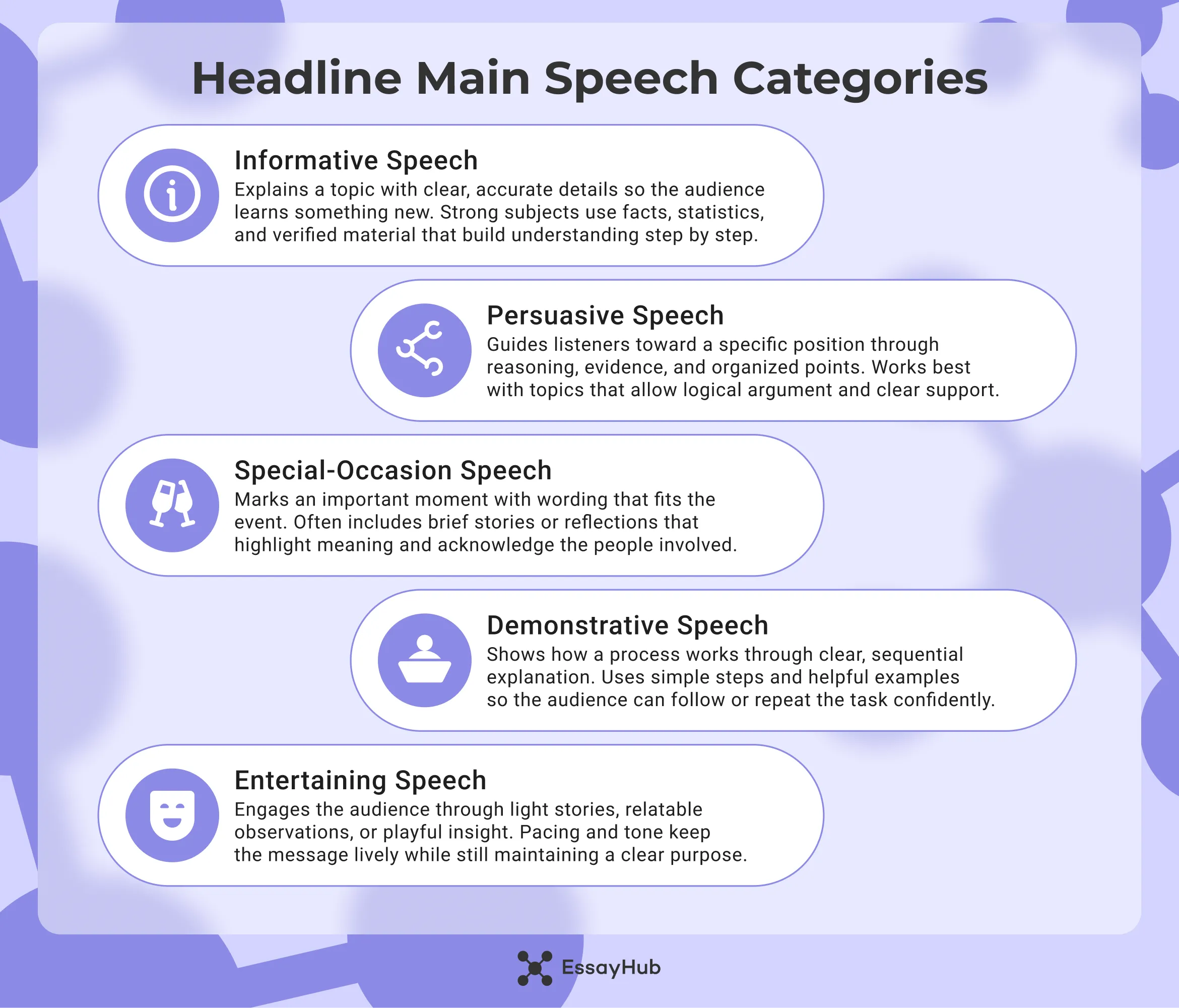
An informative speech aims to explain a subject with clarity so the audience gains a new understanding that supports the moment’s purpose. A speaker creating this kind of message focuses on making a speech that builds knowledge through verified material and steady reasoning.
Strong topics work best when they open space for clear explanation, such as scientific developments or historical events that contain useful context. Facts and statistics help the audience follow the argument because they anchor the discussion in measurable evidence. Anyone searching for ideas can look through EssayHub’s collection of good informative speech topics, which offers guidance on selecting subjects that support a focused and well-developed presentation.
Persuasive Speech
A persuasive speech seeks to guide the audience toward a specific viewpoint through reasoning, clear structure, and purposeful delivery. The speaker focuses on making a speech that uses evidence, steady explanation, and well-chosen examples to support a position that deserves consideration. Strong topics often involve social questions, policy discussions, or daily situations that benefit from logical argument. Data, expert statements, and concrete cases help the audience follow the speaker’s direction because they show how the claim connects to real conditions. Anyone looking for subject ideas can review EssayHub’s list of persuasive speech ideas, which offers practical starting points for shaping a focused and convincing presentation.
Special-Occasion Speeches
Special-occasion speeches mark important moments through clear wording, steady tone, and attention to the people involved. The speaker focuses on how to write a short speech that matches the setting, whether the event honors an achievement or recognizes a personal milestone. These speeches often include brief stories, expressions of appreciation, or reflections that highlight the meaning of the moment. The goal is to create a message that feels specific, sincere, and well-shaped for the audience who will hear it.
Demonstrative Speech
A demonstrative speech explains how a process works and shows the audience each stage in a clear, practical sequence. The speaker guides listeners through actions or concepts step by step, using simple wording, steady pacing, and concrete examples that make the process easy to follow. Visual aids or brief demonstrations help the audience understand each part because they reinforce the explanation with observable detail. The goal is to give listeners enough clarity so they can repeat the process or understand the method with confidence.
Entertaining Speech
An entertaining speech aims to hold the audience’s attention through light storytelling, relatable moments, or playful observations shaped with a clear purpose. The speaker focuses on pacing, tone, and timing so the message feels engaging without losing structure. Short anecdotes or surprising details help listeners stay involved because they add variety and movement to the presentation. Anyone searching for subject ideas can look through EssayHub’s collection of entertainment speech ideas, which offers practical starting points for shaping a lively and memorable message.


Tips for Writing a Speech
Writing your speech is a task that requires decent preparation. Contrarily, to do everything hastily and hope for the best appears wrong. So, how to write a speech that can stand out and draw the audience’s attention? We have the answer. In the following points, we provide speech writing techniques to make yours memorable.
Step 1. Know Your Audience and the Setting
Effective speech writing depends on understanding who will listen and the environment in which the message will be delivered. These elements shape tone, level of detail, and formality.
A classroom assignment often calls for a steady, informative style that helps listeners follow the main points with clarity. A ceremony favors a warmer tone that highlights shared meaning. A debate setting requires sharper reasoning because the goal is persuasion.
For instance, a student speaking at a scholarship ceremony might prepare a short message that expresses appreciation and tells a brief story about the experience that led to that moment. The same student in a debate would shape a structured argument supported by research and analysis. The audience guides the choices, and the setting gives the speech its form.
Step 2. Define Your Purpose and Choose a Focused Topic
Every speech begins with a clear purpose. Decide whether your message aims to inform or guide the audience toward a viewpoint or inspire them through a meaningful moment. Once the purpose is set, choose a topic that fits your time limit and stays relevant to the people who will listen. A focused topic helps you shape the main points with steady direction.
For example, a speaker preparing an informative presentation about climate impact might narrow the topic to urban heat patterns because this smaller focus allows enough room for research, explanation, and well-supported discussion within a short timeframe.
Step 3. Research and Gather Strong Material
One of the key tips for speech writing is to look for facts that verify your claims, examples that illustrate key ideas, stories that add human context, statistics that show scale, quotes that provide authority, and personal insights that anchor the message in real experience. These sources give you enough depth to build clear explanations and purposeful arguments. Strong research also supports pacing, tone, and structure, which are central tips for speech writing that help the audience follow each point with confidence.
For instance, a speaker preparing a message about community health might gather data on local activity levels, review a short interview with a medical professional, and include a personal observation from a neighborhood event. This mix of material creates a foundation for a grounded and informative presentation.
Step 4. Create a Clear Speech Structure
A strong message grows from a structure that stays organized from beginning to end. Build an outline that includes an introduction, two main points, supporting evidence, transitions, and a conclusion. This pattern keeps the material focused and helps the audience follow the movement of your ideas without confusion. A clear outline also prevents too much information, because every part of the structure serves a specific purpose.
This approach shapes how to make a good speech by guiding the speaker toward a logical flow. When the order is set early, the writing process becomes easier, and the delivery feels more confident. If you want a deeper look at planning informative material, EssayHub’s guide on how to write an informative essay offers helpful direction.
Step 5. Write a Strong Introduction
A strong opening helps the audience settle into the message immediately. Start with a hook that creates interest, such as a short quote, a guiding question, a brief story, or a surprising fact. State your main message clearly, then give a quick preview of the main points the speech will cover. This keeps listeners oriented and prepares them for the flow that follows during writing a speech.
- For an informative speech, you might begin with a statistic that anchors the topic.
- For a persuasive speech, a pointed question helps listeners think about the issue.
- For a ceremony or celebration, a short personal story sets the tone.
Step 6. Develop the Body With Clear Support
The body of the speech carries the main explanation, so each idea needs support drawn from reliable material. Use relevant data to ground your points and add examples or short anecdotes to make the message easier to follow. Analogies help the audience connect unfamiliar ideas to something they already understand. Visuals can also strengthen the explanation if the setting allows them.
A steady balance between depth and clarity keeps the room engaged. Listeners need enough information to learn something meaningful, yet the content should remain accessible to everyone. This balance is one of the essential steps of speech writing because it shapes how well the message reaches the entire audience.
Step 7. End With a Memorable Closing
A strong ending brings the message together with clarity. Summarize the key idea, reinforce the takeaway, and finish with a closing line that leaves a clear impression. This final line can take the form of a call to action or a meaningful insight that supports the purpose of the speech. The closing works best when it stays focused on what the audience should remember.
It helps to avoid new information at this stage because fresh points shift attention away from the message you want to highlight. A closing section benefits from steady pacing and a clear signal that the speech has reached its final moment.
For example, a speaker discussing community health may end with a short reflection on shared responsibility and a direct reminder that small daily habits create lasting impact.
Step 8. Revise and Shape the Speech for Natural Delivery
Editing helps the message sound clear, conversational, and easy to follow. Review the draft the next day when your mind is fresh, and focus on flow and accuracy. Make sure each sentence is simple to speak aloud, not only easy to read on the page. Adjust transitions so movement between ideas feels smooth and consistent. These habits are especially important when writing a speech for students, because the audience needs wording that feels direct and understandable.
Step 9. Practice the Speech Out Loud Multiple Times
Rehearsal builds confidence and improves delivery. Say the speech aloud until the pacing feels steady and the ideas connect naturally. Time the full run to confirm it fits the expected time limit and refine pauses to shape emphasis. Practice helps you become comfortable with your material and prepares you to speak with clarity in front of an audience.
Effective Speech Template
A clear outline gives the speaker a structure to follow and keeps the message focused. This template organizes the flow from the opening line to the final statement, making preparation easier and delivery smoother.
Title of Speech
Topic
Date of Presentation
I. Introduction
A. Open with a line that draws the audience in through a brief story, a striking fact, or a meaningful observation.
B. Explain the purpose of the speech, so listeners understand why the message matters.
C. Present the central idea and give a quick preview of the main points you will cover.
1. First key point
2. Second key point
3. Third key point
II. Main Point One
A. Provide your first major idea with enough explanation for the audience to follow.
B. Support this idea with evidence, an example, or a short anecdote.
1. Supporting detail
2. Additional explanation
III. Main Point Two
A. Introduce your next idea and explain how it develops the overall message.
B. Add supporting material, such as a statistic or a concrete example.
1. Supporting detail
2. Additional explanation
IV. Main Point Three
A. Present your final idea and show how it connects to the larger purpose of the speech.
B. Include support that reinforces the point clearly.
1. Supporting detail
2. Additional explanation
V. Conclusion
A. Summarize the message and restate the key idea in a clear, refined form.
B. End with a closing line that leaves the audience with a sense of completion or direction.
You can also download the full outline as a PDF to use for your next speech.

Speech Writing Examples
Reviewing examples of different speech types before you begin can help you see how speakers build flow, pacing, and emphasis.
Download the PDF versions of these examples before giving a speech.
Final Words
Learning how to write a speech in English becomes easier when you follow a clear structure, understand your audience, choose a focused purpose, and develop each section with steady reasoning. Strong preparation, organized ideas, and thoughtful delivery give the speaker enough control to keep listeners engaged from the opening line to the final statement.
If you ever struggle with shaping a paper or preparing great speeches, EssayHub can support you. You can read an EssayHub review to see how other students evaluate the service and how it helps them complete their work with confidence.
FAQs
What Makes A Good Speech?
How Do I Start My Opening Speech?
How Do I Structure A Speech?
What Are The 5 Major Steps In Speech Writing?
How Do You Start Writing A Speech?

Mark Bradford, a passionate and talented artist, utilizes his innovative spirit to support academic pursuits. In partnering with EssayHub, he leverages his artistic insights to assist students as a professional essay writer, helping them navigate and complete their academic assignments at every level of difficulty.
- Northern Illinois University. (n.d.). Giving effective presentations. https://www.niu.edu/academic-support/student-guides/giving-effective-presentations.shtml
- *Columbia University School of Professional Studies. (2023). Five tips to give a great speech. https://sps.columbia.edu/news/five-tips-give-great-speech
- Yeshiva University. (n.d.). Giving speeches and class presentations [PDF]. https://www.yu.edu/sites/default/files/inline-files/Giving%20Speeches%20and%20Class%20Presentations%20PPT_0.pdf